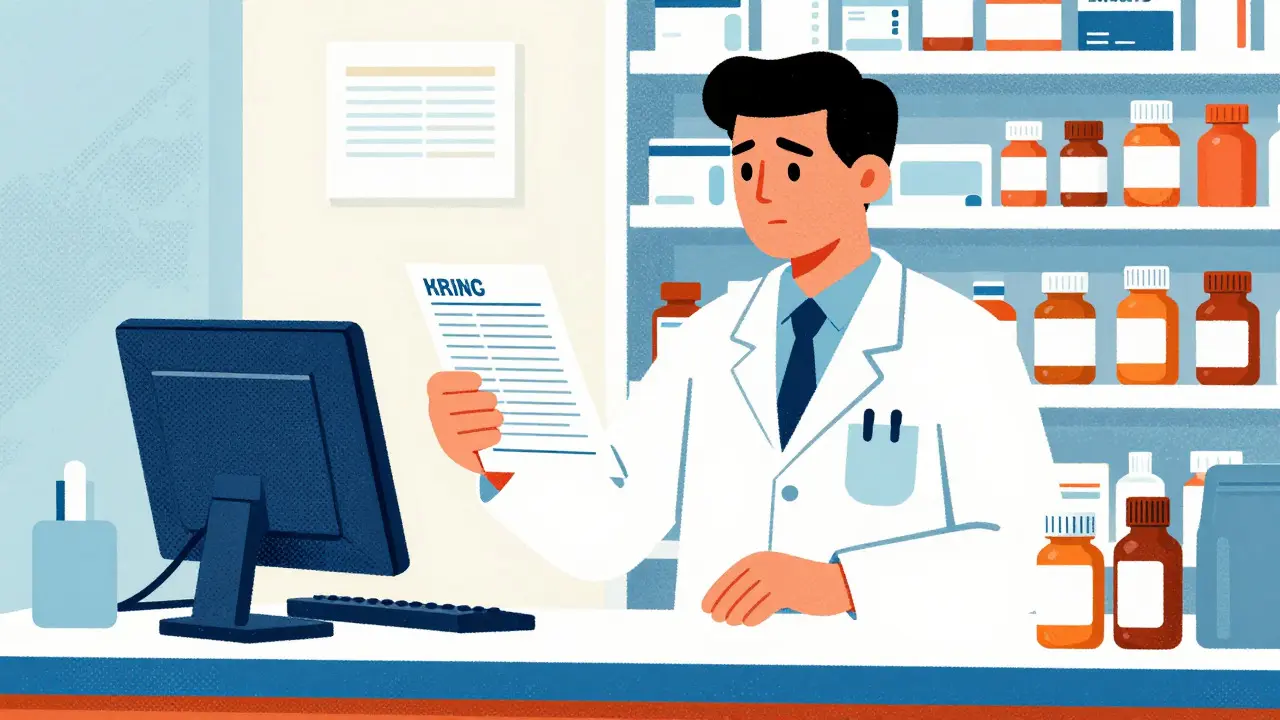
Imagine a busy Tuesday afternoon. A patient hands you a prescription for a brand-name medication. You check your inventory and see the generic equivalent is in stock. It’s cheaper, it’s bioequivalent, and state law allows you to substitute it. But before you hand that bag over the counter, there is a critical step that separates professional practice from potential liability: documentation. Getting this wrong doesn’t just mean an insurance denial; it can lead to board discipline or, worse, patient harm.
Generic drug substitution is defined by the World Medical Association (WMA) as 'the dispensing of a different brand or an unbranded drug product for the drug product prescribed.' While the Hatch-Waxman Act of 1984 paved the way for generics via the Abbreviated New Drug Application (ANDA) pathway, the FDA does not regulate the actual act of substitution at the pharmacy level. That responsibility falls squarely on state laws and the pharmacist’s judgment. With nearly 90% of prescriptions in the U.S. being filled with generics, understanding exactly what needs to be recorded-and why-is non-negotiable for modern pharmacy practice.
The Core Elements of Substitution Documentation
When you decide to substitute a generic for a brand-name drug, you are creating a legal and clinical record. This isn't just administrative busywork; it’s the backbone of patient safety and audit defense. According to a 2022 survey by the National Association of Boards of Pharmacy, 48 out of 50 states require specific data points to be logged when a substitution occurs.
At a minimum, your pharmacy management system should capture the following attributes for every substituted prescription:
- Brand Name Prescribed: The exact name written by the prescriber.
- Generic Name Dispensed: The active ingredient name of the product you actually gave the patient.
- Manufacturer Name: Who made the generic? This is crucial because bioequivalence is established per manufacturer, not just per molecule.
- Lot Number: Essential for tracking recalls or quality issues back to a specific batch.
- Expiration Date: To ensure potency and validity at the time of dispensing.
Why do we need all this detail? Consider a scenario where a patient experiences an adverse reaction. If you only documented 'dispensed generic,' you have no way to prove which manufacturer's product was involved. Proper documentation links the clinical outcome directly to the specific product entity, allowing for accurate reporting to regulatory authorities like the FDA or the appropriate national medical association.
| Attribute | Purpose | Regulatory Basis |
|---|---|---|
| Brand Name Prescribed | Establishes original intent | State Prescription Laws |
| Generic Name Dispensed | Confirms therapeutic equivalence | FDA Orange Book |
| Manufacturer | Traceability for recalls/quality | NABP Standards |
| Lot Number | Batch-specific tracking | Good Supply Practices (GSP) |
| Expiry Date | Ensures potency | State Board Regulations |
Navigating State-Specific Variations
If you think documentation is uniform across the country, think again. The variation in state substitution laws creates significant challenges for pharmacists, especially those working for national chains. Dr. Erika Lietzan, Associate Professor of Law at the University of Missouri, notes that these variations force pharmacies to maintain separate protocols for each jurisdiction.
As of 2023, the landscape looks like this:
- 27 States: Permit substitution at the pharmacist’s discretion without explicit patient consent.
- 14 States: Require explicit patient consent before substituting.
- 9 States: Use a combination approach, often depending on the drug type or insurance plan.
In states requiring consent, such as Oklahoma, it is unlawful to substitute without the authority of the prescriber or purchaser. This means your documentation must include a signed consent form or a digital acknowledgment from the patient. In contrast, in discretionary states, you might only need to notify the patient, but documenting that notification is still best practice. The American Pharmacists Association’s 2022 survey found that while 68% of pharmacists find these requirements 'moderately burdensome,' 23% credited proper documentation with preventing adverse drug events.
For example, California’s SB 564, effective January 1, 2024, mandates real-time electronic documentation of substitutions accessible to prescribers. This shifts the burden from paper trails to integrated Electronic Health Record (EHR) systems. If your pharmacy uses Epic Systems, note that their 2023 update revealed 32% of pharmacies needed custom configuration to meet these new state-specific fields. Don’t assume your software is compliant out of the box; verify it.

Special Handling for Narrow Therapeutic Index (NTI) Drugs
Not all generics are created equal in the eyes of risk management. Narrow Therapeutic Index (NTI) drugs, such as warfarin, levothyroxine, and phenytoin, have a small margin between effective dose and toxic dose. Even minor differences in bioavailability can lead to serious clinical consequences.
While the FDA has not formally designated NTI drugs in the Orange Book, 17 states have established specific documentation protocols for them. These protocols typically require:
- Additional Physician Notification: Contacting the prescriber to confirm the substitution is acceptable.
- Explicit Patient Consent: Often in writing, acknowledging the risks.
- Enhanced Monitoring Records: Documenting follow-up labs or clinical assessments.
A case documented in the Journal of the American Pharmacists Association (2021) highlights the stakes: inadequate documentation of a warfarin substitution led to unmonitored INR fluctuations and patient hospitalization. The lesson? For NTI drugs, standard substitution logs aren’t enough. You need a dedicated section in your patient profile that tracks every switch, the reason for it, and the clinical outcome. The WMA strongly recommends that once medication for chronic diseases has begun, no substitution should be made without the attending physician's permission. Treat NTI drugs with this level of caution.

Electronic Systems and Audit Readiness
The shift to electronic documentation is accelerating. Industry adoption rates show that 98% of chain pharmacies and 87% of independent pharmacies have implemented electronic systems for substitutions. However, 'electronic' doesn't automatically mean 'compliant.'
Your pharmacy management system must support the creation of immutable records. Key features to look for include:
- Timestamps: Every action-prescription receipt, substitution decision, dispensing-must be time-stamped.
- User Identification: Clear attribution of who made the substitution decision.
- Integration with PBM Data: Ensuring the insurer sees the same substitution code you do.
The Medicare Part D program requires clear indication of substitution with manufacturer information for audit purposes. CMS updated its documentation requirements in October 2022 to reflect this. If you’re auditing your own records, ask yourself: Can I reconstruct the entire journey of this prescription from the prescriber’s script to the patient’s hand? If not, your documentation has gaps.
Future trends point toward even greater transparency. A pilot program by the National Pharmaceutical Council in July 2023 showed a 22% reduction in documentation errors using blockchain technology for substitution records. While widespread adoption may take time, preparing your workflows for higher levels of traceability is wise. The ASPE is developing national guidelines for substitution documentation, with a draft expected in Q2 2024, which may reduce current interstate variations.
Best Practices for Pharmacists
To stay ahead of compliance curves and protect your patients, adopt these practical habits:
- Know Your State’s Law: Subscribe to updates from your State Board of Pharmacy. Laws change, and ignorance is not a defense.
- Use Standardized Fields: Advocate for EHR systems that have standardized fields for generic substitution decisions, as recommended by the WMA in June 2023.
- Document Adverse Events: If a patient reports an issue after a substitution, document it immediately. Report it to the FDA MedWatch program and your internal quality assurance team.
- Train New Staff Thoroughly: The learning curve for new pharmacists averages 4-6 weeks to master state-specific documentation. Create checklists and simulation exercises during onboarding.
- Review Regularly: Conduct monthly audits of substitution records. Look for missing lot numbers, unsigned consents, or vague notes.
Remember, documentation is not just about avoiding fines. It’s about proving that you exercised due care. When a patient questions why their pill looks different, your detailed record allows you to explain confidently: 'We substituted Brand X with Generic Y from Manufacturer Z, which is therapeutically equivalent according to the FDA Orange Book, and here is the record confirming we notified you and your doctor.'
What is the primary purpose of documenting generic substitution?
The primary purpose is to ensure patient safety, provide a legal record of the pharmacist's decision-making process, and facilitate traceability in case of adverse events or recalls. It also ensures compliance with state laws and insurance requirements.
Do all states require patient consent for generic substitution?
No. As of 2023, 27 states permit substitution at the pharmacist’s discretion without explicit consent. However, 14 states require explicit patient consent, and 9 use a combination approach. Pharmacists must know their specific state's regulations.
How should Narrow Therapeutic Index (NTI) drugs be documented?
NTI drugs require enhanced documentation, including additional physician notification, explicit patient consent, and records of clinical monitoring. Seventeen states have specific protocols for NTI drugs due to their narrow margin of safety.
What information must be included in a substitution record?
A complete record should include the brand name prescribed, the generic name dispensed, the manufacturer name, the lot number, and the expiration date. Most states also require the timestamp and the identity of the pharmacist who authorized the substitution.
Does the FDA regulate the act of generic substitution?
No. The FDA regulates the approval of generic drugs through the ANDA process to ensure therapeutic equivalence. However, the actual act of substitution at the pharmacy level is regulated by state laws and boards of pharmacy.
What are the consequences of poor documentation?
Poor documentation can lead to insurance claim denials, board of pharmacy disciplinary action, increased liability in malpractice cases, and difficulty tracing adverse drug events. It can also result in patient harm if recall information cannot be matched to specific batches.