

Medication & Fiber Timing Calculator
How It Works
This tool helps you schedule fiber supplements safely with your medications. The American Gastroenterological Association recommends taking fiber at least 2 hours before or after all medications. Enter your medication schedule and fiber dosage to see safe intervals.
Important: This tool is for educational purposes only. Always consult your healthcare provider or pharmacist for personalized advice.
Safe Timing Schedule
Your Safe Schedule
Take fiber 2 hours before or 2 hours after each medication.
Safe Fiber Window: You can take fiber between and
Take fiber at least before or after medications
Important: For lithium, carbamazepine, and olanzapine, some experts recommend waiting 4 hours instead of 2 hours due to narrow therapeutic windows.
Key Recommendations from the Article
- Take fiber with at least 8 oz of water
- Avoid taking fiber after 6 p.m. to prevent nighttime discomfort
- Start with 1 serving per day and increase gradually
Constipation is one of the most common digestive complaints, and fiber supplements like psyllium are often the first thing doctors recommend. But if you’re taking medications, taking fiber at the wrong time can make those meds less effective-or even dangerous. It’s not just about eating more veggies. It’s about timing.
Why Fiber Can Interfere With Your Medications
Fiber supplements, especially those made with psyllium husk like Metamucil, don’t just add bulk to your stool. When mixed with water, they form a thick, gel-like substance in your gut. That’s great for softening stools and easing constipation. But that same gel can also trap medications as they pass through your digestive system, slowing down or blocking their absorption. This isn’t theoretical. Studies show that people taking metformin for diabetes, carbamazepine for seizures, lithium for bipolar disorder, or olanzapine for schizophrenia can see their drug levels drop significantly if they take fiber at the same time. One Reddit thread with over 140 users reported that 67% noticed their meds didn’t work as well when taken with fiber. The most common complaint? Blood sugar spikes after skipping the gap between metformin and fiber. The American Gastroenterological Association confirms this: fiber changes how fast your stomach empties and how quickly things move through your intestines. That’s enough to alter how much of your pill actually gets into your bloodstream.What the Experts Say About Timing
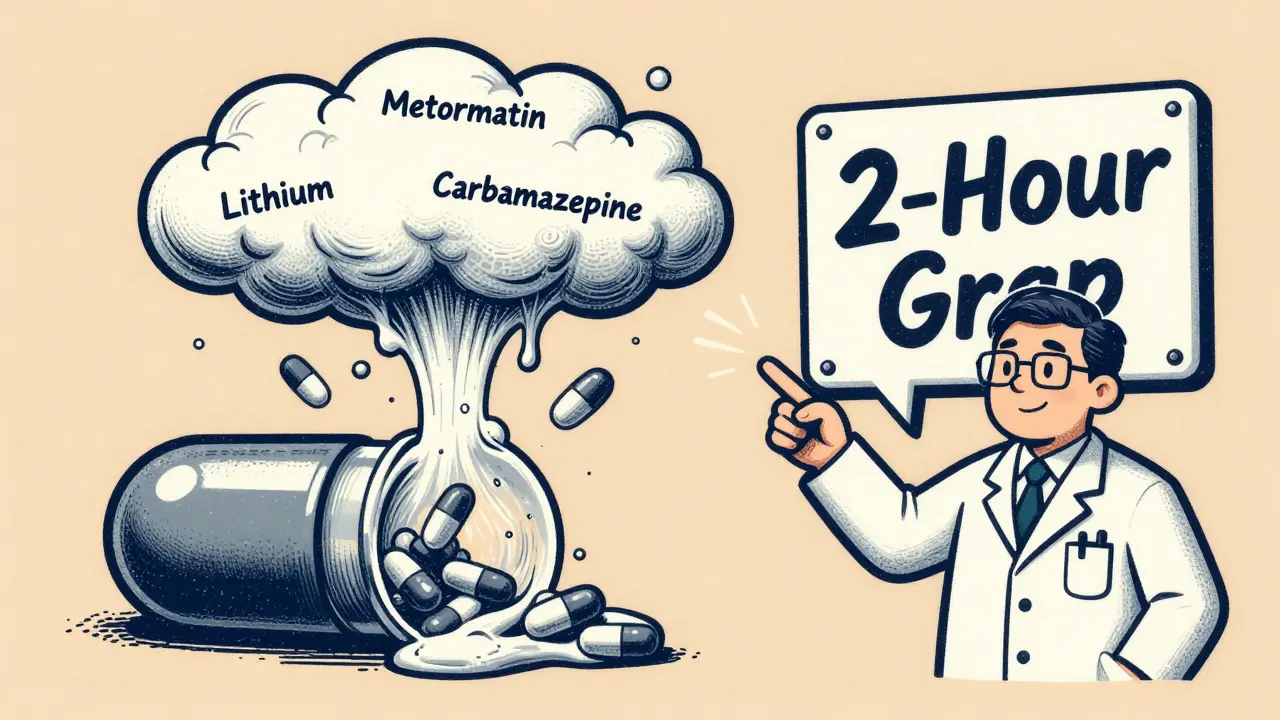
There’s no single rule, but the safest advice across most medical sources is this: take fiber supplements at least 2 hours before or after your medications. Metamucil’s official label says it plainly: “Bulk-forming fibers like psyllium husk may affect how well medicines work. Take this product at least 2 hours before or after medicines.” That’s the gold standard. But some sources go further. For drugs like lithium and carbamazepine, some pharmacists recommend waiting 4 hours after taking fiber before taking the medication. Why? Because these drugs have narrow therapeutic windows-meaning even a small drop in absorption can lead to serious side effects. Nature Made suggests taking fiber before bed if you take meds in the morning, or vice versa. But here’s the catch: FreeRx and other patient forums report that taking fiber at night causes bloating, gas, and cramps that keep people awake. In fact, 82% of users who switched from nighttime to morning fiber saw better sleep and fewer digestive issues. SAMPA Docs recommends taking fiber in the late morning-around 10 or 11 a.m.-especially if you’re on morning meds. That way, you avoid interference and still get the digestive benefits before lunch and dinner. It’s a practical middle ground.How to Build a Safe Routine
If you’re on multiple medications, writing down your schedule helps. Here’s a simple template:- Take your morning meds (e.g., blood pressure, thyroid) at 7 a.m.
- Wait until 9 a.m. to take your fiber supplement with 8 oz of water.
- Take your afternoon meds (e.g., metformin, antidepressants) at 1 p.m.
- Wait until 3 p.m. to take your second fiber dose, if needed.
- Take evening meds (e.g., cholesterol, sleep aids) at 8 p.m.
- Avoid fiber after 6 p.m. to prevent nighttime discomfort.
Dosage Matters-More Isn’t Always Better
Not all fiber supplements are the same. Psyllium husk is the most studied and effective type for constipation. One teaspoon of Metamucil powder delivers 5 grams of fiber (3 insoluble, 2 soluble). For constipation, you need at least 10 grams per day-so two servings. But you must build up slowly. Start with one serving a day. Wait a week. If you’re not having regular bowel movements, add another. Going too fast causes bloating, gas, and cramps. Most people adjust within 1-2 weeks. Also, don’t skip the water. You need at least 8 ounces (237 mL) with every dose. Without enough liquid, the gel can swell and block your esophagus. That’s rare, but it’s happened-especially in older adults or people with swallowing problems. Always drink water first, then take the fiber, then drink more after.What About Other Fiber Types?
Not all fiber is psyllium. Inulin, methylcellulose, and calcium polycarbophil are other common types. But psyllium is the only one with strong evidence for both constipation relief and cholesterol lowering. The FDA requires supplements claiming to reduce cholesterol to contain at least 7 grams of soluble fiber daily-that’s why Metamucil’s heart-health dose is five capsules four times a day. Other fibers may be gentler on the stomach, but they don’t bind medications the same way. Still, until more research is done, it’s safest to assume all fiber supplements need the same 2-hour gap.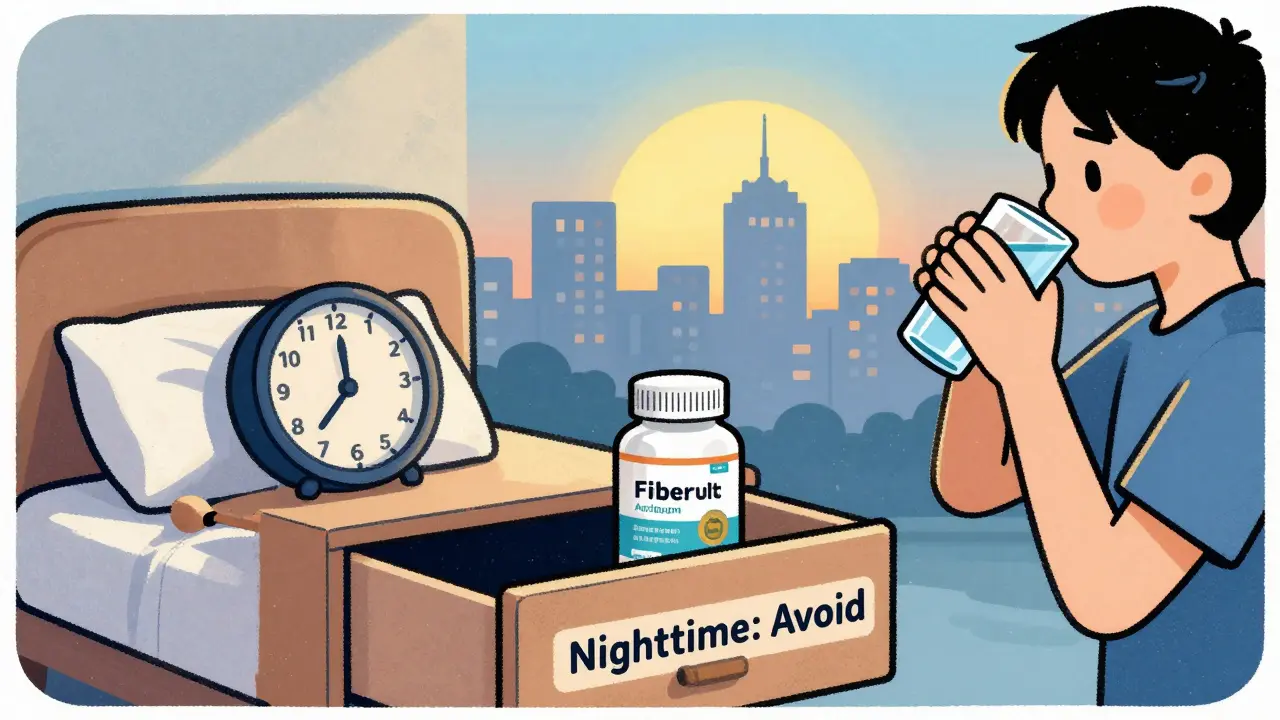
When to Stop Taking Fiber
Fiber is usually safe, but it’s not for everyone. If you experience:- Abdominal pain that doesn’t go away
- Nausea or vomiting
- Sudden changes in bowel habits lasting more than two weeks
- Rectal bleeding
What’s Changing in 2026
The American Gastroenterological Association’s 2024 draft guidelines now specifically recommend psyllium as the first-line treatment for chronic constipation-and they’ve added clear timing rules for common drug classes. That’s a big deal. It means doctors are finally recognizing that timing isn’t optional-it’s part of the prescription. The FDA is also cracking down. In November 2023, they issued warning letters to three supplement makers for claiming their products “don’t interfere with medications.” Those claims aren’t backed by evidence. The message is clear: supplement companies can’t make up safety rules. Looking ahead, researchers are testing time-release psyllium capsules that release fiber slowly over 6-8 hours. Early results (NCT05678901) suggest these could reduce medication interference while still relieving constipation. If they work, this could be a game-changer.Bottom Line: Don’t Guess. Plan.
Fiber supplements are powerful tools for constipation. But they’re not harmless add-ons. If you’re on meds, treating fiber like a vitamin is risky. You wouldn’t take your blood thinner with grapefruit juice-so don’t take it with psyllium either. The safest, simplest approach:- Take fiber at least 2 hours before or after every medication
- Use psyllium (like Metamucil) for best results
- Drink 8 oz of water with every dose
- Avoid taking fiber at night if you have bloating or sleep issues
- Start low, go slow, and stop if something feels wrong

michelle Brownsea
January 20, 2026 AT 13:18Let’s be real-this isn’t just about timing. It’s about accountability. People treat fiber like a magic fairy dust that fixes everything, but if you’re on lithium or metformin, you’re playing Russian roulette with your neurochemistry and glucose levels. And no, ‘I’ve been doing it for years’ doesn’t count as evidence. The AGA isn’t guessing. They’re publishing guidelines because people keep dying from avoidable interactions. Wake up.
MARILYN ONEILL
January 21, 2026 AT 14:41Ugh. I hate when people turn a simple thing like fiber into a whole drama. Just take it at night. Done. Stop overthinking.
Kevin Narvaes
January 22, 2026 AT 15:25so like… fiber = slow mo pill trap? wild. i always just chugged it with my meds cause i forget stuff. guess i’m just lucky? or dumb? maybe both 😅
Dee Monroe
January 24, 2026 AT 05:02There’s something deeply human about how we treat our bodies like machines we can hack with supplements, while ignoring the delicate symphony of biochemistry happening inside us. Fiber isn’t just a bulking agent-it’s a silent conductor in the orchestra of digestion, and when we force it to play alongside pharmaceuticals without regard for tempo, we disrupt the harmony. The body doesn’t care about convenience. It cares about balance. And balance, my friends, is not a suggestion-it’s a law written in cells, not in marketing pamphlets.
Jerry Rodrigues
January 24, 2026 AT 19:30This is actually really useful. I’ve been taking Metamucil with my BP med and never thought twice. Gonna adjust my routine now. Thanks for the clarity.
Barbara Mahone
January 26, 2026 AT 17:51In Japan, we use konjac root fiber for constipation-it’s gentler, and traditionally taken with warm water in the morning. No one worries about drug interactions because the doses are low and the cultural approach is slow, ritualistic. Maybe we need less ‘supplement hustle’ and more mindful integration.
Samuel Mendoza
January 27, 2026 AT 02:402 hours? That’s a myth. I’ve taken fiber and metformin together for 8 years. My A1C is perfect. Your fear is marketing.
Stephen Rock
January 29, 2026 AT 00:02Wow. So now we’re treating psyllium like a villain? Next they’ll say sunlight interferes with antidepressants. This is the kind of overmedicalized nonsense that makes people distrust doctors. You’re turning a natural remedy into a liability just to sell more pills.
Amber Lane
January 29, 2026 AT 06:19My grandma took fiber with her pills. Lived to 92. Maybe it’s not that scary.
Ashok Sakra
January 31, 2026 AT 00:08YOU ARE ALL WRONG. In India we mix psyllium with yogurt and honey at night. No problems. You Westerners overthink everything. Your bodies are weak.
Andrew Rinaldi
January 31, 2026 AT 08:18Interesting how the science is clear but the real challenge is consistency. Most people won’t stick to a 2-hour window. Maybe the real solution is reformulating the meds or the fiber to work together, not against each other.
Gerard Jordan
January 31, 2026 AT 21:27Thank you for this 🙏 I’ve been taking fiber at night and waking up bloated as a balloon. Switched to 10 a.m. like SAMPA said and now I’m sleeping like a baby 😴💩
Roisin Kelly
February 1, 2026 AT 11:59Who even wrote this? Pharma shill? I bet they’re getting paid to scare people away from fiber so they’ll buy more expensive ‘drug-friendly’ laxatives. Wake up, sheeple.