
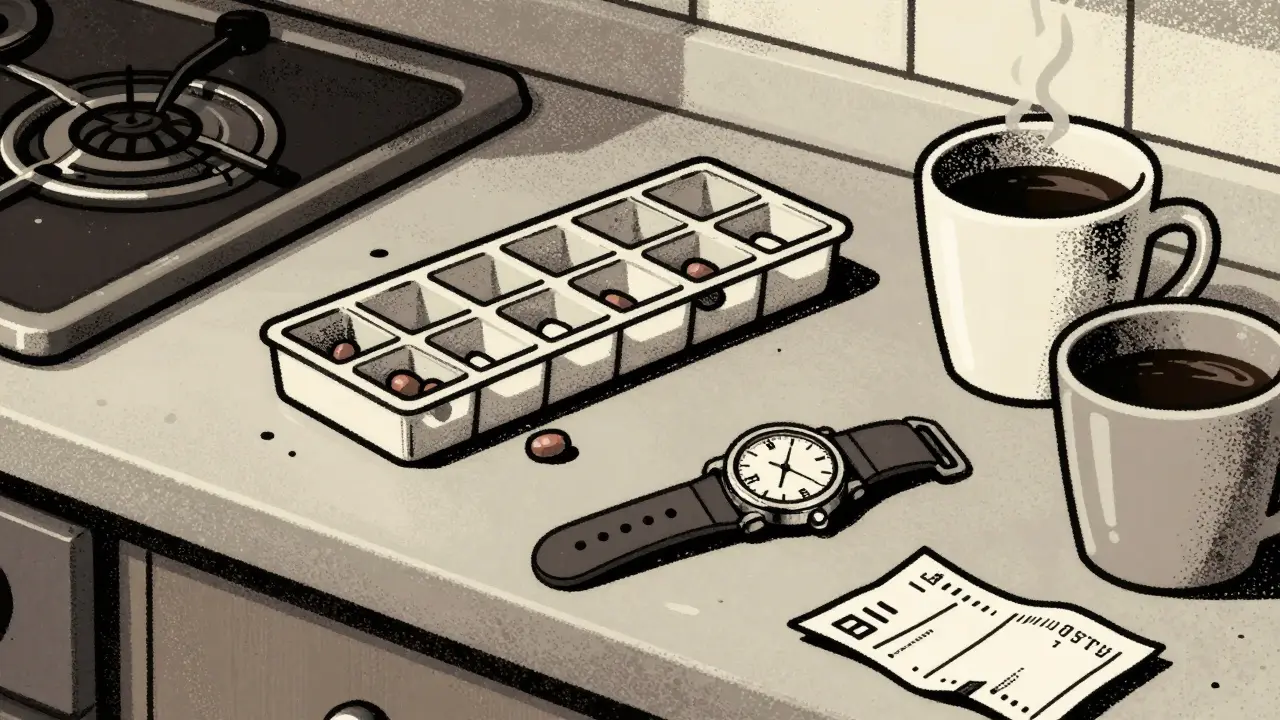
It’s not rare to hear someone say, "I forgot to take my pill today," or "It’s too expensive to keep refilling." But these aren’t just small oversights-they’re part of a massive, silent crisis in healthcare. About 50% of people with long-term illnesses like high blood pressure, diabetes, or heart disease don’t take their medications as prescribed. That’s half of all patients. And it’s costing lives: around 125,000 deaths a year in the U.S. alone, and over $100 billion in avoidable medical costs.
Forgetfulness Is the #1 Reason People Skip Doses
If you’ve ever missed a pill because you were rushing out the door, changed your routine, or just got distracted, you’re not alone. In fact, forgetfulness is the most common reason people don’t stick to their medication schedule. A 2024 study found that 44% of diabetic patients over 59 cited memory lapses as their main barrier. It’s not about being lazy or careless-it’s about human biology. Our brains aren’t wired to remember daily tasks that don’t have immediate feedback. If you don’t feel better right away after taking a blood pressure pill, it’s easy to think, "Do I even need this?"Complex schedules make it worse. Taking four different pills at three different times a day? That’s a recipe for confusion. Research shows adherence drops sharply with every added dose. People on once-daily medications have a 79% adherence rate. Those taking four or more doses daily? Only 51%. It’s not magic-it’s math. More pills, more chances to mess up.
Cost Keeps People From Filling Prescriptions
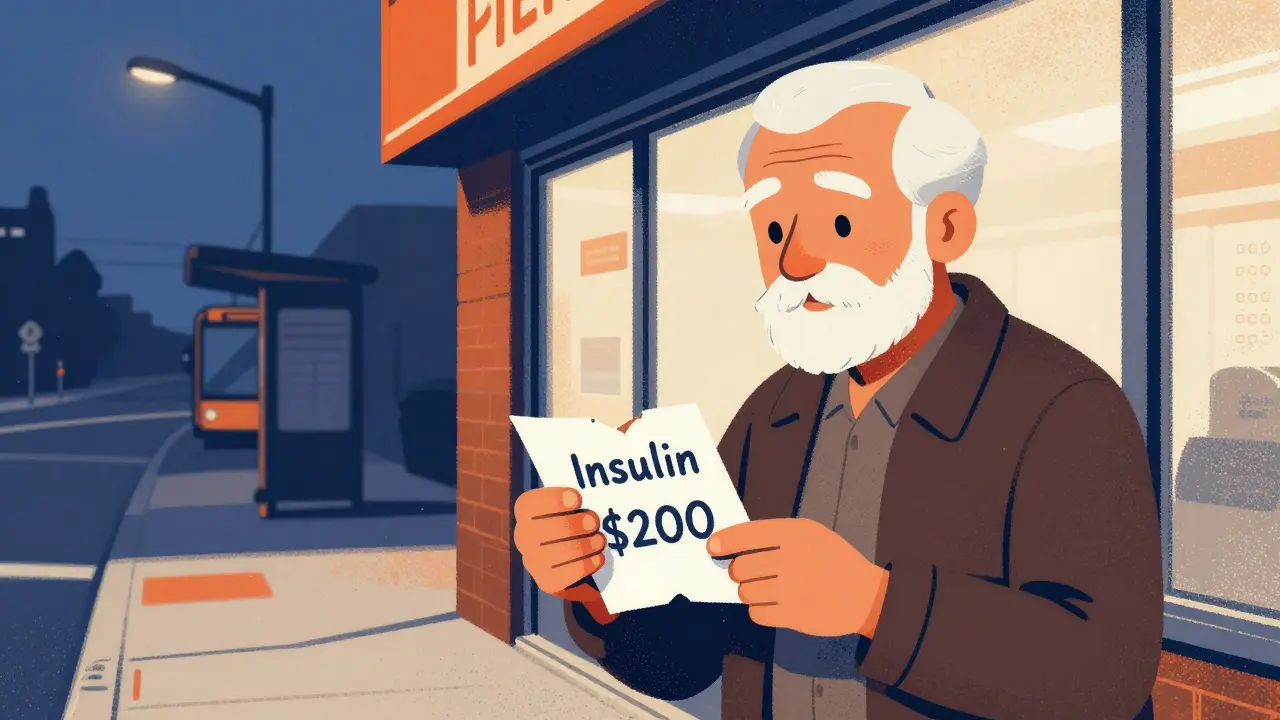
Even if someone remembers to take their meds, they might not be able to afford them. One in five new prescriptions are never picked up because of price. For many, choosing between insulin and groceries isn’t a metaphor-it’s reality. A 2023 survey by the American Medical Association found that 50% of patients named cost as their top barrier. This isn’t just about being uninsured. Even people with insurance often face high copays, especially for newer or brand-name drugs. A month’s supply of a diabetes drug can cost $200 or more out-of-pocket. When you’re living paycheck to paycheck, skipping a dose for a few days feels like a small compromise. But those small compromises add up to hospital stays, emergency visits, and worse outcomes.Confusion Over How and Why to Take Medications
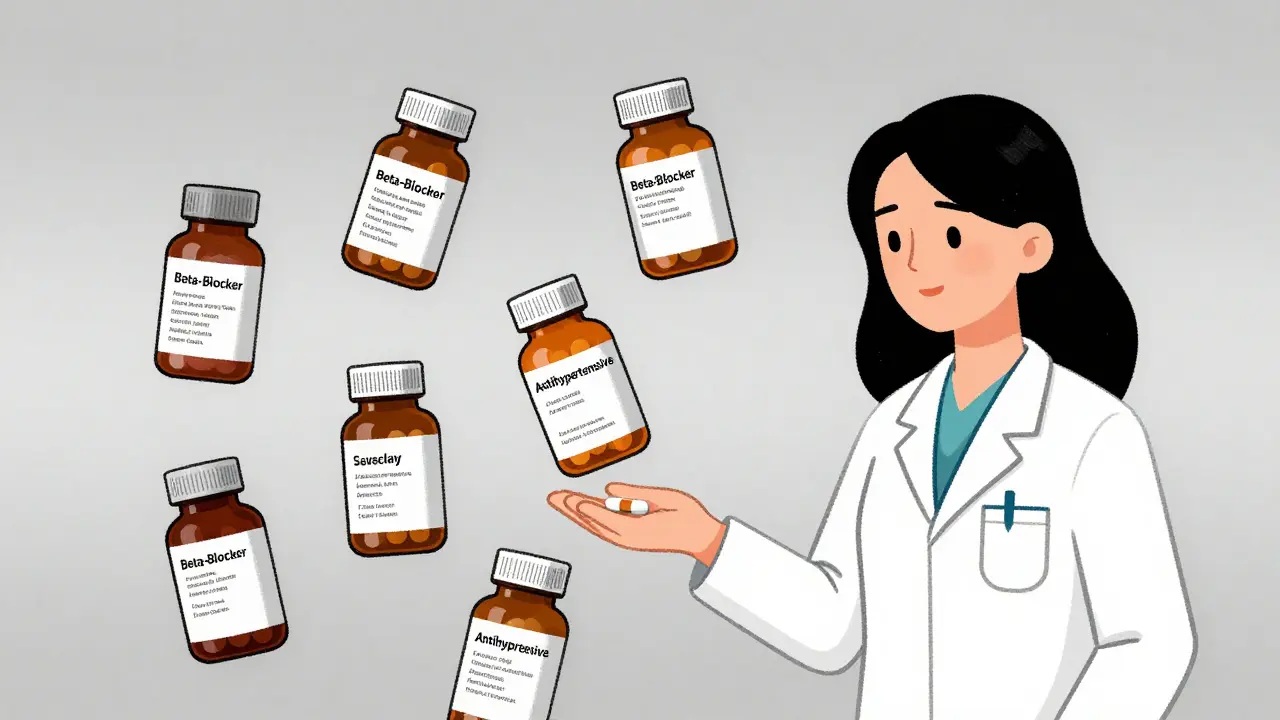
Many patients don’t understand what their pills are for-or how to take them correctly. Tiny print on pill bottles, unclear instructions, mixing up morning and night doses-these aren’t just annoyances. They’re dangerous. One patient on Reddit shared how they overdosed on insulin because they couldn’t read the dosage markings on their pen. Another said their doctor never explained why their blood pressure pill had to be taken at bedtime. They switched it to morning-and their numbers got worse.Health literacy plays a huge role. Patients with low health literacy are 2.5 times more likely to skip medications. This isn’t about intelligence-it’s about access to clear, simple information. If your doctor talks for 15 minutes and uses terms like "antihypertensive" or "beta-blocker," you’re not learning-you’re drowning. The real issue? Only 55% of patients feel they got enough counseling when their meds were prescribed. That’s not enough.
Too Many Medications, Too Much Overload
Polypharmacy-taking five or more medications-is common among older adults and those with multiple chronic conditions. But each extra pill increases the chance of nonadherence by 16%. Imagine having to manage seven different pills, each with different times, food restrictions, and side effects. It’s overwhelming. One patient described their routine: "I have pills for my heart, my joints, my blood sugar, my anxiety, and my sleep. I have a chart on my fridge, and I still mess up twice a week."Doctors often prescribe new meds without reviewing what’s already on the list. A patient might get a new antidepressant, a new cholesterol pill, and a new painkiller-all without anyone asking if they’re still taking their old ones or if the schedule is doable. Simplifying regimens-like switching to combination pills or long-acting formulations-can cut adherence barriers in half. The FDA approved seven new extended-release drugs in 2022 just to help with this.
Side Effects and Fear of Medication
Some people skip pills because they’re afraid of side effects. They read the long list of possible reactions on the label-dizziness, nausea, weight gain-and decide the risk isn’t worth it. In fact, 38% of nonadherence cases are linked to concerns about adverse effects. Others question whether the medicine is even working. "I feel fine," they say. "Why do I need this?"This is where the "Necessity-Concerns Framework" comes in. People weigh two things: Do I need this? And am I afraid of what it might do? If fear outweighs necessity-even slightly-adherence drops. A 2013 study found that 47% of nonadherence stems from doubts about whether the treatment is necessary. That’s more than forgetfulness, more than cost. It’s a belief problem. And beliefs aren’t fixed. They can change-with the right conversation.
Life Gets in the Way
Work schedules, caregiving, transportation, and unstable housing all interfere with taking meds. A shift worker can’t take a pill at 8 a.m. if they’re sleeping. Someone without a car can’t drive 20 miles to refill a prescription. A person caring for an elderly parent might forget their own meds because they’re focused on someone else’s needs. These aren’t medical problems-they’re social ones. And they’re often ignored.Patients in "pharmacy deserts"-areas with no nearby pharmacy-experience 37% higher nonadherence rates. If you’re elderly, on a fixed income, and your nearest pharmacy is across town, you’re not just inconvenienced. You’re at risk. Even simple things like not having a working fridge to store insulin can force someone to skip doses.
What Actually Works to Fix This
There’s no single fix. But the best solutions combine practical tools with better communication. Here’s what helps:- Simplify the regimen: Switch to once-daily pills or combination tablets. Fewer pills = fewer mistakes.
- Automate refills: 90-day mail-order prescriptions increase adherence by 15-20%. No more running out.
- Medication synchronization: Getting all prescriptions due on the same day cuts missed doses by 18%.
- Pharmacist-led counseling: A 10-minute chat with a pharmacist who asks, "Do you know why you’re taking this?" can double understanding.
- Text reminders: Simple automated texts improve adherence, especially for younger adults. But for older patients, tech can backfire-42% of those over 65 say they’re uncomfortable with apps.
The most successful programs don’t just remind people to take pills. They ask why they’re not taking them-and then solve the real problem. Is it cost? Help them find coupons or patient assistance programs. Is it confusion? Use pictures instead of words on labels. Is it fear? Talk about the real risks of skipping the medicine-not just the side effects.
It’s Not About Willpower
We’ve been told for years that adherence is about discipline. Take your pills. Be responsible. But that’s wrong. This isn’t about motivation. It’s about design. If the system makes it hard to take your medicine, people will fail-even if they want to succeed. The goal isn’t to blame patients. It’s to fix the system.Healthcare needs to stop treating adherence as a personal failing and start treating it like a design problem. Just like we build apps with clear buttons and intuitive menus, we need to build medication regimens that are easy to follow. One pill a day. Clear instructions. Affordable prices. Regular check-ins. That’s not asking too much.
When patients take their meds as prescribed, they live longer, avoid hospital visits, and have better quality of life. But that only happens when we stop asking them to be perfect-and start making the system work for them.
Why do people forget to take their medications even when they know they should?
People forget because human memory isn’t designed for daily tasks without immediate rewards. If you don’t feel better right away after taking a pill-like for high blood pressure or cholesterol-your brain doesn’t link the action to the benefit. Add a busy schedule, multiple medications, or changing routines, and forgetfulness becomes almost inevitable. It’s not laziness-it’s how the brain works.
Is cost the biggest barrier to taking medications?
Cost is one of the top barriers, especially for people without good insurance. About half of patients say affordability is a major issue, and one in five prescriptions are never filled because of price. But it’s not always the #1 reason-forgetfulness and confusion often rank higher. Still, cost can make other problems worse. If you can’t afford your meds, you’ll skip doses, which leads to worse health-and even higher costs later.
How does taking too many pills affect adherence?
Every additional medication increases the chance of nonadherence by 16%. Taking five or more pills a day means juggling different times, food rules, and side effects. The more complex the schedule, the more likely someone is to mix them up, skip one, or give up entirely. Simplifying regimens-like switching to combination pills or once-daily versions-can dramatically improve adherence.
Can doctor-patient communication improve medication adherence?
Yes, dramatically. Studies show structured counseling-where doctors or pharmacists spend 10-15 minutes explaining why a medication matters, how to take it, and what side effects to expect-can improve adherence by up to 25%. Many patients don’t understand their meds because they’re never told in plain language. A simple question like, "What do you think this pill is for?" can uncover misunderstandings and fix them.
Are reminder apps helpful for older adults?
For younger adults, yes. For older adults, often no. About 42% of people over 65 say they’re uncomfortable using apps or digital tools for health. They prefer simple solutions: pill organizers, written schedules, or phone calls from a pharmacist. Technology works best when it’s optional and easy to use-not forced.
What can I do if I’m struggling to take my medications?
Talk to your pharmacist. They can help you simplify your regimen, set up automatic refills, or find low-cost options. Ask for a medication review-many pharmacies offer this for free. Use a pill organizer. Set phone alarms. Bring your list of meds to every appointment and ask: "Can any of these be combined or cut?" You don’t have to figure this out alone.
Kylie Robson
December 29, 2025 AT 08:07The data is unequivocal: nonadherence is a pharmacokinetic failure rooted in cognitive load theory and behavioral economics. The 44% forgetfulness statistic? That’s a direct correlate of working memory saturation under polypharmacy conditions. When you layer in executive function decline in aging populations-especially with comorbidities like T2DM or HTN-the brain simply cannot maintain temporal encoding for non-reinforced behaviors. It’s not ‘forgetting’-it’s neural resource depletion.
And let’s not romanticize cost. The $200 insulin copay isn’t a market failure-it’s a systemic misalignment of value-based care. The FDA’s 2022 extended-release approvals are a Band-Aid. What we need is formulary redesign based on adherence probability matrices, not formulary convenience.
Text reminders? Only effective in cohorts with digital literacy >70%. For geriatric populations, the cognitive overhead of app navigation exceeds the benefit. Pill organizers with chrono-synchronized compartments are the only evidence-based intervention for this demographic.
Pharmacist-led counseling improves adherence by 25%? That’s because pharmacists aren’t burdened by EHR time constraints. They can engage in motivational interviewing without the 12-minute visit ceiling. Primary care needs to outsource adherence management-or we’re just rearranging deck chairs on the Titanic.
Paula Alencar
December 30, 2025 AT 13:55Let us pause, for just a moment, to consider the profound humanity at the heart of this crisis. We speak of statistics-44%, 51%, 125,000 lives-but behind each number is a trembling hand, reaching for a pill bottle that feels heavier than the burden of a lifetime. A mother skipping her blood pressure medication because she can’t afford both insulin and her child’s lunch. An elderly man, alone, staring at seven different containers, wondering if he’s taking the right one, or if he’s already taken it, or if perhaps, just perhaps, his body no longer needs it.
These are not failures of discipline. They are failures of compassion. We have built a healthcare system that treats the body like a machine, and the soul like an afterthought. We prescribe, we dispense, we bill-and then we wonder why the patient vanishes from our records.
Let us not fix the pill. Let us fix the world that makes taking the pill feel like an act of rebellion. Let us design not for efficiency, but for dignity. For connection. For love. Because healing does not begin in a pharmacy. It begins when someone says, ‘I see you.’
Nikki Thames
December 31, 2025 AT 07:28How tragic that we’ve reduced human health to a series of algorithmic compliance checks. The real issue isn’t forgetfulness-it’s the erosion of meaning. When medicine becomes a ritual without spiritual weight, when pills are just objects in a schedule rather than symbols of survival, adherence becomes impossible. People don’t stop taking their meds because they’re forgetful-they stop because they’ve lost faith in the system that tells them they need it.
And let’s be brutally honest: doctors don’t care. They’re incentivized to write prescriptions, not to ensure they’re taken. The ‘counseling’ you mention? A 10-minute chat? That’s performative empathy. It’s a compliance checkbox. Real counseling requires time, trust, and vulnerability-qualities that are antithetical to the modern healthcare industrial complex.
Until we dismantle the profit-driven paradigm that treats patients as data points, no pill organizer, no text reminder, no ‘extended-release’ formulation will ever solve this. The disease isn’t nonadherence. The disease is capitalism.
Chris Garcia
January 1, 2026 AT 12:45In my homeland of Nigeria, we have no access to the luxury of 90-day mail-order prescriptions or pharmacist-led counseling. Yet, we have higher adherence than many U.S. communities. Why? Because community holds us accountable. When your auntie sees you walking to the clinic, she asks, ‘Did you take your blood pressure medicine?’ When your neighbor shares her insulin vial with you because you missed your ride, you don’t forget.
We don’t have apps. We have elders. We don’t have automated refills-we have kinship. The American system is so obsessed with efficiency that it has forgotten the power of a human voice saying, ‘I’m here.’
Perhaps the answer isn’t more technology-but more tribe. More belonging. More ‘we.’ Because when you are not alone, you do not forget. You are remembered-and that is the most powerful medicine of all.
James Bowers
January 2, 2026 AT 09:21The notion that ‘it’s not about willpower’ is dangerously naive. The data shows that patients who engage in self-monitoring-journaling doses, tracking symptoms, setting alarms-have significantly higher adherence rates. The issue isn’t the system; it’s the refusal to take personal responsibility. If you can’t manage seven pills, then perhaps you’re not ready for polypharmacy. Maybe you should be on a simpler regimen-or maybe you shouldn’t be taking so many drugs in the first place.
Pharmacists don’t ‘counsel’-they enable dependency. Automating refills encourages complacency. Text reminders? That’s digital babysitting. Real health requires discipline. If you can’t follow a simple schedule, you’re not a victim-you’re a liability to the system.
Will Neitzer
January 3, 2026 AT 06:25While I deeply appreciate the systemic critique offered here, I must emphasize that the most effective interventions are those that combine structural reform with individual empowerment. The data is clear: when patients are given agency-when they are co-designers of their treatment plans, not passive recipients-their adherence improves exponentially.
Consider the ‘Medication Therapy Management’ programs implemented in VA hospitals: patients meet monthly with pharmacists to review every medication, voice concerns, and simplify regimens. Adherence rose to 87% in six months. Why? Because they were heard. Because their fears were validated. Because their input was treated as clinical data.
It’s not about ‘fixing’ patients. It’s about listening to them. And then acting-not with algorithms, but with humanity.
Olivia Goolsby
January 4, 2026 AT 02:00Wait-hold on. Let me get this straight: you’re telling me that 50% of patients don’t take their meds… and the solution is… more pills? More apps? More ‘synchronized refills’? Are you kidding me? This is all a psyop. The pharmaceutical industry is deliberately creating complex regimens to keep people dependent. They don’t want you cured-they want you chronic. That’s why they push combination pills-so you can’t stop one without stopping them all. And the FDA? They approve every new ‘extended-release’ drug because it extends profits, not lives.
And don’t even get me started on ‘pharmacist counseling.’ That’s just a front for up-selling. You think they’re helping you? They’re selling you supplements, OTC painkillers, and ‘wellness’ programs that cost $300 a month. Meanwhile, your insulin still costs $200.
Real solution? Ditch the pills. Go keto. Do intermittent fasting. Get sunlight. The whole system is a scam. You’re being poisoned by Big Pharma-and now they want you to buy an app to remind you to take the poison. I’m not taking it. And neither should you.
Gerald Tardif
January 4, 2026 AT 06:49Look-I’ve been there. My dad had five meds. He’d take three, forget two, then panic when his blood sugar spiked. We got him a pill organizer with a loud alarm. We printed out a color-coded chart with pictures. We called his pharmacist. He still missed doses. But here’s the thing-he started talking about it. Not to us. To his neighbor. To the guy at the corner store. He’d say, ‘Man, I forgot my heart pill again.’ And someone would say, ‘Same. I took mine this morning.’
That’s the magic. Not the tech. Not the apps. Just someone saying, ‘Me too.’
So if you’re struggling? Say it out loud. Even once. Someone’s listening. And they’re probably just as scared as you are.
Monika Naumann
January 6, 2026 AT 00:18It is deeply troubling that Western medicine, in its arrogance, presumes to diagnose the entire world’s health crisis through the lens of individual compliance. In India, we do not have the luxury of ‘once-daily formulations’ or ‘mail-order refills.’ Yet, our elderly take their medicines with reverence. Why? Because we honor our elders. Because we believe that health is a duty, not a choice. Because we do not ask, ‘Why should I take this?’-we ask, ‘How can I serve my body?’
Western individualism has corrupted the sacred act of healing. You turn medicine into a consumer product. We turn it into a ritual. You blame the system. We honor tradition. Your solution is technology. Ours is discipline. Yours is convenience. Ours is devotion.
Perhaps the answer is not to Americanize global health-but to learn from those who have never forgotten how to care.
Babe Addict
January 7, 2026 AT 13:55LMAO. ‘44% forgetfulness’? Bro, it’s not ‘forgetfulness’-it’s the body saying ‘I don’t need this.’ You think people are dumb for skipping pills? Nah. They’re smarter than you. If you’re on 7 meds and still feel like crap, maybe the whole damn regime is BS. Pharma’s been lying for decades. Blood pressure meds don’t fix anything-they just mask it. Diabetes drugs? They make you fat and tired. And you wanna ‘simplify’ the regimen? Why not simplify the problem? Quit sugar. Move your body. Sleep. Stop taking 10 pills a day and start living.
Also, ‘pharmacist counseling’? That’s just a shill for the next overpriced supplement. I’ve seen it. They hand you a flyer for ‘heart health gummies’ after you ask about your statin. Yeah. No thanks. I’ll take my chances with kale.