
When you see an expiration date on a pill bottle, it’s easy to assume that the medicine becomes useless-or even dangerous-on that exact day. But what does that date actually mean? And should you toss out that old antibiotic, blood pressure pill, or allergy tablet just because the date has passed? The truth is more complicated than most people think.
Expiration Dates Are About Potency, Not Poison
The expiration date on your medication isn’t a "use-by" date like milk. It’s not a safety cutoff where the drug suddenly turns toxic. Instead, it’s the last day the manufacturer guarantees the drug will work as intended-meaning it still contains at least 90% of the labeled amount of active ingredient. This standard comes from U.S. Pharmacopeia (USP) guidelines and is enforced by the FDA. The date is based on stability testing under controlled conditions: 25°C (77°F) and 60% humidity. If your medicine stays in those perfect conditions, it should remain effective until that date.
But here’s the catch: most people don’t store pills in a climate-controlled lab. We keep them in bathrooms, cars, or sunlit drawers. Heat, moisture, and light break down drugs faster. A study from the European Medicines Agency found that storing medications at 30°C instead of 25°C can speed up degradation by 40-60%. So even if your pill is technically "not expired," it might already be losing strength.
What Happens When Medications Expire?
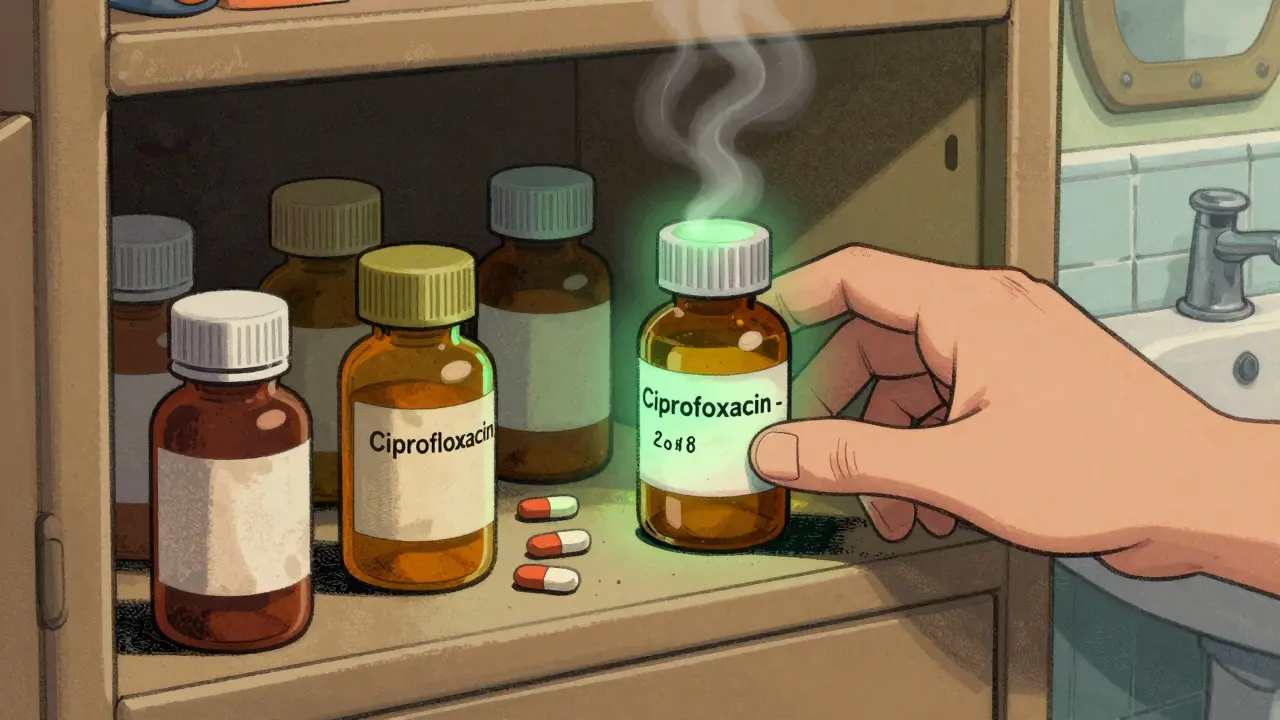
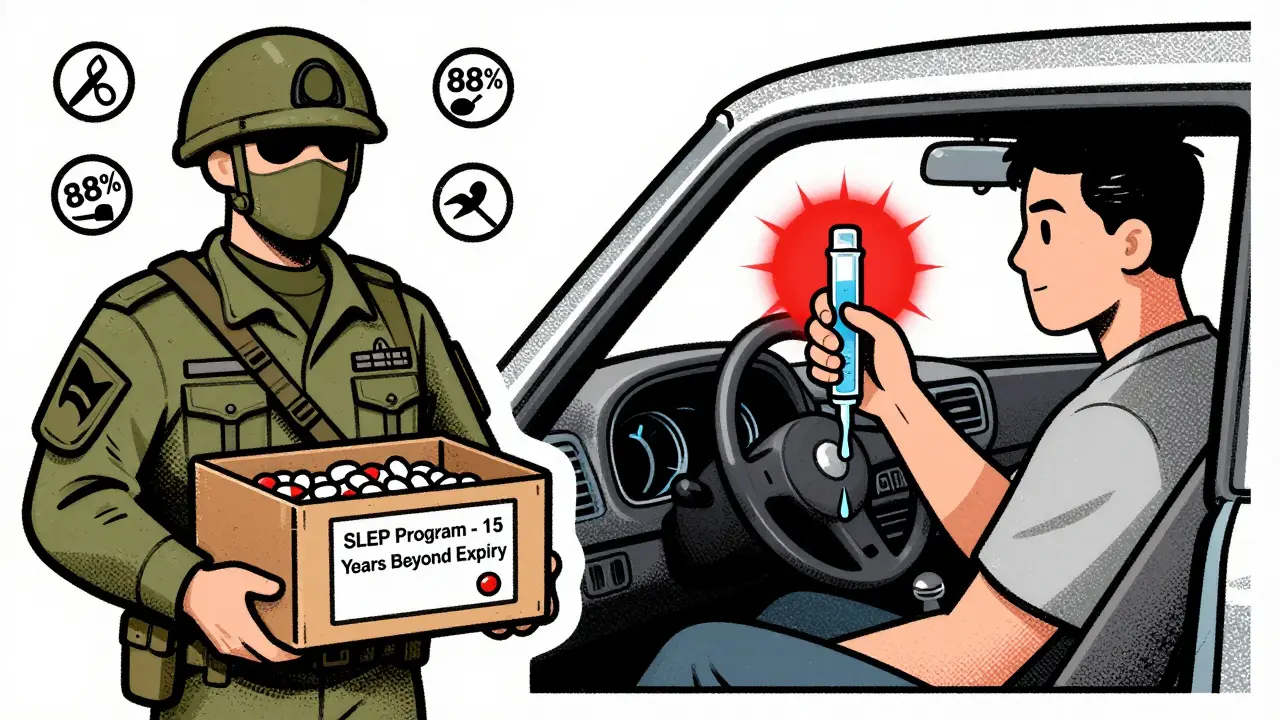
Most expired pills don’t become poisonous. They just become weaker. A 2012 study by Dr. Lee Cantrell in the Annals of Internal Medicine tested 12 prescription drugs stored properly for 28 to 40 years past their expiration dates. Nearly all still had over 90% potency. The U.S. military’s Shelf Life Extension Program (SLEP), which tested over 3,000 lots of drugs from 1985 to 2006, found that 88% of medications were still effective-some even 15 years beyond their labeled date. Ciprofloxacin retained 97% potency 12 years out. Amoxicillin held 94% after 8 years.
But potency loss isn’t the same as safety. For some drugs, even a small drop in strength can be dangerous. Take insulin: it degrades at 1.5-2.5% per month if kept above 8°C. A vial that’s been sitting on a counter for six months could deliver less insulin than needed, leading to dangerously high blood sugar. Nitroglycerin, used during heart attacks, loses half its potency within months after opening-even before the expiration date. If you rely on it during chest pain and it’s weak, you could die.
High-Risk Medications: Don’t Take the Chance
Not all expired drugs are created equal. Experts classify them into three risk categories:
- Category 1 (High Risk): Nitroglycerin, insulin, liquid antibiotics (like amoxicillin-clavulanate), epinephrine auto-injectors (EpiPens), and tetracycline antibiotics. These can degrade unpredictably or become harmful. EpiPens lose 15-20% potency per year after expiration. In anaphylaxis, that could mean not enough epinephrine reaches your bloodstream to save your life.
- Category 2 (Moderate Risk): Antibiotics, anticoagulants (like warfarin), seizure medications, and asthma inhalers. If these lose potency, you risk treatment failure. A weak antibiotic might not kill all your bacteria, leading to resistant infections. Warfarin’s effect can become erratic, increasing bleeding risk.
- Category 3 (Low Risk): Most solid pills-statins, antidepressants, pain relievers, and blood pressure meds like ACE inhibitors. These degrade slowly and predictably. If you’re out of your refill and have a 6-month-old bottle of lisinopril, it’s likely still doing its job.
The Institute for Safe Medication Practices (ISMP) says it best: if your life depends on it, don’t risk it. If it’s for occasional heartburn or a mild headache? Probably fine.
Storage Matters More Than the Date
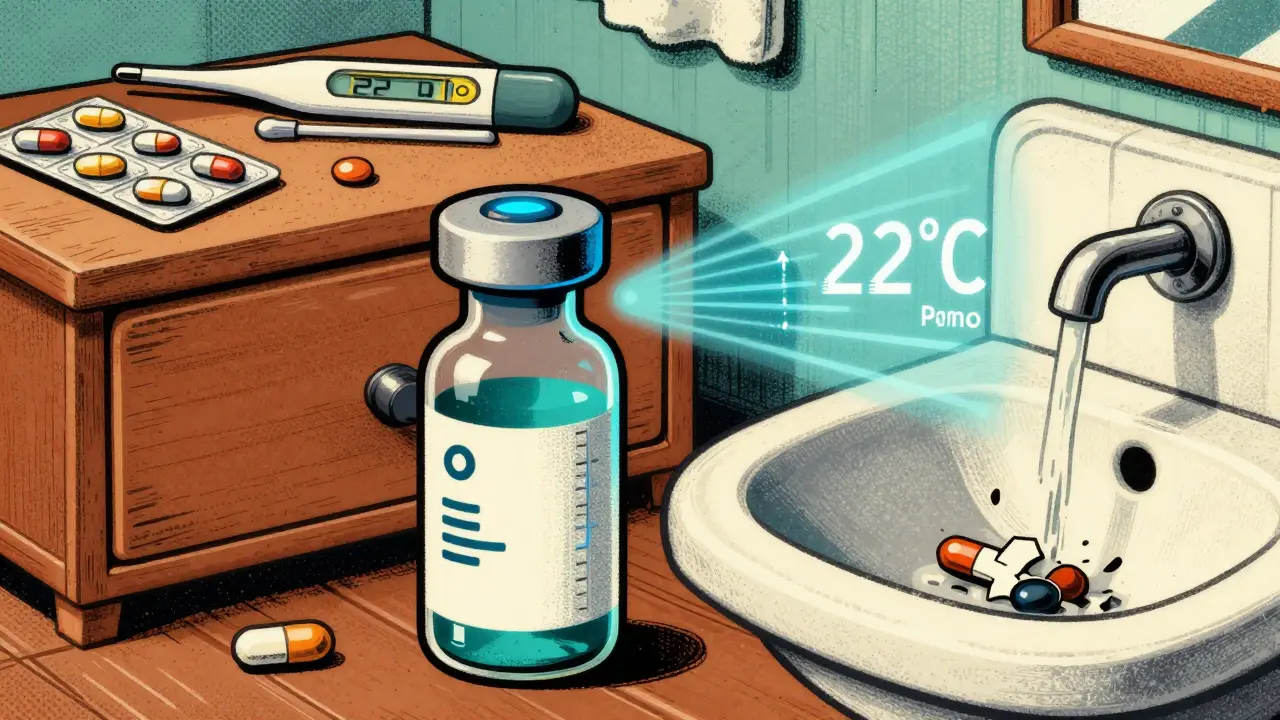
Where you store your meds has a bigger impact than the expiration date printed on the label. Bathrooms are the worst place: humidity levels hit 75-85% during showers. That moisture breaks down tablets and capsules. Heat from a windowsill or car dashboard? Even worse.
Best storage? A cool, dry, dark place-like a bedroom drawer. Keep pills in their original containers with child-resistant caps sealed. Avoid transferring them to pill organizers unless you use them within a week. Some pharmacies now use temperature-monitoring devices (costing $25-$150) to ensure meds stay within safe ranges. If your pharmacy doesn’t, ask them.
Look for physical changes: pills that crumble, change color, or smell strange? Throw them out. Liquid that looks cloudy or has particles? Don’t use it. These are signs of chemical breakdown-not just aging.
What the FDA Says vs. What the Science Shows
The FDA’s official stance is clear: "Don’t be tempted to use expired medicines. They may be less effective or even harmful." That’s their legal and liability position. But their own data contradicts it. The SLEP program, funded by the NIH, showed most drugs last far longer than labeled. The military has saved $1.2 billion annually by extending expiration dates on stockpiled meds.
Dr. Joel Davis, chief pharmacist at Johns Hopkins, says for stable conditions like high blood pressure or cholesterol, expired medications may be safe for short-term use during shortages-if stored properly. But he adds: "Never use them for emergencies, infections, or critical therapies."
The disconnect exists because manufacturers test under ideal conditions, and the FDA sets conservative dates to cover worst-case scenarios. They’re not trying to trick you-they’re trying to protect you from bad storage. But that doesn’t mean every expired pill is a hazard.
What Should You Do?
Here’s a simple guide:
- Check the drug type. If it’s insulin, EpiPen, nitroglycerin, or liquid antibiotic-throw it out. No exceptions.
- Look at storage. Was it kept in a hot bathroom or a sunny window? If yes, toss it, even if the date hasn’t passed.
- Inspect the pill. Discolored, cracked, smelly, or sticky? Discard it.
- For chronic conditions. If you’re out of refills and have a 1-year-old statin or antidepressant, it’s likely fine for a few extra days. But get a new prescription ASAP.
- For emergencies. If you need an antibiotic for an infection or pain relief for severe pain, don’t gamble. Get a new one.
And when you do dispose of expired meds, don’t flush them unless they’re on the FDA’s Flush List (like fentanyl patches or oxycodone tablets). Instead, use a drug take-back program. In 2023, DEA collection sites removed over 900,000 pounds of unused medications. You can find local drop-off sites at drugtakebackday.com.
The Future of Expiration Dates
Change is coming. The FDA is testing Bluetooth-enabled sensors on insulin vials that track real-time temperature and adjust expiration dates accordingly. Early results show a 22% drop in unnecessary discards. Researchers at the University of Utah are building machine learning models that predict remaining potency based on storage history-with 89.7% accuracy. By 2030, experts believe we could extend average shelf life by over 40%, saving billions.
But until then, use common sense. Expiration dates are a safety net, not a countdown clock. Most pills are fine. But some aren’t. Know the difference.
Are expired medications dangerous to take?
Most expired medications aren’t dangerous-they just lose potency. But some, like insulin, nitroglycerin, and liquid antibiotics, can become ineffective or unpredictable, which can be life-threatening. For common pills like statins or ibuprofen, the risk is low if stored properly. Always check for physical changes like discoloration or odor.
How long do pills last after their expiration date?
Many solid medications retain potency for years beyond their expiration date. The U.S. military’s Shelf Life Extension Program found 88% of drugs were still effective 15 years past expiration when stored properly. However, this varies by drug type. Liquid medications, insulin, and epinephrine degrade much faster and should never be used past their date.
Should I keep expired medication for emergencies?
Only if it’s a low-risk medication like a blood pressure pill or antidepressant, and it was stored correctly. Never rely on expired EpiPens, insulin, or antibiotics during an emergency. If you’re unsure, it’s safer to replace them. Having a backup is smart-but only if it’s reliable.
Can I store pills in the fridge to make them last longer?
Only if the label says to. Most pills don’t need refrigeration, and moisture from the fridge can damage them. The ideal storage is a cool, dry place-like a bedroom drawer-between 15°C and 25°C. Never store pills in the bathroom or car.
Why do pharmacies put a "beyond-use" date on prescriptions?
Pharmacies set a "beyond-use" date (often 1 year for pills, 30 days for eye drops) based on how they handle and store the medication after dispensing. This is more conservative than the manufacturer’s date because once a bottle is opened and repackaged, exposure to air and humidity increases. It’s a safety buffer for real-world conditions.
Stephen Habegger
March 21, 2026 AT 01:36Good breakdown. I’ve kept my blood pressure meds for over a year past expiration, stored in a dark drawer, and they’ve never flinched. No drama, no panic-just common sense.
MALYN RICABLANCA
March 22, 2026 AT 10:56Oh. My. GOD. You just described the entire pharmaceutical-industrial complex like it’s a villainous puppet show! 💥 The FDA? More like the FDA-RA (Federal Drug Administration-Ridiculously Arbitrary). They don’t care if your pills are still potent-they care if someone sues them because you took a 10-year-old ibuprofen and… maybe felt slightly less better? 🤯
And don’t get me started on the $1.2 BILLION the military saves by NOT trashing perfectly good ciprofloxacin. That’s not a savings-that’s a heist. A heist of your wallet, your peace of mind, and your trust in institutions that treat expiration dates like a death sentence for chemistry.
Meanwhile, I’ve got a 2018 bottle of sertraline in my nightstand. It’s been through heatwaves, humidity, and my cat’s accidental ‘medication yoga.’ Still tastes like chalk. Still works like a charm. And yet? The pharmacist hands me a new script like I’m a criminal trying to smuggle hope.
It’s not about safety-it’s about liability. It’s about fearmongering disguised as science. The real poison? The system that makes you feel guilty for not throwing away perfectly good medicine because a label says so.
Let’s be real: if your insulin is expired, yes-replace it. But if your statin’s been chilling in a drawer since 2021? You’re not a fool. You’re a survivor.
And if you’re still buying new prescriptions every 30 days just because the date says so? Honey, you’re being scammed.
Sanjana Rajan
March 23, 2026 AT 19:02Ugh. I can’t believe people still think this is a debate. If it’s expired, toss it. Period. I don’t care if some military study says it’s fine. You’re not a chemist. You’re not a pharmacist. You’re just someone who Googled ‘is my old pill still good?’
And don’t even get me started on storing meds in a drawer. That’s like saying ‘my car’s fine if I don’t check the oil’-until it explodes.
My grandma died because she took expired antibiotics. Don’t be her.
Linda Olsson
March 24, 2026 AT 23:58Oh, so now we’re trusting the military’s stash of 20-year-old pills? Next thing you know, we’ll be using expired vaccines from a Cold War bunker. 🤨
Who even funds these studies? Big Pharma? The FDA? Please. This is all a distraction. They want you to think it’s safe so you keep buying new bottles. It’s not science-it’s capitalism.
And don’t even mention ‘proper storage.’ Who lives in a climate-controlled lab? You? I live in a 95°F apartment with a window that leaks humidity like a sieve. So no. I’m not risking it.
Expiration dates exist for a reason. Stop trying to outsmart them.
lawanna major
March 26, 2026 AT 21:58There’s a quiet wisdom in knowing when to trust science and when to trust common sense. The data is clear: most solid medications retain potency for years beyond their labeled date-especially when stored properly. But wisdom isn’t just about data; it’s about context.
For chronic conditions like hypertension or depression, where consistent dosing matters more than peak potency, a slightly degraded pill is often far safer than the anxiety of going without. But for life-critical drugs-insulin, epinephrine, nitroglycerin-precision isn’t negotiable.
Storage matters more than the date. A cool, dry drawer beats a bathroom cabinet any day. And physical changes-color, smell, texture-are better indicators than any label.
The FDA’s stance isn’t wrong-it’s cautious. But caution shouldn’t become dogma. We’re not children. We can hold nuance. We can weigh risk. We can make informed choices.
And if you’re still using expired medicine because you can’t afford a refill? That’s not negligence. That’s a system failure. And that’s the real issue.
Ayan Khan
March 27, 2026 AT 04:45Interesting perspective. In India, we often rely on expired medicines due to cost and access. Many people don’t have the luxury of replacing every bottle every 30 days. But we also have generations of experience-our elders know which pills still work and which don’t.
My grandfather used to say: ‘If the pill looks right, smells right, and works right, then it is right.’
Of course, we never used expired insulin or antibiotics. But for blood pressure or cholesterol? We did. And we lived.
Perhaps the real lesson isn’t about dates-it’s about community knowledge. We don’t need a lab to know when something still works. We just need to listen.
Shameer Ahammad
March 29, 2026 AT 03:11While the empirical evidence presented is compelling, it is imperative to acknowledge the legal and regulatory frameworks that govern pharmaceutical efficacy. The expiration date is not an arbitrary construct; it is the culmination of rigorous, standardized stability testing under controlled conditions as mandated by the United States Pharmacopeia and enforced by the Food and Drug Administration.
Deviating from this standard, even with anecdotal success, introduces unacceptable risk into the clinical domain. The fact that 88% of military stockpiled drugs retained potency does not negate the 12% that did not-nor does it justify the casual disregard for professional pharmaceutical guidelines.
Furthermore, the variability in storage conditions across households renders generalizations perilous. A single instance of degradation in a critical medication can result in irreversible harm.
Therefore, while scientific curiosity is admirable, it must be tempered by professional responsibility. The prudent course remains: when in doubt, discard.
Lauren Volpi
March 30, 2026 AT 18:59Ugh, another ‘let’s ignore the FDA’ post. You people are why America’s healthcare is a joke. The government doesn’t lie. They don’t set expiration dates to make you buy more pills. They set them because they know you’re dumb enough to leave your meds in the car. And you are.
My cousin took expired amoxicillin. Got sepsis. Died. Don’t be that guy.
Amadi Kenneth
March 31, 2026 AT 23:17Wait… so you’re saying the government is hiding the truth? That they’re forcing us to throw away perfectly good medicine so Big Pharma can profit? That’s not paranoia-that’s HISTORY. Look at the 1930s Elixir Sulfanilamide disaster. Look at the opioid crisis. Look at how they let lead paint stay on the market for decades.
They don’t care if you live. They care if you buy. That 88% potency stat? That’s not a win. That’s proof they’ve been lying for decades.
And now they want you to trust ‘proper storage’? In a country where 40% of people live in apartments with no AC? In a world where the FDA approves drugs based on 3-month trials?
They’re not protecting you. They’re protecting their bottom line. And you? You’re just a consumer. A number. A dollar sign.
So yeah-I’m keeping my 10-year-old lisinopril. And I’m not sorry.
Manish Singh
April 1, 2026 AT 02:53My aunt in Kerala used to say: ‘If the pill still looks like a pill, it still works like a pill.’
She lived to 94. Took her BP meds for 20 years past expiration. Never had a stroke. Never went to the hospital for it.
But she never kept them in the bathroom. Never left them in the sun. She had a little tin box. Dark. Dry. Cool.
Maybe the real lesson isn’t about dates. Maybe it’s about respect. Respect for the medicine. Respect for your body. Respect for the fact that not every problem needs a new bottle.
Just don’t be lazy. And don’t be reckless.
Kyle Young
April 1, 2026 AT 10:55It’s fascinating how we treat expiration dates as moral absolutes when they’re, at their core, probabilistic estimates. The 90% potency threshold is not a binary switch-it’s a statistical boundary drawn for liability, not biology.
What does it mean to ‘be safe’? Is it to follow a label written under ideal conditions? Or is it to understand degradation curves, storage variables, and clinical thresholds?
Perhaps the real question isn’t whether expired pills are dangerous-but whether our fear of uncertainty is more dangerous than the pills themselves.