
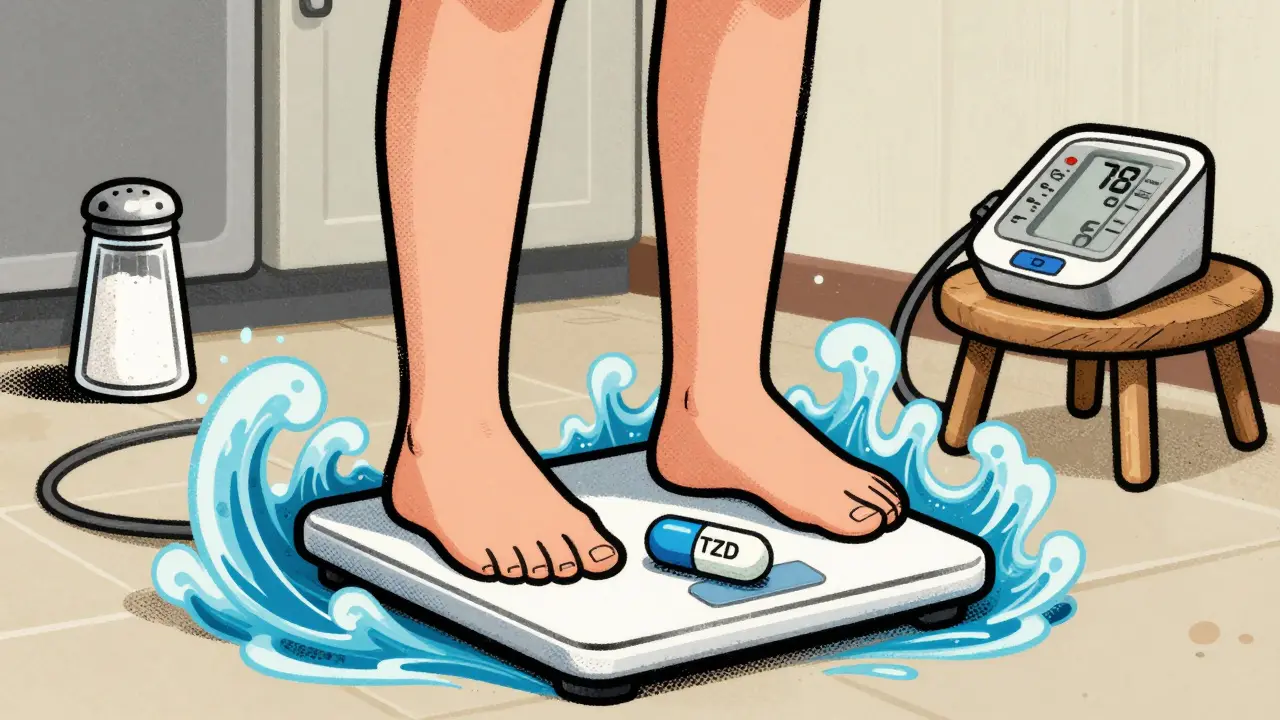
TZD Weight Gain Calculator
TZD medications often cause weight gain. According to research, 65-70% of this weight gain comes from fluid retention, not fat. This calculator helps you understand how much of your weight gain is likely fluid versus fat.
Important Note
Sudden weight gain of more than 2-3 kg (4-6 lbs) in one week is a red flag for fluid retention and requires immediate medical attention.
If you're taking a TZD like pioglitazone or rosiglitazone for type 2 diabetes, you might have noticed something unexpected: your clothes feel tighter, your ankles are swollen, or the scale jumped up by a few pounds in just a few weeks. You're not alone. About 60% of people on these drugs gain weight, and up to 16% develop noticeable fluid retention-especially if they're also on insulin. This isn’t just inconvenience; it’s a real risk that can lead to heart strain, hospital visits, and even stopping your medication altogether.
Why TZDs Cause Weight Gain and Swelling
TZDs work by making your body more sensitive to insulin. That’s great for blood sugar control. But they also activate receptors in your kidneys that tell them to hold onto sodium and water. This isn’t fat gain-it’s mostly fluid. Studies show that 65-70% of the weight gain from TZDs comes from extra fluid in your tissues, not fat. That’s why your legs swell, your rings feel tight, or you wake up with puffy eyes. The swelling, called edema, happens because TZDs boost activity in kidney transporters like ENaC and NKCC2. These are the same channels that help your body reabsorb salt instead of flushing it out. More salt = more water stuck in your body. At the same time, TZDs increase vascular permeability, letting fluid leak out of tiny blood vessels into your skin and muscles. It’s a double hit: your kidneys hold onto fluid, and your blood vessels leak it out.Who’s Most at Risk?
Not everyone gets edema. But certain people are far more likely to:- Those already on insulin (risk jumps to 15-16%)
- People with kidney problems
- Anyone with heart issues, especially NYHA Class III or IV heart failure
- Older adults
- Women
How Much Weight Gain Is Normal?
On average, people gain 2.7 to 3 kg (6-7 lbs) in the first few months. Some gain more-up to 5 kg (11 lbs)-especially at higher doses. Pioglitazone 45 mg daily can cause nearly double the swelling compared to 15 mg. Rosiglitazone shows similar patterns. The weight gain usually plateaus after 3-6 months, but the fluid retention can linger. Here’s the key: It’s not just about the number on the scale. A sudden gain of more than 2-3 kg (4-6 lbs) in a week is a red flag. That’s not normal fat gain-that’s fluid building up fast. It’s a warning sign your body can’t handle the drug anymore.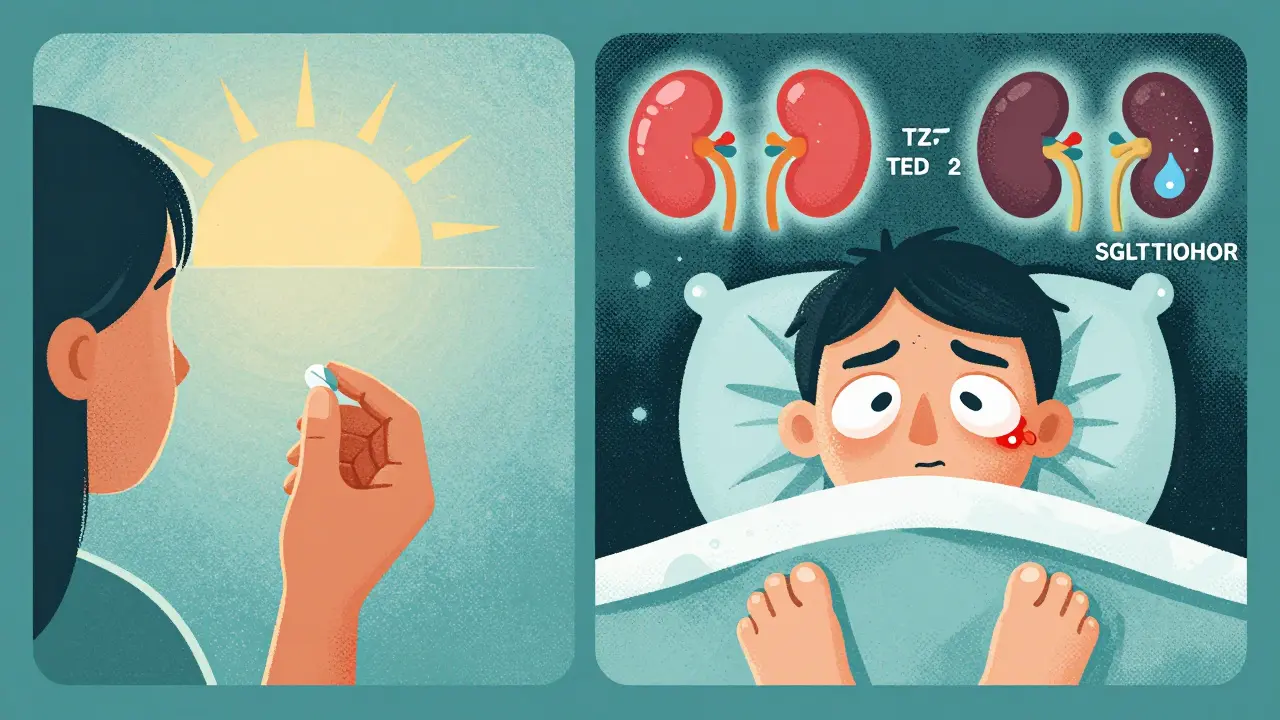
What Works to Reduce Swelling and Weight Gain
You don’t have to just live with it. There are proven ways to fight back.1. Lower the Dose
Start low. Pioglitazone 15 mg daily causes only 2.1% edema risk. At 45 mg? That jumps to 4.8%. Many people don’t need the highest dose. Work with your doctor to find the smallest dose that keeps your blood sugar in range. You might be surprised how little you need.2. Take It in the Morning
Fluid retention tends to build up overnight. Taking your TZD in the morning gives your body a full day to process it before you sleep. One small study in Diabetes Research and Clinical Practice found that morning dosing reduced nighttime swelling compared to evening use. It’s not a cure, but it’s an easy tweak.3. Cut Back on Salt
Sodium is the enemy here. Limit salt to under 2,000 mg per day. That means no processed foods, canned soups, deli meats, or fast food. Read labels. Cook at home. Use herbs and lemon instead of salt. A 2021 trial showed that strict sodium restriction cut edema severity by 27%.4. Elevate Your Legs
When you’re sitting or lying down, prop your feet up. Even 15-20 minutes a few times a day helps gravity pull fluid back out of your ankles. It’s simple, free, and surprisingly effective.5. Add an SGLT2 Inhibitor
This is the most powerful strategy. Drugs like empagliflozin, dapagliflozin, or canagliflozin make your kidneys dump sugar-and salt-out in your urine. They directly counteract TZD fluid retention. A 2020 study in Diabetes Therapy showed that combining an SGLT2 inhibitor with a TZD cut edema risk by 45%. Plus, SGLT2 inhibitors often cause weight loss, which balances out the TZD gain. Many patients who kept both drugs reported better blood sugar control and less swelling.6. Consider a Diuretic
If you can’t use an SGLT2 inhibitor, a low-dose thiazide diuretic (like hydrochlorothiazide) can help. Studies show it reduces TZD-related swelling by 38%. But avoid loop diuretics like furosemide unless you have serious heart failure-they’re overkill and can mess with your electrolytes. Always use diuretics under medical supervision.What Doesn’t Work
Don’t waste time on these myths:- Drinking more water won’t flush out the fluid-it can make swelling worse by increasing total body volume.
- Exercise alone won’t fix it. While movement helps circulation, it doesn’t stop the kidney mechanisms causing retention.
- Weight loss diets might help with fat, but they won’t touch the fluid buildup caused by TZDs.
When to Stop TZDs
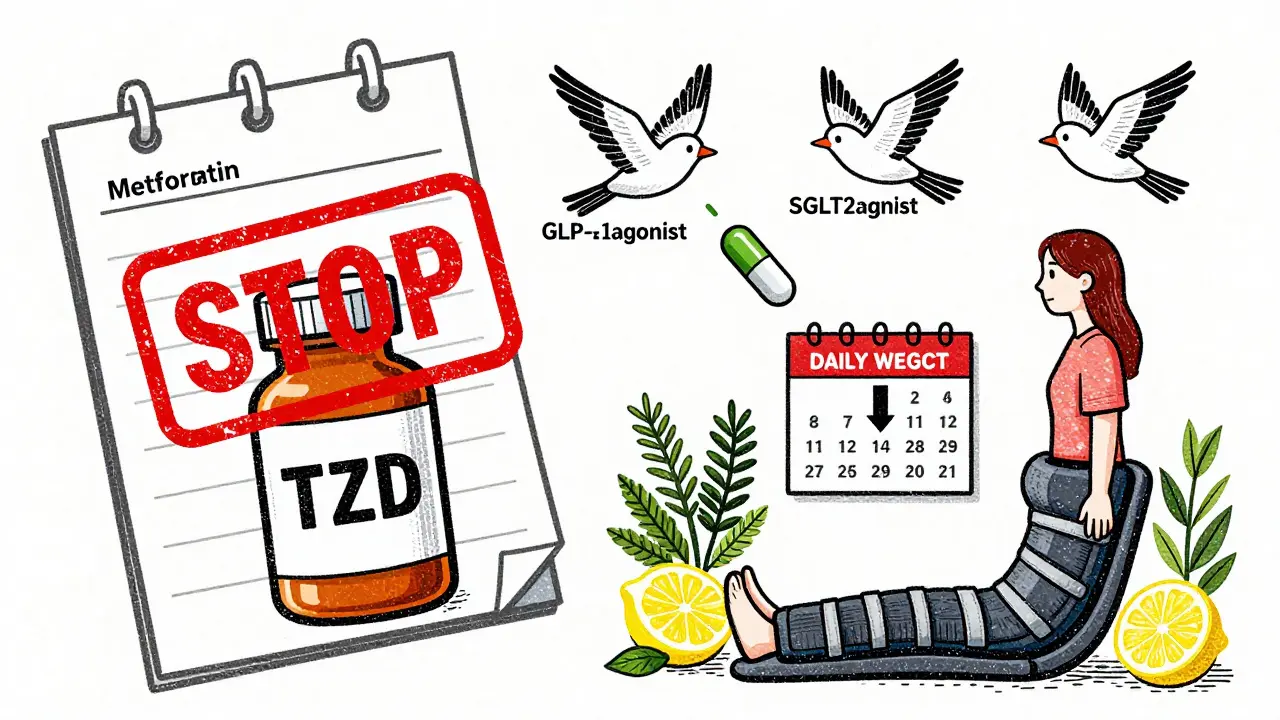
You should stop immediately if you notice:- Weight gain over 2-3 kg (4-6 lbs) in one week
- Swelling in your legs, feet, or abdomen
- Shortness of breath when lying flat or walking short distances
- Increased need to urinate at night
Alternatives to TZDs
If side effects are too much, there are better options:- Metformin: First-line. Neutral or slight weight loss. No fluid retention.
- GLP-1 agonists (like semaglutide, liraglutide): Cause weight loss, lower blood pressure, protect the heart.
- SGLT2 inhibitors: Reduce heart failure risk, cause weight loss, lower blood pressure.
What’s Coming Next
Researchers are working on next-gen drugs called SPPARMs-selective PPAR modulators-that keep the insulin-sensitizing benefits of TZDs without the fluid retention. Saroglitazar, used in India, shows 60% less edema than pioglitazone in trials. While not yet approved in the U.S. or UK, it’s a sign that better options are coming. There’s also early research into genetic testing. Some people carry a gene variant (rs1801282) that makes them 2.3 times more likely to get edema on TZDs. In the future, a simple blood test might tell you if this drug is safe for you before you even start.Bottom Line
TZDs work-but they come with a cost. Weight gain and swelling aren’t minor side effects. They’re warning signs your body can’t tolerate the drug. But you don’t have to accept them. By lowering your dose, cutting salt, taking the pill in the morning, and pairing it with an SGLT2 inhibitor, you can often keep the benefits without the downsides. If you’re already on a TZD and feeling swollen or heavier, don’t wait. Track your weight daily. Talk to your doctor. There are smarter, safer ways to control your diabetes now. You don’t have to live with side effects that could hurt your heart.Do TZDs cause weight gain because of fat or fluid?
Most of the weight gain from TZDs-about 65-70%-comes from fluid retention, not fat. The drugs cause your kidneys to hold onto sodium and water, leading to swelling in your legs, ankles, and feet. While some fat gain does occur, the sudden increase in weight, especially within the first few weeks, is mostly water.
Can I take a diuretic with my TZD to reduce swelling?
Yes, but only under medical supervision. Low-dose thiazide diuretics like hydrochlorothiazide can reduce TZD-related edema by about 38%. Avoid loop diuretics like furosemide unless you have serious heart failure-they’re too strong and can cause electrolyte imbalances. Always check with your doctor before combining these drugs.
Is it safe to take TZDs if I have high blood pressure?
High blood pressure alone doesn’t automatically rule out TZDs, but it increases your risk. These drugs can worsen fluid retention, which raises blood pressure further. If you have high blood pressure and are considering a TZD, your doctor should first try to control your BP with other medications and monitor you closely for signs of heart strain or swelling.
Why are TZDs not used as often anymore?
TZDs have declined in use because newer drugs like SGLT2 inhibitors and GLP-1 agonists offer better safety profiles-they lower blood sugar, cause weight loss, protect the heart, and don’t cause fluid retention. After safety concerns in the 2000s and the rise of better alternatives, TZDs are now mostly reserved for patients with severe insulin resistance who haven’t responded to other treatments.
How long does it take for TZD-related swelling to go away after stopping the drug?
Most people notice improvement within a few days to a week after stopping TZDs. The fluid builds up gradually, so it takes time to flush out. Complete resolution usually happens within 2-4 weeks. If swelling persists longer, it may indicate another underlying issue like heart or kidney disease, and you should see your doctor.
Can lifestyle changes alone fix TZD-induced weight gain?
Lifestyle changes like reducing salt, elevating your legs, and staying active can help reduce swelling by up to 27%, but they won’t fully reverse the fluid retention caused by TZDs. The root cause is the drug’s effect on your kidneys. For significant improvement, you usually need to adjust your medication-either lower the dose, switch drugs, or add an SGLT2 inhibitor.
Are there any new TZD drugs without these side effects?
Yes, next-generation drugs called SPPARMs (selective PPAR modulators) like saroglitazar are being developed to keep the insulin-sensitizing benefits of TZDs without the fluid retention. Early trials show up to 60% less swelling compared to traditional TZDs. While not yet approved in the U.S. or UK, these represent the future of this drug class.
Jody Kennedy
December 26, 2025 AT 12:13Just started pioglitazone and my socks are now combat boots. Also, my face looks like I’ve been crying for a week-turns out, I haven’t. Thanks, science.
christian ebongue
December 26, 2025 AT 19:09lol i took my tzd at night and woke up looking like a pufferfish. switched to morning. no more balloon legs. also, salt is the devil. i now season everything with lemon and regret.
jesse chen
December 27, 2025 AT 04:06I’ve been on pioglitazone for two years, and honestly? The swelling was terrifying at first-until I started pairing it with empagliflozin. My ankles went from ‘oh no’ to ‘meh’ in three weeks. Also, cutting salt was the single biggest change. I didn’t realize how much sodium was hiding in ‘healthy’ foods. And yes, morning dosing helps. I swear by it now.
Joanne Smith
December 27, 2025 AT 22:03Let me guess-you’re the person who thinks ‘just drink more water’ fixes everything? No. No, no, no. Your kidneys aren’t clogged with existential dread, they’re hijacked by PPAR-gamma. You need to outsmart the drug, not hydrate your way out of a pharmacological trap. SGLT2 inhibitors aren’t magic-they’re math. And math wins.
Prasanthi Kontemukkala
December 28, 2025 AT 20:59As someone from India where saroglitazar is available, I can say-this drug is a game-changer. No puffiness, no weight gain, same blood sugar control. I wish it was easier to get here in the US. Maybe one day. Until then, lower dose + SGLT2 + no salt = survival mode. You’re not alone in this.
Alex Ragen
December 30, 2025 AT 00:45Ah, the tragic irony of modern pharmacology: we engineer molecules to restore metabolic equilibrium… only to disrupt osmotic harmony in the interstitial matrix. One might argue that TZDs are not merely drugs-they are metaphors for our hubris in manipulating biological systems without fully comprehending their emergent properties. And yet… we still take them. Because what else is there?
Lori Anne Franklin
December 31, 2025 AT 13:30OMG I just realized my rings got tight and I thought I was getting fat… turns out I was just full of water? I feel so dumb. But also… I tried the morning thing and the leg elevation and my ankles actually feel better?? Like, actual progress. Who knew? Thanks for the post!!
Bryan Woods
January 1, 2026 AT 21:12Thank you for this comprehensive overview. I’ve been managing type 2 diabetes for over a decade and have cycled through several agents. TZDs were effective, but the edema was unsustainable. The combination of SGLT2 inhibitors and dose reduction has proven to be the most viable long-term strategy in my experience. I appreciate the emphasis on daily weight tracking-it’s a simple, powerful tool that is too often overlooked.