

Statins-Antifungals Interaction Checker
Check Your Medication Combination
This tool checks whether your statin and antifungal combination is dangerous. Many combinations can lead to rhabdomyolysis, a life-threatening muscle condition.
Interaction Results
What to do:
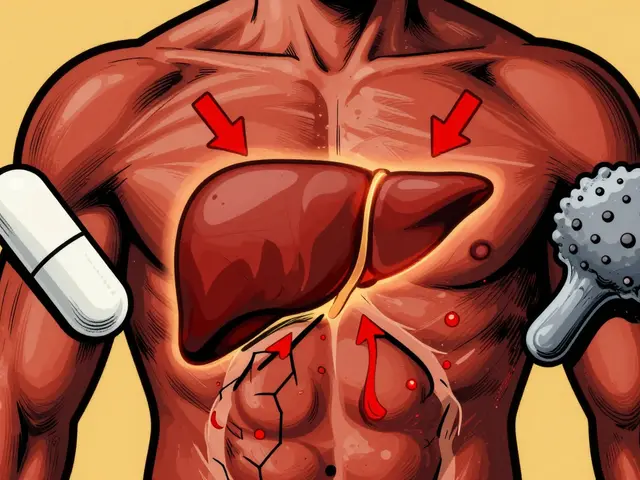
When you take a statin to lower your cholesterol and then get a fungal infection that needs an antifungal pill, you might not realize you’re walking into a dangerous medical trap. This isn’t just a theoretical risk-it’s a real, life-threatening combination that sends people to the hospital every year. The problem? Statins and certain antifungal medications can crash together in your body and trigger rhabdomyolysis, a condition where your muscles start breaking down and leaking toxic proteins into your bloodstream. If left unchecked, it can lead to kidney failure or even death.
Why This Interaction Happens
Most statins are broken down in your liver by an enzyme called CYP3A4. It’s like a recycling plant that processes these drugs so they don’t build up. But when you add certain antifungals-especially azoles like itraconazole, ketoconazole, or voriconazole-they shut down that recycling plant. These antifungals are powerful inhibitors of CYP3A4. That means the statin doesn’t get cleared. It piles up. And when statin levels spike, they start attacking your muscle cells.This isn’t random. The FDA flagged this danger in 2012 after reviewing dozens of hospital cases. They updated labels to say: Don’t mix simvastatin or lovastatin with strong CYP3A4 inhibitors. But many people still get this combination prescribed. Why? Because doctors aren’t always aware of the full risk, or the patient didn’t mention they were taking an antifungal. And in outpatient clinics, where most of these prescriptions happen, the warning systems often fail.
Which Statins Are Most Dangerous?
Not all statins are created equal when it comes to this interaction. Here’s the breakdown:- High risk: Simvastatin, lovastatin, and atorvastatin. These rely heavily on CYP3A4. Simvastatin is the worst offender. When paired with itraconazole, its blood levels can jump by more than 10 times. That’s not a typo. A 40 mg dose can act like a 400 mg dose.
- Moderate risk: Atorvastatin. Still dangerous with strong inhibitors, but less so than simvastatin. A 20 mg daily dose is often the max allowed with fluconazole.
- Low risk: Pravastatin, fluvastatin, rosuvastatin, and pitavastatin. These use different liver pathways. They’re much safer to use with antifungals.
Let’s put numbers to this. A 2017 study found that itraconazole increased simvastatin exposure by 1,160%. That’s more than eleven times the normal level. For fluconazole, the increase is less dramatic but still dangerous-350% for simvastatin. Even a common 200 mg daily dose of fluconazole for a yeast infection can push simvastatin into the danger zone.
What Does Rhabdomyolysis Feel Like?
Most people don’t realize they’re in trouble until it’s too late. Symptoms usually show up 7 to 14 days after starting the antifungal. You might think it’s just soreness from working out. But here’s what to watch for:- Severe muscle pain, especially in the shoulders, thighs, or lower back
- Weakness so bad you can’t climb stairs or stand up from a chair
- Dark, tea-colored urine
- Unexplained fatigue
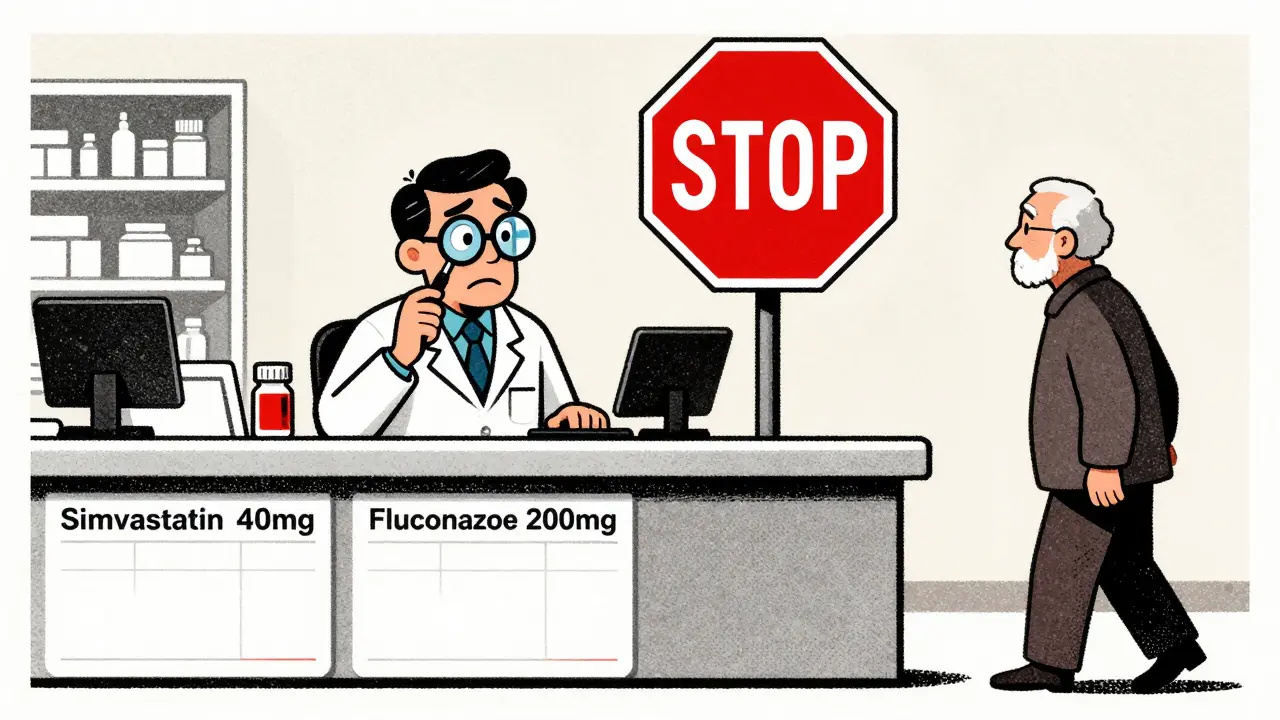
One case from 2018 involved a 68-year-old man on simvastatin 40 mg who started fluconazole for toenail fungus. Seven days later, his creatine kinase (CK) level hit 18,400 U/L. Normal is 30-200. He spent three days in the hospital. That’s not rare. A 2020 analysis of FDA reports found over 1,200 rhabdomyolysis cases tied to statin-azole combos between 2010 and 2019. Simvastatin with itraconazole made up nearly 40% of those cases.
Who’s Most at Risk?
It’s not just about the drugs. Certain people are sitting ducks for this interaction:- People over 75
- Those with kidney or liver problems
- Diabetics
- People taking multiple medications (like blood pressure or heart drugs)
- Those with low body weight or frailty
A 2022 study found that 23.4% of patients over 75 were still getting contraindicated combinations. That’s almost one in four. And in outpatient clinics, where prescriptions are written without full medical reviews, the rate was 21.1%. Hospitals are better at catching it-only 14.3% of inpatients got the wrong combo. Why? Because pharmacists are there to check. Outside the hospital? Not so much.
What Should You Do?
If you’re on a statin and need an antifungal, here’s what actually works:- Stop simvastatin and lovastatin completely. If you’re on either, don’t take them while on itraconazole, ketoconazole, or voriconazole. Wait at least 2-3 days after finishing the antifungal before restarting.
- Switch to a safer statin. Pravastatin, fluvastatin, or rosuvastatin are your best bets. They’re just as effective for lowering cholesterol but don’t interact with antifungals. Your doctor can switch you over in a day.
- Limit fluconazole doses. If you must take fluconazole and are on simvastatin, the max daily dose should be 10 mg. For atorvastatin, don’t go over 20 mg.
- Ask about alternatives. Isavuconazole is a newer antifungal that doesn’t block CYP3A4. It’s more expensive, but for high-risk patients, it’s worth it.
- Get a CK test. If you’re on a risky combo, ask your doctor for a baseline creatine kinase test before starting the antifungal. Then check again after 5-7 days. If CK is over 10 times the normal level, stop both drugs immediately.

What’s Being Done to Fix This?
The good news? Systems are catching up. Electronic health records like Epic now block prescriptions when simvastatin over 20 mg is paired with itraconazole. A 2022 Mayo Clinic study showed this cut dangerous prescriptions by 87%. That’s huge. Pharmacies are also getting smarter-many now flag these combos before filling the script.Guidelines are evolving too. The American College of Cardiology and the Infectious Diseases Society of America are finalizing new joint guidelines for 2024. These will give doctors step-by-step algorithms based on age, kidney function, and other meds. It’s about time.
And the science keeps improving. Researchers now know that some people have a genetic variant (CYP3A5*3/*3) that makes them extra sensitive to this interaction. Their bodies process statins even slower. That’s why two people on the same dose can have wildly different outcomes. Genetic testing isn’t routine yet-but it might be soon.
Bottom Line
This isn’t a rare edge case. It’s a preventable disaster that happens far too often. Millions of people take statins. Millions more get antifungals for yeast infections, athlete’s foot, or lung infections. The overlap is massive. But with better awareness, smarter prescribing, and safer alternatives, this risk can be slashed.If you’re on a statin and your doctor prescribes an antifungal, ask: “Is this safe with my statin?” Don’t assume. Don’t wait. If they say yes without checking the type of statin, push back. Your muscles-and your kidneys-depend on it.
Can I take fluconazole with my statin?
It depends on which statin you take. If you’re on simvastatin, the max safe dose is 10 mg per day. For atorvastatin, don’t exceed 20 mg daily. Pravastatin, fluvastatin, rosuvastatin, and pitavastatin are safer options. Always check with your doctor or pharmacist before combining these drugs.
What are the signs of rhabdomyolysis from statins and antifungals?
Severe muscle pain, especially in the thighs or lower back, weakness that makes daily tasks hard, and dark, tea-colored urine are the top warning signs. These usually appear 7-14 days after starting the antifungal. If you notice any of these, stop the meds and get medical help right away.
Why is simvastatin more dangerous than other statins?
Simvastatin is almost entirely broken down by the CYP3A4 enzyme. When antifungals like itraconazole or fluconazole block this enzyme, simvastatin builds up in your blood-sometimes by more than 10 times. Other statins use different pathways, so they don’t pile up the same way. Simvastatin also has a very narrow safety window-small increases in dose can push it into toxic territory.
Are there antifungals that don’t interact with statins?
Yes. Isavuconazole is a newer antifungal with minimal effect on CYP3A4, making it safe to use with most statins. Fluconazole is a moderate inhibitor, so it’s risky with simvastatin and lovastatin but manageable with lower doses. Voriconazole and itraconazole are strong inhibitors and should be avoided with any CYP3A4-metabolized statin.
How common is this interaction?
In the U.S., about 36 million people take statins, and 15-20 million azole antifungal prescriptions are filled each year. Studies show that despite warnings, nearly 1 in 5 patients still get contraindicated combinations-especially older adults. Between 2010 and 2019, over 1,200 rhabdomyolysis cases were linked to these combos in FDA reports alone.
Miranda Varn-Harper
March 12, 2026 AT 05:08Statins and antifungals are a ticking time bomb in outpatient clinics, and it's astonishing how often this gets overlooked. The FDA warning from 2012 should have been a seismic event in primary care, yet here we are, five years later, with prescriptions still slipping through. Simvastatin at 40 mg with fluconazole for toenail fungus? That’s not a prescription-it’s a clinical error waiting to happen. I’ve reviewed charts where patients had CK levels over 15,000 and no one caught it because the EHR didn’t flag it. We need mandatory pharmacist review before dispensing these combos. Not optional. Not advisory. Mandatory.
Tom Bolt
March 12, 2026 AT 16:02There is a fundamental failure in pharmacovigilance when a drug interaction with a 1,160% increase in exposure-documented in peer-reviewed literature, flagged by the FDA, and embedded in clinical guidelines-is still being prescribed at a rate of nearly one in five patients over the age of 75. This is not negligence. This is systemic incompetence. The fact that electronic health records only began blocking these combinations in 2022-after over a thousand hospitalizations-is proof that reactive systems are not sufficient. Proactive, algorithm-driven, real-time clinical decision support is not a luxury. It is a moral imperative.
Shourya Tanay
March 14, 2026 AT 08:15As someone who works in clinical pharmacology, I appreciate the granularity of this breakdown. The CYP3A4 inhibition kinetics are well-characterized, but what’s often missed is the pharmacokinetic variability in elderly populations. Reduced hepatic mass, decreased renal clearance, and polypharmacy create a perfect storm. Pravastatin and rosuvastatin are indeed safer, but even then, dose adjustments based on eGFR and CYP polymorphisms should be considered. I’d add that genetic testing for CYP3A5*3/*3, while not routine, should be prioritized in patients over 70 with a history of statin intolerance. It’s cost-effective in the long run-avoiding one rhabdomyolysis case pays for a hundred tests.
LiV Beau
March 15, 2026 AT 05:40Y’all are absolutely right about the danger-but here’s the hopeful part: we’re fixing it 💪
Pharmacies are now auto-flagging these combos, EHRs are blocking them, and doctors are finally listening. I had my grandma switch from simvastatin to rosuvastatin last year after her foot fungus script. She’s fine now, no muscle pain, no hospital visits. And guess what? Her LDL is still under 90! 🎉 It’s not about fear-it’s about smart swaps. If your doc doesn’t know this, educate them. And if they’re resistant? Ask for a pharmacist consult. We’ve got tools. We just need to use them.
Adam Kleinberg
March 15, 2026 AT 19:26Denise Jordan
March 17, 2026 AT 07:55Gene Forte
March 17, 2026 AT 08:42Every life is a complex equation of risk and reward. Statins save lives. Antifungals restore dignity. But when we allow systems to fail because of inertia, we betray the very principle of healing. The solution is not complexity-it is clarity. Simpler regimens. Clearer warnings. Better communication. We do not need more drugs-we need more awareness. One conversation between patient and provider can prevent a lifetime of regret. Start with asking: ‘What are the alternatives?’ That single question is the first step toward true care.
Kenneth Zieden-Weber
March 18, 2026 AT 13:34So let me get this straight-you’re telling me that a 68-year-old man on simvastatin for cholesterol gets a fluconazole script for athlete’s foot… and then ends up in the hospital because his muscles melted? And this is still happening in 2024? Wow. Just wow.
Let’s be real: if this were a car defect that killed 1,200 people, we’d recall every model. But because it’s medicine, we shrug and say, ‘Well, the doctor didn’t know.’
Here’s the truth: doctors aren’t bad people. They’re overworked. Systems are broken. And the people paying the price? They’re not even aware they’re in danger until their urine turns the color of a root beer float.
So yes-switch statins. Ask questions. Demand a CK test. But also-demand better systems. Because no patient should have to be their own pharmacist.