
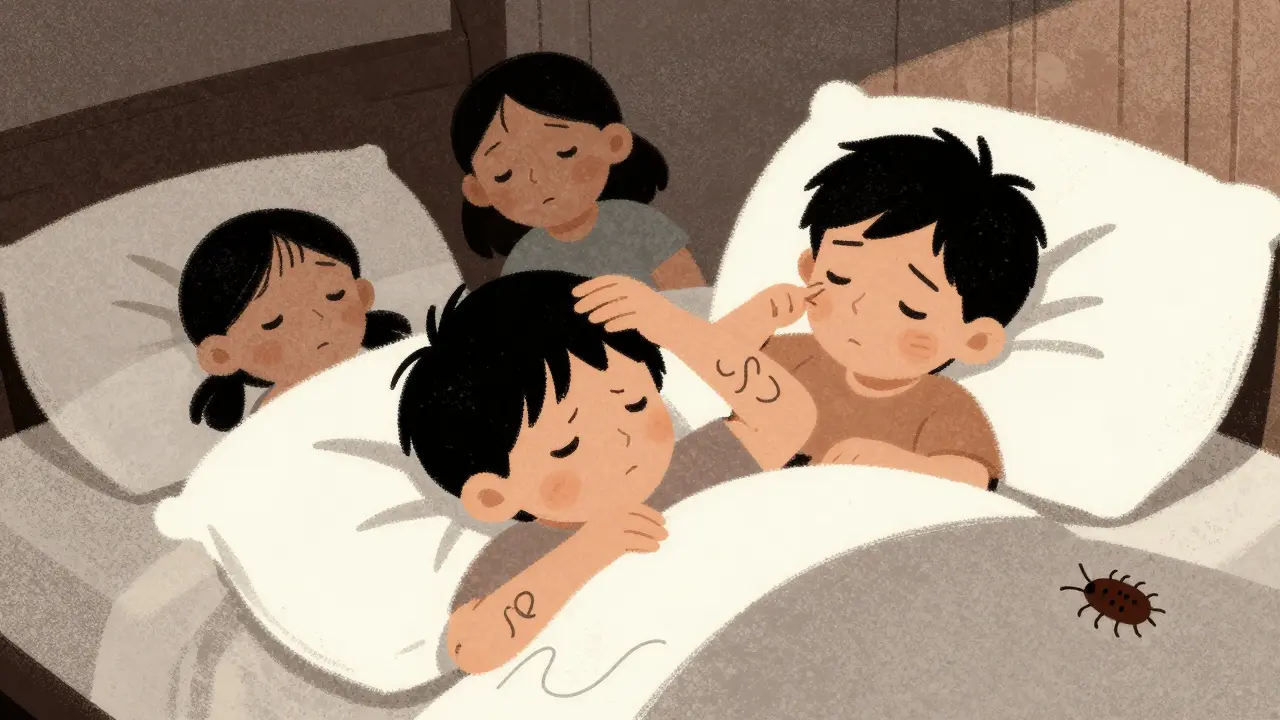
It’s not just about itching. When you or someone you live with starts scratching nonstop-especially at night-it’s rarely just dry skin. More often than not, it’s scabies or lice. These aren’t rare, old-fashioned problems. In 2023, the World Health Organization estimated 204 million people worldwide had scabies. In the U.S. alone, 6 to 12 million children get head lice every year. And here’s the thing: if you treat one person and ignore everyone else, you’re just setting up a cycle of reinfection.
What Exactly Are Scabies and Lice?
Scabies isn’t caused by dirt. It’s caused by a tiny mite called Sarcoptes scabiei var. hominis. These mites burrow into your skin, lay eggs, and trigger an allergic reaction that makes you itch like crazy-especially at night. The classic sign? Wavy, grayish lines on your skin, often between fingers, on wrists, around the waist, or on genitals. In babies, the rash can cover the whole body. In elderly or immunocompromised people, it can turn into crusted scabies, where millions of mites pile up and the skin becomes thick, scaly, and contagious beyond normal.
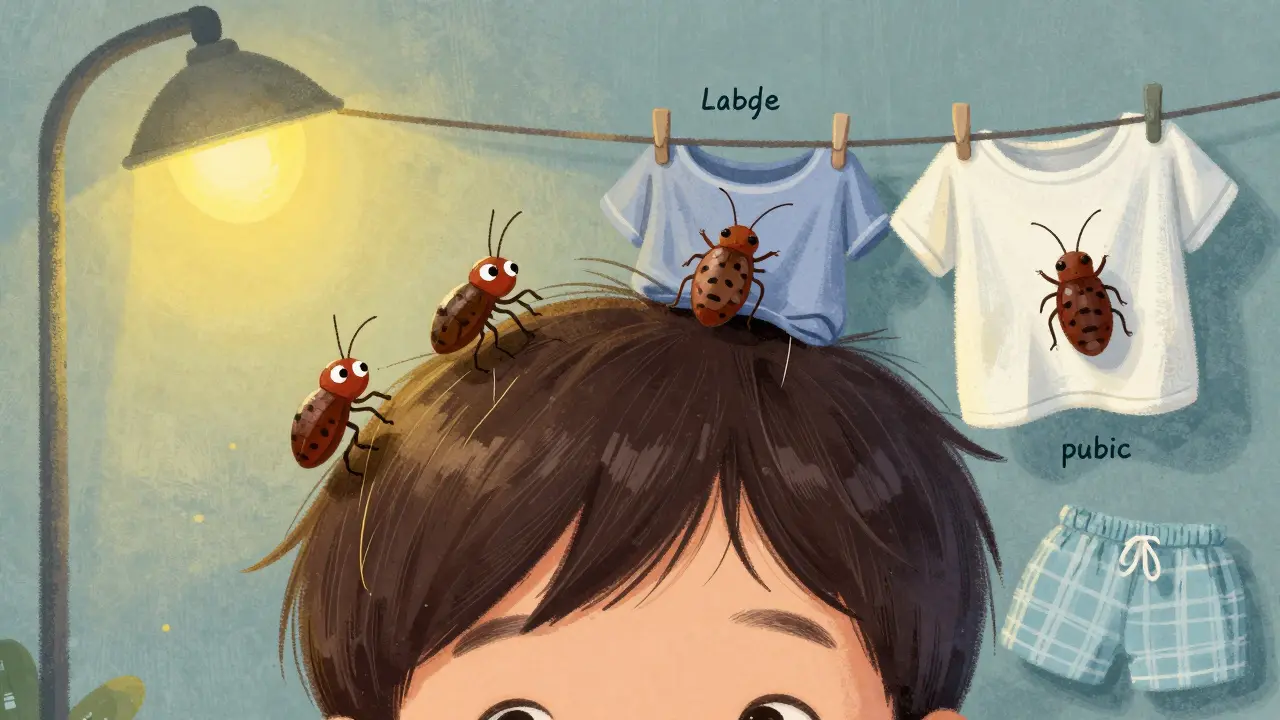
Lice are different. There are three kinds:
- Head lice (Pediculus humanus capitis)-most common in kids 3 to 11. They cling to hair, not skin, and spread through direct head-to-head contact.
- Body lice (Pediculus humanus corporis)-rare in developed countries. They live in clothes and bedding, not hair. You get them from poor hygiene or crowded living conditions.
- Pubic lice (Phthirus pubis)-also called crabs. They live in coarse body hair: pubic area, armpits, beard. Mostly spread through sexual contact.
Both scabies and lice are contagious. But they don’t jump. They crawl. You get them from close contact: sharing beds, clothes, towels, or sitting on a couch someone with lice just left.
How Are They Treated?
The good news? Both are treatable. The bad news? Many treatments don’t kill the eggs. That means you need to do more than one treatment.
Scabies Treatment: Permethrin vs. Ivermectin
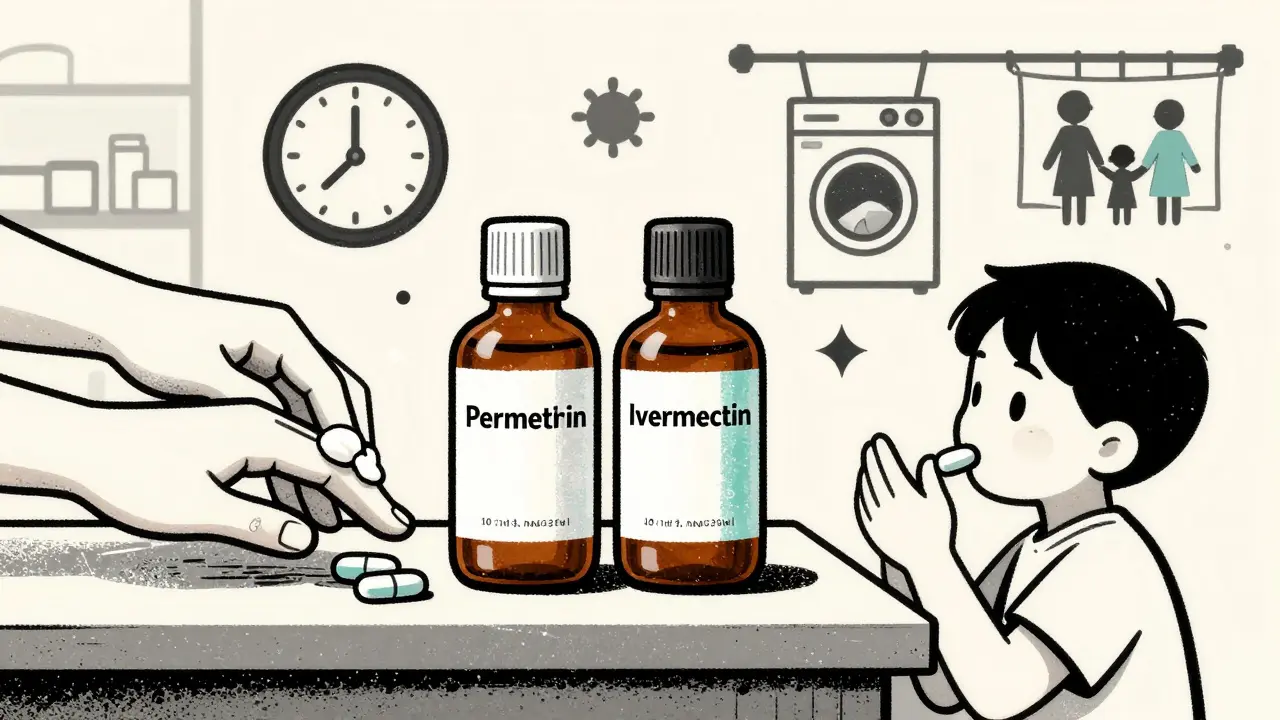
The go-to treatment for scabies is permethrin 5% cream. You apply it from the neck down, covering every inch of skin-including under nails, between fingers, and the genital area. Leave it on for 8 to 14 hours, then wash it off. Repeat after 7 days. Why? Because the eggs hatch in about 3 to 4 days, and the new mites need to be killed before they lay more eggs.
Studies show permethrin cures about 92.5% of cases after two applications. But it’s messy. People skip spots. Some forget to reapply. A 2022 audit from a California dermatology clinic found 12.3% of treatment failures were due to improper application.
Enter oral ivermectin. It’s not FDA-approved for scabies, but doctors use it all the time. You take it by mouth-200 micrograms per kilogram of body weight-on an empty stomach, then again 7 to 14 days later. It’s especially useful for people who can’t apply cream (like those with dementia or severe eczema) or in outbreaks (nursing homes, shelters). One study of 242 patients in Iran showed a 85.9% cure rate after one dose, jumping to 100% after the second.
There’s also topical ivermectin 1%-a lotion you apply like permethrin. A 2023 study found it works just as well: 92.5% cure rate. It’s less messy, easier for kids, and doesn’t require full-body coverage.
For crusted scabies, you need both. Doctors combine oral ivermectin with permethrin cream. Dosing varies by severity, but often it’s two to three doses of ivermectin spaced two weeks apart.
Lice Treatment: Permethrin, Spinosad, and the Rise of Resistance
Head lice have become harder to kill. In many U.S. areas, 15 to 30% of lice are resistant to permethrin. That’s why alternatives matter.
- Spinosad 0.9% liquid (approved in 2019) kills both lice and eggs in one application. No need to comb. Just apply to dry hair, leave for 10 minutes, rinse. Safe for kids as young as 4.
- Oral ivermectin is now used off-label for lice too. A 2020 study in the Solomon Islands found a double dose (0.4 mg/kg) wiped out 95-100% of head lice.
- Dimethicone and natural oils (like coconut or tea tree) are popular in home remedies, but there’s little solid proof they work consistently.
For body lice, washing clothes and bedding in hot water (at least 130°F) and drying on high heat kills lice and eggs. No medicine needed-just hygiene.
Why Treatment Fails (And How to Avoid It)
Most treatment failures aren’t because the medicine doesn’t work. They’re because of human error.
- Not treating everyone. If Mom gets treated but the kids don’t, the mites or lice come right back. Everyone who had close contact-family, roommates, partners-must be treated at the same time.
- Washing off too soon. Permethrin needs 8-14 hours to work. Showering after 2 hours? You’re wasting your time.
- Missing spots. Scabies mites hide in finger webs, under nails, under breast folds, around the waistline. You have to cover every crease.
- Not cleaning the environment. Scabies mites can live off the body for up to 72 hours. Wash bedding, towels, and clothes worn in the last 3 days in hot water. Dry on high heat. Items you can’t wash? Seal them in plastic bags for 7 days.
One study of nursing home outbreaks found that when staff treated everyone at once and cleaned everything, eradication rates hit 98.7%. When they treated only the symptomatic, it dropped to 42%.
What About Side Effects?
Permethrin is generally safe. Some people report mild burning or tingling. About 18% of users in a 2022 survey said it felt uncomfortable.
Ivermectin can cause nausea, dizziness, or diarrhea. In one review, 8.3% of users reported stomach upset. It’s not recommended for children under 15 kg or pregnant women because safety data is limited.
Lindane lotion? It’s banned in many places-including the U.S.-because it can cause seizures. Don’t use it unless every other option has failed.
What’s New in Treatment?
The field is evolving. Researchers are testing new drugs that kill eggs-something current treatments can’t do. Three compounds are in Phase II trials as of late 2023.
Mass treatment programs are showing promise. In the Solomon Islands, giving azithromycin (for trachoma) and ivermectin (for scabies) together cut scabies rates by over 95%. That’s a model other countries are watching.
And the global market? It’s growing. The scabies treatment market was worth $287 million in 2022 and is expected to grow over 5% yearly. Permethrin still leads, but ivermectin and spinosad are gaining ground fast.
When to See a Doctor
You can try over-the-counter lice treatments at home. But if:
- You’ve tried two treatments and the lice are still there,
- Your child has scabies and is under 2 years old,
- You or someone has thick, crusted skin (possible crusted scabies),
- You’re pregnant or breastfeeding,
then see a doctor. Prescription treatments work faster and safer.
Prevention Tips
- Avoid sharing hats, combs, towels, or bedding.
- Check kids’ heads weekly during school outbreaks.
- Don’t panic if you find one louse. Treat immediately, don’t wait for a full infestation.
- For scabies, if someone in your home has it, treat everyone-even if they don’t itch yet. Symptoms can take 4-6 weeks to appear in first-time cases.
These aren’t diseases of poor hygiene. They’re diseases of close contact. And they’re treatable-if you do it right.
Can scabies be cured with just one treatment?
No. Most treatments don’t kill mite eggs. Even if you kill all the adult mites, the eggs hatch in 3-4 days. That’s why you need a second treatment 7 days after the first. Skipping the second dose is the #1 reason scabies comes back.
Is ivermectin safe for children?
Oral ivermectin is not FDA-approved for children under 15 kg (about 33 pounds), and its safety in very young children hasn’t been fully studied. Topical ivermectin 1% is approved for children as young as 6 months. Spinosad liquid is approved for kids 4 and up. Always check weight-based dosing with a doctor.
Do I need to treat my pets if I have scabies?
No. The human scabies mite (Sarcoptes scabiei var. hominis) can’t live on animals. If your pet is scratching, it’s likely mange from a different mite species. You don’t need to treat your dog or cat for human scabies, but you should still wash bedding and linens that came in contact with the infected person.
How long does it take for itching to stop after treatment?
Itching can last for 2 to 4 weeks after treatment, even if all the mites or lice are dead. That’s because your body is still reacting to leftover mite parts and eggs. Antihistamines or hydrocortisone cream can help. If itching gets worse after a week or new burrows appear, you may still have live mites-see your doctor.
Can lice jump or fly?
No. Lice crawl. They can’t jump, fly, or swim. They spread through direct head-to-head contact or by sharing items like hats, combs, or headphones. Lice don’t survive long off the scalp-usually less than 24 hours.
Eimear Gilroy
February 27, 2026 AT 09:31Really appreciate the breakdown on permethrin vs. ivermectin. I never realized topical ivermectin was an option-it sounds way less messy than slathering cream on your whole body. I’ve had scabies twice, and the second time I missed my ankle creases. Big mistake. It came back in a week. Now I use a mirror and a flashlight. Weird, but it works.
Also, the bit about crusted scabies being contagious beyond normal? That’s terrifying. My aunt had it in a nursing home. They didn’t isolate her right away. Took three weeks to get it under control. Everyone in the wing got treated. It was chaos.
Also, why isn’t this stuff on the CDC’s main page? It should be. People think it’s just ‘bad hygiene’ and blame the victim. It’s not. It’s biology.
Martin Halpin
February 28, 2026 AT 01:52Okay, let’s be real here. The whole ‘treat everyone at once’ thing? That’s a fantasy in real life. You think your cousin’s boyfriend’s roommate’s dog is gonna get treated because your kid has lice? No. You think your roommate’s gonna wash their entire closet because you had scabies? They’ll just say ‘I’m fine’ and keep wearing their hoodie.
And let’s talk about ivermectin. I’ve seen people take horse dewormer because they read a Reddit post. That’s not science, that’s a death wish. Oral ivermectin is NOT OTC. You don’t just swallow a pill because you ‘felt itchy.’
Also, the WHO says 204 million have scabies? That’s more than the population of Brazil. Either that number is inflated, or we’re living in a post-apocalyptic parasite hellscape. Which one is it? The data doesn’t add up.
And don’t get me started on ‘natural oils.’ Tea tree oil? You’re telling me I should rub tree juice on my genitals because some influencer said it works? I’d rather get bit by a hundred lice than risk chemical burns from ‘essential’ nonsense.
Stop selling snake oil as medicine. Real science doesn’t need hype. It needs regulation.
Lou Suito
March 1, 2026 AT 22:19Permethrin works. End of story. Ivermectin? Off-label. Spinosad? Expensive. Dimethicone? Anecdotal. You want proof? Look at the RCTs. Permethrin has 40 years of peer-reviewed data. Everything else? Pilot studies. Small samples. Conflicts of interest. The market is pushing new drugs because they’re profitable-not because they’re better.
Also, ‘treat everyone’? Who’s paying for that? Insurance? Medicaid? The state? You think low-income families can afford to replace every towel, sheet, and hoodie? No. They’re told to ‘just wash it’ and left to fend for themselves.
And yes, lice can’t fly. But they don’t need to. They hitch a ride on a hoodie, a headband, a stuffed animal. You think your kid’s school is cleaning every desk? Ha. They’re too busy with budget cuts.
Stop romanticizing ‘hygiene.’ It’s not about cleanliness. It’s about access. And the system is rigged.
Joseph Cantu
March 3, 2026 AT 17:58You know what’s really going on here? This isn’t about mites. It’s about control. Why do you think the CDC only talks about permethrin? Because it’s patented. Because Big Pharma owns the narrative. Ivermectin? Used to be cheap. Now it’s ‘off-label’ because they can’t patent it. Spinosad? Only available in fancy bottles at Whole Foods. Why? Because they want you to keep buying.
And don’t get me started on the ‘everyone must be treated’ mandate. That’s government overreach. Who gave them the right to force your family into treatment? What if I don’t believe in parasites? What if I think it’s just stress? Or toxins? Or 5G? I have rights.
They’re using ‘scabies’ as an excuse to monitor your home, your laundry, your children. They want to track who’s infected. Who’s ‘clean.’ Who’s ‘contaminated.’
And they’re lying about the numbers. 204 million? That’s not real. That’s fear-mongering. Why? To sell more cream. More pills. More fear.
Wake up. This isn’t medicine. It’s a scam.
Jacob Carthy
March 5, 2026 AT 10:03Look I get it. We gotta treat everyone. But come on. In America we got bigger problems than lice. We got border security. We got inflation. We got schools teaching kids gender stuff. Why are we wasting time on this? You got a kid with lice? Put em in a tub. Wash em. Done. No need for all this science stuff. Permethrin? Fine. Ivermectin? Maybe. But don’t make me wash my whole house. I got a job. I got kids. I got a dog. I ain’t got time for this.
Also why do we even care about scabies? It’s not like it’s COVID. People get it. People get over it. Stop making it a national crisis. We got real threats. Like China. And woke teachers. Not some itchy mites.
And pets? Nah. My dog gets itchy all the time. He’s fine. He’s not a scabies carrier. Stop scaring people. It’s not a pandemic. It’s a nuisance. Treat it like one.
Lisandra Lautert
March 5, 2026 AT 13:15One treatment doesn’t cure scabies. Eggs hatch. Second dose required. Period. No exceptions. No myths. No ‘I’ll just wait and see.’
Lice don’t fly. They crawl. Don’t say they jump. It’s inaccurate.
Crusted scabies is a medical emergency. Not a ‘maybe.’
Topical ivermectin works. Studies confirm. Not opinion. Data.
Wash bedding. 130°F. 30 minutes. Not ‘kinda warm.’
Stop spreading misinformation. It’s not helping.
Cory L
March 6, 2026 AT 03:19Man, I read this whole thing and I just felt… lighter? Like, I didn’t know scabies could get that bad. I thought it was just ‘itchy bum’ stuff. But crusted scabies? That’s next level. And the part about treating everyone? Yeah. I had lice in college. My roommate didn’t get treated. Next week? She had it. I had it again. We were stuck in this loop.
Also, I used tea tree oil once. Felt like my scalp was on fire. Didn’t work. Spinosad? That’s the real MVP. One application. No combing. Just rinse. Life changer.
And yeah, itching lasts weeks. That’s wild. I thought if the bugs were dead, the itch was gone. Nope. Body’s still mad. Antihistamines saved me.
Also, pets? Good to know. My cat’s been scratching. Now I know it’s not my fault. Phew.
Thanks for the clarity. This isn’t just ‘gross.’ It’s science. And science is cool.
Bhaskar Anand
March 7, 2026 AT 09:11In India we have no such problems. We have natural remedies. Neem leaves. Coconut oil. Turmeric paste. We don’t need Western chemicals. These pills and creams are made by corporations to control us. Our ancestors lived without permethrin. Why can’t we?
Also, the WHO numbers are fake. They are paid by American pharma. 204 million? Impossible. India has 1.4 billion people. If we had even 1% scabies, we would have 14 million cases. But we don’t. Because we don’t use chemicals. We use wisdom.
Why do you think the US has so many cases? Because they poison their water. Because they use processed food. Because they don’t respect nature. We know better. We don’t need your medicine. We have tradition.
And lice? We comb with neem wood. It works. No need for expensive liquids. You just need discipline. And purity. Not pills.