
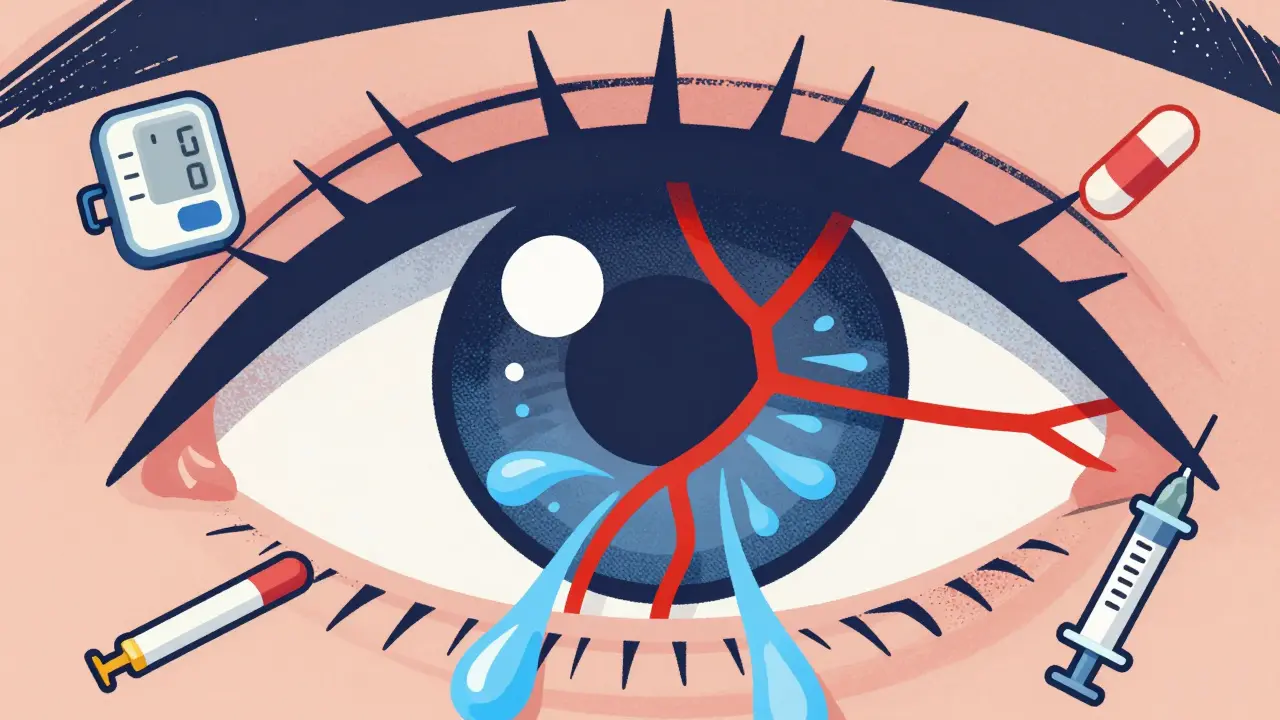
When you wake up one morning and notice your vision is blurry or distorted in one eye - no pain, no redness, just sudden changes - it could be something called retinal vein occlusion (RVO). It’s not rare. Around 16 million people worldwide live with it. And for many, it’s not just a one-time event. It’s a condition that needs ongoing care, especially when complications like swelling in the macula start stealing vision.
What Happens in Retinal Vein Occlusion?
Your retina is like the film in a camera. It catches light and turns it into signals your brain turns into images. Blood flows into the retina through arteries and leaves through veins. When one of those veins gets blocked - usually because a hardened artery presses against it - blood backs up. Fluid leaks into the retina, especially the macula, the part responsible for sharp central vision. That’s what causes blurriness or blind spots. There are two main types:- Branch Retinal Vein Occlusion (BRVO): Affects a smaller vein, usually causing partial vision loss - maybe half your vision goes blurry.
- Central Retinal Vein Occlusion (CRVO): Blocks the main vein. Vision loss is often more severe, sometimes total in that eye.
Neither type is painful. That’s why many people ignore early signs. But the longer you wait, the harder it is to recover vision.
Who’s at Risk?
RVO doesn’t come out of nowhere. It’s tied to underlying health problems. Age is the biggest factor. Over 90% of CRVO cases happen in people over 55. More than half of all cases occur in those over 65. But it’s not just an older person’s disease. About 5-10% of cases affect people under 45.Here’s what increases your risk:
- Hypertension: High blood pressure is the number one risk. Up to 73% of CRVO patients over 50 have it. Even in younger patients, uncontrolled blood pressure triples the risk.
- Diabetes: Around 10% of RVO patients have diabetes. It doesn’t cause the blockage directly, but it makes swelling worse and healing slower.
- High cholesterol: Total cholesterol above 6.5 mmol/L is found in 35% of RVO cases - no matter how old you are.
- Glaucoma: High pressure inside the eye can squeeze the vein at the optic nerve, especially if the optic cup is narrow.
- Smoking: Found in 25-30% of patients. It hardens arteries faster and thickens blood.
- Obesity and inactivity: Both raise inflammation and blood pressure. Losing even 5% of body weight can reduce risk.
- Birth control pills: In women under 45, oral contraceptives are the most common link to CRVO.
- Blood disorders: Conditions like polycythemia vera, multiple myeloma, or inherited clotting disorders (like factor V Leiden) can turn blood into a thicker, stickier fluid.
Many people with RVO have two or more of these. That’s why doctors don’t just treat the eye - they look at your whole health.
How Is It Diagnosed?
It starts with a simple eye exam. But that’s just the beginning. To confirm RVO and plan treatment, you’ll need:- Optical Coherence Tomography (OCT): This scan shows swelling in the macula. If the central subfield thickness is over 300 micrometers, treatment is usually started.
- Fluorescein angiography: A dye is injected into your arm, and photos track how it moves through retinal blood vessels. This shows exactly where the blockage is and if new, leaky blood vessels are forming.
- Eye pressure check: To rule out glaucoma as a contributing factor.
These tests aren’t one-time. You’ll need repeat OCTs every 4-8 weeks during treatment to see if the swelling is going down.

The Role of Injections
There’s no cure for the blocked vein itself. The goal is to stop the damage it causes - mainly fluid buildup in the macula. That’s where injections come in.Two types of injections are used:
Anti-VEGF Injections
VEGF is a protein that makes blood vessels leaky. Anti-VEGF drugs block it. The three main ones are:
- Ranibizumab (Lucentis): Approved specifically for RVO. Clinical trials showed patients gained an average of 16.6 letters on an eye chart after 12 months.
- Aflibercept (Eylea): Works similarly. In the COPERNICUS trial, patients gained 18.3 letters on average.
- Bevacizumab (Avastin): Originally a cancer drug, it’s used off-label. Costs about $50 per dose vs. $2,000 for the others. Used heavily in public clinics.
Treatment usually starts with monthly shots until swelling drops below 250 micrometers. Then, it switches to "as needed" - sometimes every 2 months, sometimes every 4. Real-world data shows patients need 8-12 injections a year to keep vision stable.
Corticosteroid Injections
The dexamethasone implant (Ozurdex) is a tiny, slow-release pellet injected into the eye. It lasts 3-6 months. In the GENEVA study, 27.7% of CRVO patients gained 15 or more letters of vision. But there’s a catch:
- It causes cataracts in 60-70% of people who still have their natural lens.
- It raises eye pressure in about 30% of users, sometimes needing medication.
Because of this, it’s usually reserved for patients who don’t respond to anti-VEGF or can’t handle monthly visits.
What Patients Really Experience
One woman, 62, started monthly Lucentis injections after her CRVO diagnosis. "My vision went from 20/200 to 20/60 by month four," she said. "But $150 per shot? I’m on a fixed income. I skip some."
Another patient tried eight Avastin shots with no improvement. Then she got the Ozurdex implant. "I gained 10 lines of vision. Was it worth $2,500? Yes. I can read my granddaughter’s face again."
But the emotional toll is real. Many describe dread before each injection. "My heart races even though I know it’s quick," said one Reddit user. Others develop "injection fatigue" - missing appointments because the stress is too much.
A 2022 survey of over 1,200 RVO patients found:
- 78% saw significant vision improvement
- 63% struggled with cost
- 41% felt burned out by the treatment schedule
What’s New in Treatment?
Doctors are moving away from "one-size-fits-all" monthly shots. New protocols are being tested:
- Treat-and-extend: Start monthly, then extend intervals if the eye stays dry. The 2023 COMINO study showed this works just as well as monthly shots - with 30% fewer injections.
- Combination therapy: Some experts now use anti-VEGF first, then add steroids if swelling returns. Early results suggest better outcomes for stubborn cases.
- Gene therapy: A drug called RGX-314 is in trials. It’s injected once and makes your eye cells produce their own anti-VEGF protein for years.
- Port Delivery System: A tiny refillable implant (like Susvimo) that releases ranibizumab over months. Already approved for macular degeneration - trials for RVO are underway.
By 2025, biosimilar versions of anti-VEGF drugs will hit the market. That could slash costs by 50-70%.
What You Can Do
If you’ve been diagnosed with RVO:
- Control your blood pressure. Aim for under 130/80.
- Manage cholesterol. Diet, exercise, and statins if needed.
- Quit smoking. Even cutting down helps.
- Get regular eye checks - even if your vision seems fine.
- Ask about your injection plan. Is monthly really necessary? Could treat-and-extend work for you?
- Don’t skip appointments. Vision can drop fast if swelling returns.
If you’re under 45 and have RVO, ask your doctor about blood tests for clotting disorders. That’s not routine - but it should be.
What to Expect Long-Term
With treatment, 30-40% of patients regain vision to 20/40 or better - enough to drive and read normally. But without treatment, many lose vision permanently.
The good news? Treatment works. The bad news? It’s not a quick fix. It’s a marathon. You’ll need to stay engaged, keep appointments, and manage your overall health.
One doctor put it this way: "We’re not just treating an eye. We’re treating your risk for stroke, heart attack, and kidney disease. RVO is a warning sign from your body. Listen to it."
Can retinal vein occlusion be cured?
No, there is no cure for the blocked vein itself. But treatments can stop or reverse the damage it causes - especially swelling in the macula. With timely injections, many people regain usable vision. Without treatment, vision loss is often permanent.
How long do injections last?
Anti-VEGF injections (like Lucentis or Eylea) work for about 4-8 weeks. That’s why they’re given monthly at first. The dexamethasone implant (Ozurdex) lasts 3-6 months. New delivery systems, like the Port Delivery System, aim to extend this to 6 months or longer.
Are injections painful?
Most patients feel only a slight pressure or brief sting. The eye is numbed with drops, and the needle is very thin. The whole process takes 5-7 minutes. The anxiety before the injection is often worse than the procedure itself.
Can I drive after an injection?
You should not drive immediately after. Your pupil will be dilated, and your vision may be blurry for a few hours. Most clinics recommend having someone drive you home. Avoid operating heavy machinery until your vision clears.
What happens if I miss an injection?
Missing doses can lead to fluid building up again. Vision can drop quickly - sometimes within weeks. If you miss one, call your doctor. Don’t wait for your next scheduled appointment. Early intervention can prevent permanent damage.
Is there a cheaper alternative to brand-name injections?
Yes. Bevacizumab (Avastin), originally a cancer drug, is used off-label for RVO. It costs about $50 per dose compared to $2,000 for Lucentis or Eylea. Many safety-net clinics use it. While not FDA-approved for eye use, studies show it’s just as effective. Talk to your doctor about whether it’s right for you.
Can retinal vein occlusion affect both eyes?
It’s rare, but possible. Most cases affect only one eye. However, if you have RVO in one eye, your risk of developing it in the other eye increases - especially if you have uncontrolled diabetes, high blood pressure, or a clotting disorder. Regular eye exams are critical.
Levi Viloria
March 1, 2026 AT 19:54Richard Elric5111
March 2, 2026 AT 06:11Betsy Silverman
March 2, 2026 AT 12:40Ivan Viktor
March 2, 2026 AT 23:14Zacharia Reda
March 3, 2026 AT 12:58Helen Brown
March 5, 2026 AT 01:11John Cyrus
March 6, 2026 AT 16:05marjorie arsenault
March 8, 2026 AT 15:31Deborah Dennis
March 10, 2026 AT 01:24