
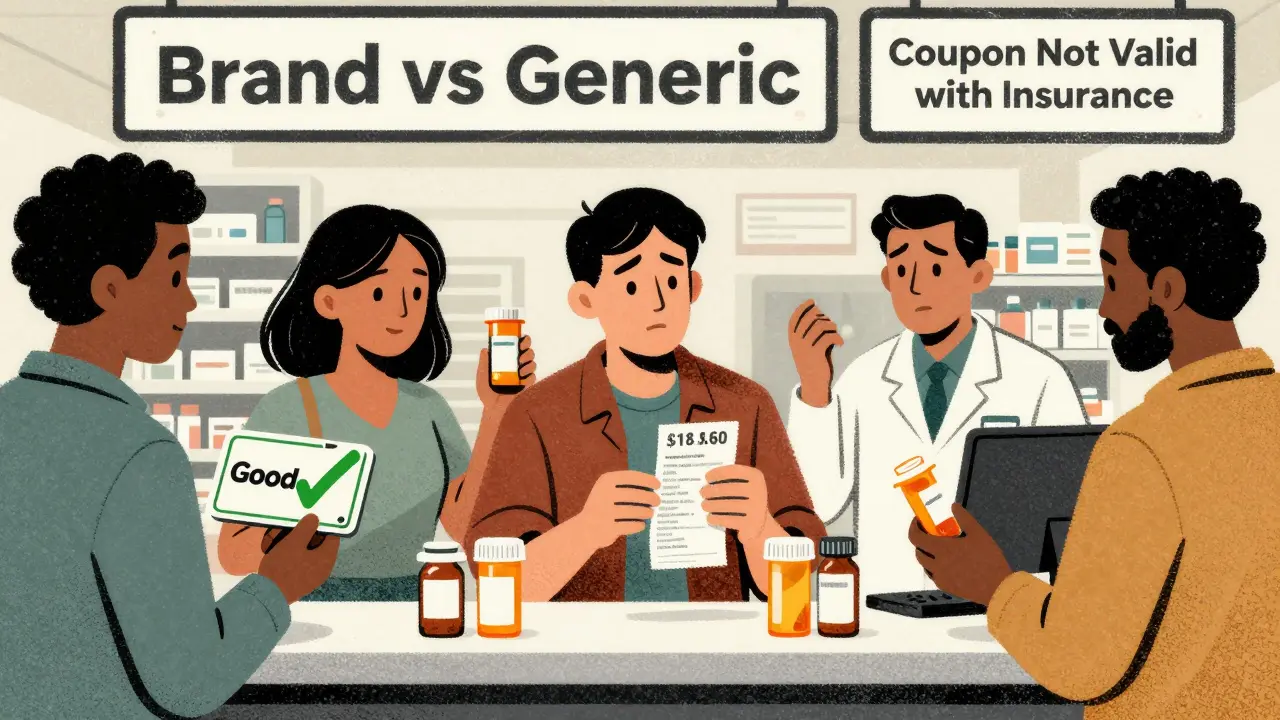
Let’s be real: prescription drugs are expensive. Even if you have insurance, you might still be handed a bill for $80, $150, or more just to fill a basic medication. That’s why millions of people turn to prescription discount programs and coupons. But do they actually work? Or are they just another confusing trick in a broken system?
What Exactly Are These Discount Programs?
There are three main types of prescription savings tools out there. First, there are manufacturer coupons - these come directly from drug companies like Pfizer or Eli Lilly. They’re usually offered for brand-name drugs and work like a rebate: you print it, scan it, or show it on your phone at the pharmacy, and your out-of-pocket cost drops. But here’s the catch: these coupons don’t lower the actual price of the drug. They just shift the cost from you to your insurance or the healthcare system. Then there are third-party discount cards like GoodRx, Blink Health, and SingleCare. These aren’t tied to any one drug maker. Instead, they negotiate bulk prices with pharmacies. You enter your drug name and zip code, and they show you the lowest cash price nearby - often way below what your insurance charges. These are especially useful if you’re uninsured, have a high-deductible plan, or your insurance doesn’t cover the drug at all. Finally, there are prescription assistance programs (PAPs), usually run by nonprofits or clinics. These give free or deeply discounted medications to people who qualify based on income. They’re not for everyone, but for those who qualify, they can be life-changing.How Much Can You Really Save?
The savings vary wildly - and it all depends on what you’re buying and how you’re paying. For generic drugs, third-party cards like GoodRx often deliver huge discounts. One 2022 study found that for a common three-drug generic regimen, cash prices dropped from $52.80 to just $18.60. That’s more than 60% off. People on Reddit have reported saving $47 on a 90-day supply of metformin using GoodRx - even when their insurance copay was higher. But brand-name drugs? Not so much. The same study showed that for a four-drug heart failure regimen, the brand-name version only dropped from $1,300 to $1,212 with a discount card. That’s less than 7% off. Manufacturer coupons for brand-name drugs can help, but they rarely cut costs enough to make a real difference. One user on Reddit spent $1.20 less on Lyrica with a coupon - barely enough to cover the bus fare to the pharmacy. Prescription assistance programs are the real winners when it comes to per-patient savings. A free clinic in Tennessee helped 61 patients get 23 different medications over 13 months. Total savings? Over $222,000. That’s nearly $3,650 per person. That’s not a discount - that’s free medicine.When Do Discount Programs Backfire?
Here’s the dark side: these programs can sometimes make things worse. Manufacturer coupons are designed to keep people on expensive brand-name drugs - even when cheaper, equally effective generics exist. A 2024 study in JAMA Network Open found that when patients use these coupons, they’re 60% more likely to stick with the brand instead of switching to a generic. That’s bad for your wallet, and bad for the system. The Congressional Budget Office estimates this behavior adds $2.7 billion a year to Medicare Part D spending. And it gets trickier with insurance. Some Medicare Part D plans don’t allow you to combine coupons with your coverage. If you use a manufacturer coupon, your copay might not count toward your deductible or out-of-pocket maximum. That means you could end up paying more over the year. Pharmacists often don’t know how these programs work. One in four users report being turned away or confused at the counter. Some pharmacies don’t accept certain cards. Others don’t know how to process them. You might have to call ahead, go to a different location, or wait while they figure it out.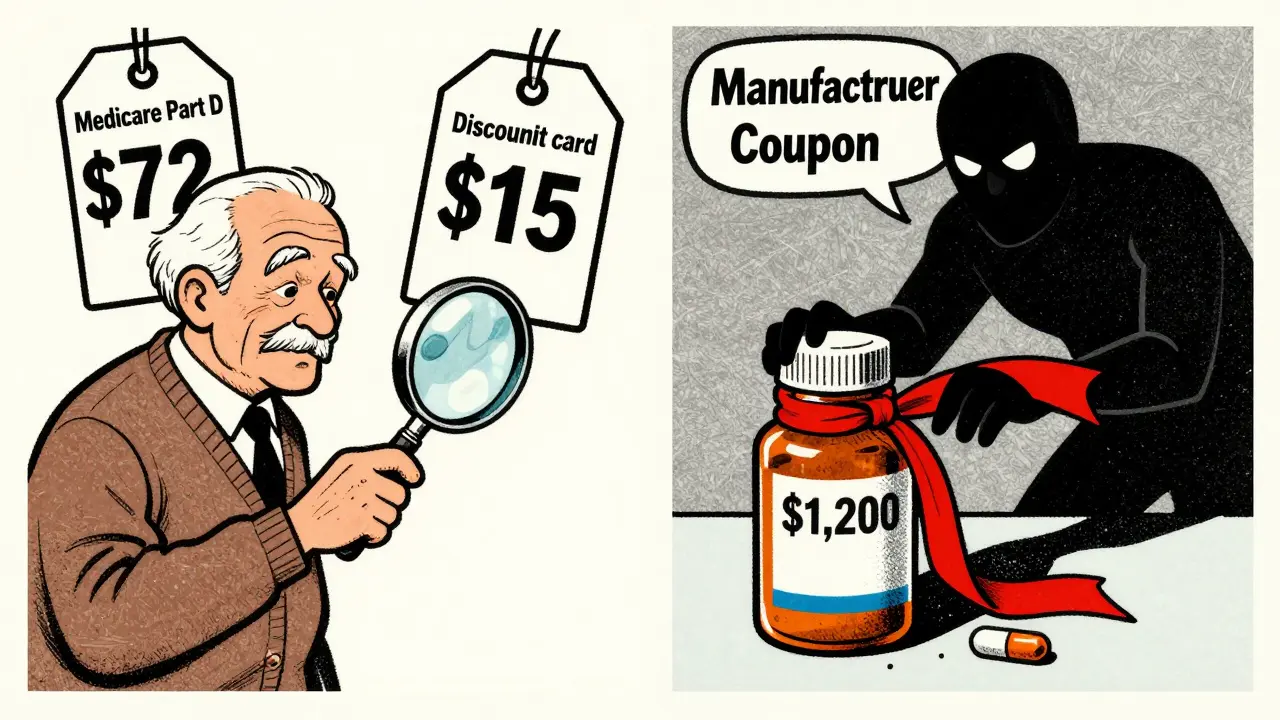
Who Benefits the Most?
Not everyone wins equally. People without insurance get the biggest bang for their buck. For them, discount cards are often the only way to afford meds. A Blue Cross Blue Shield study found that 54% of members who initially skipped filling a prescription because of cost later used a discount card to get it - saving an average of $18.75 per fill. Seniors on Medicare Part D are another big group. Nearly half of them save more than $5 per prescription using discount cards. But here’s the problem: 42% of seniors say they’re confused about whether to use their insurance or the card. The answer? Always compare. Sometimes your insurance is better. Sometimes the card is. You have to check both. If you’re on Medicaid or have a low-income subsidy, you probably don’t need these programs. Your copays are already capped. And if you’re on a generous employer plan, your savings might be minimal.How to Use These Programs the Right Way
Don’t just grab the first coupon you see. Here’s how to do it right:- Check your insurance first. Log into your plan’s website or call your pharmacy. Ask: “What’s my copay for this drug?”
- Compare with GoodRx or SingleCare. Enter your drug name and zip code. Look at the cash price at nearby pharmacies. Don’t just pick the first one - prices vary by location.
- Ask if the coupon counts toward your deductible. Especially if you’re on Medicare Part D. Some coupons don’t count, and that could cost you later.
- For brand-name drugs, check manufacturer coupons. Go to the drug’s official website. Look for “Patient Assistance” or “Savings Card.” Register and print or save the code.
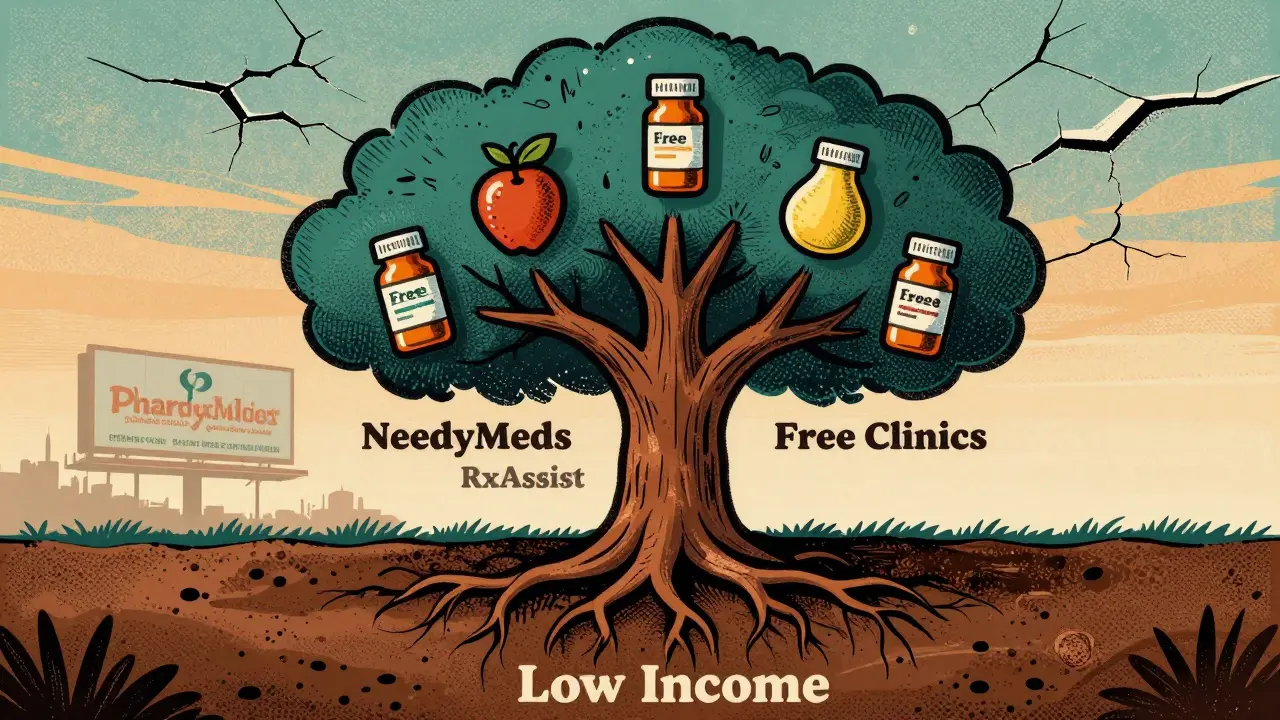
- For high-cost or chronic meds, apply for PAPs. Sites like NeedyMeds and RxAssist list free programs. You’ll need income proof, but if you qualify, it’s free medicine.
The Future: Are These Programs Here to Stay?
The landscape is shifting. The 2024 Inflation Reduction Act caps out-of-pocket drug costs for Medicare beneficiaries at $2,000 a year starting in 2025. That will reduce the need for coupons among seniors. Meanwhile, the FTC is investigating whether manufacturer coupons are anti-competitive. They might be banned or restricted soon. Some pharmacies and insurers are starting to build their own price-comparison tools into apps. Instead of fighting with third-party cards, they’re trying to offer lower prices directly. That’s the future: savings built into the system, not tacked on as a workaround. Right now, discount programs are a patch - not a fix. But for many people, they’re the only thing standing between them and skipping their meds. Used wisely, they can save hundreds, even thousands, a year. Used blindly? You might end up paying more in the long run.Frequently Asked Questions
Do prescription discount cards work with Medicare Part D?
Yes, but only if you’re not using a manufacturer coupon. Third-party discount cards like GoodRx can be used alongside Medicare Part D, but you must choose between your plan’s price and the card’s cash price - you can’t stack them. Always compare both before paying. Some Medicare plans don’t let you use manufacturer coupons at all, so check your plan rules first.
Why is my GoodRx price different from my insurance copay?
Your insurance uses negotiated rates with pharmacies, which are often higher than the cash prices GoodRx negotiates - especially for generics. Sometimes your copay is based on your plan’s deductible or tier system, which can make it more expensive than paying cash. Always compare the two before you pay.
Can I use a manufacturer coupon and a discount card together?
No. Pharmacies can’t process both at the same time. Manufacturer coupons are rebates tied to the drug’s list price, while discount cards offer a pre-negotiated cash price. You have to pick one. For brand-name drugs, the coupon might be better. For generics, the discount card almost always wins.
Are prescription discount programs legal?
Yes, they’re completely legal. Third-party cards like GoodRx are regulated as price comparison tools. Manufacturer coupons are allowed under federal law as long as they don’t target government programs like Medicare or Medicaid. However, the FTC is investigating whether these coupons distort the market - so rules could change.
What if the pharmacy says they don’t accept GoodRx?
Call ahead next time. Some pharmacies, especially smaller ones, don’t participate in discount programs. But most major chains like CVS, Walgreens, and Walmart do. If one location says no, try another nearby. GoodRx shows you multiple pharmacy options - pick the one that accepts it.
Do these programs work for controlled substances like opioids or ADHD meds?
Yes, but with limits. Many discount cards cover controlled substances, but pharmacies may require additional verification. Manufacturer coupons are usually available too. However, some insurance plans have stricter rules for these drugs, so always check your plan’s policy. If you’re struggling to afford them, look into patient assistance programs - many offer free or low-cost versions.
Can I use these programs if I’m uninsured?
Absolutely. In fact, that’s who they’re designed for. If you don’t have insurance, discount cards and PAPs are often your only affordable options. GoodRx, SingleCare, and NeedyMeds all offer free access to low-cost prescriptions for uninsured patients. Many pharmacies also have discount programs for cash-paying customers - ask.
Crystel Ann
January 16, 2026 AT 21:09My dad uses GoodRx for his blood pressure meds and saves about $40 a month. He never even knew his insurance was charging more until he asked the pharmacist to check the cash price. Simple trick, huge difference.
ellen adamina
January 17, 2026 AT 01:54I used to skip my insulin because of the cost then found a PAP through NeedyMeds now I get it free no questions asked life changed
Haley Graves
January 17, 2026 AT 20:19If you’re on Medicare Part D and using a manufacturer coupon, you’re playing a dangerous game. That coupon doesn’t count toward your out-of-pocket max. So you’re paying more now to pay even more later. Always check with your plan before you swipe.
Niki Van den Bossche
January 18, 2026 AT 10:10These discount programs are not salvation-they’re symptoms. The system is a grotesque theater where pharmaceutical corporations stage elaborate rituals of exploitation, and we, the audience, are handed glittering coupons as if they were tickets to redemption. The real tragedy? We applaud the illusion. We call it ‘saving money’ when what we’re really doing is legitimizing a machine that turns human need into profit margin. The coupon is the opiate of the medicated masses.
Frank Geurts
January 19, 2026 AT 00:39It is imperative to note, with the utmost clarity and precision, that the proliferation of third-party discount platforms such as GoodRx represents a profound disruption in the traditional pharmaceutical supply chain. This disruption, while ostensibly beneficial to the consumer, introduces significant regulatory ambiguities and undermines the negotiated contractual frameworks between insurers and pharmacy benefit managers. One must, therefore, exercise extreme diligence when electing to utilize such services, as the long-term consequences for systemic integrity remain profoundly uncertain.
Sohan Jindal
January 20, 2026 AT 01:49Big Pharma is laughing all the way to the bank. They make the drug expensive, then give you a coupon so you think you’re winning. But your insurance pays more later. It’s rigged. And the government lets them do it because they’re paid off.
Jami Reynolds
January 20, 2026 AT 22:13Let me clarify a critical misconception: the notion that GoodRx offers ‘cash prices’ is a deliberate obfuscation. These are not market-driven prices-they are artificially suppressed rates negotiated under opaque contractual agreements with pharmacies, often involving rebates and volume incentives that ultimately inflate the list price for non-discount users. The result? A perverse subsidy system where the uninsured absorb the cost of the insured’s ‘savings.’ This is not a solution-it is a structural distortion masked as consumer empowerment.
Gloria Montero Puertas
January 22, 2026 AT 15:23Anyone who uses a manufacturer coupon without reading the fine print is either naive or willfully ignorant. These coupons are designed to lock you into expensive brand-name drugs-forever. And yes, they’re illegal to use with Medicaid or Medicare, but nobody tells you that. You think you’re saving money? You’re just handing Big Pharma a blank check. And you wonder why your premiums keep rising? It’s because you’re enabling them.
Tom Doan
January 22, 2026 AT 19:04So let me get this straight: the system is so broken that the only way to afford medicine is to play a game of pharmacy roulette with discount cards, while the people who designed the system sit in boardrooms counting their bonuses? Brilliant. Truly. I’m impressed by how elegantly capitalism turns healthcare into a scavenger hunt.
Mike Berrange
January 23, 2026 AT 14:11My pharmacist told me last week that if I use the GoodRx card, they lose money on the transaction. So they ‘forget’ to process it sometimes. I’ve had to go to three different locations just to get my generic lisinopril. It’s not convenience-it’s a minefield.
Arjun Seth
January 25, 2026 AT 10:59People in India pay less than $5 for the same drugs you’re fighting over coupons for. Why? Because your government lets corporations own the law. You think you’re smart using GoodRx? You’re just a pawn. Real change means breaking the monopoly-not hunting for discounts.
RUTH DE OLIVEIRA ALVES
January 26, 2026 AT 21:10It is with profound respect for the complexity of pharmaceutical economics that I offer this observation: while discount programs provide immediate relief to individuals, they do not address the root cause of pharmaceutical pricing inequities. The ethical imperative lies not in navigating the labyrinth of coupons, but in advocating for transparent, publicly regulated pricing structures that ensure access as a fundamental human right-not a privilege contingent upon consumer savvy.