
What is hypoparathyroidism?
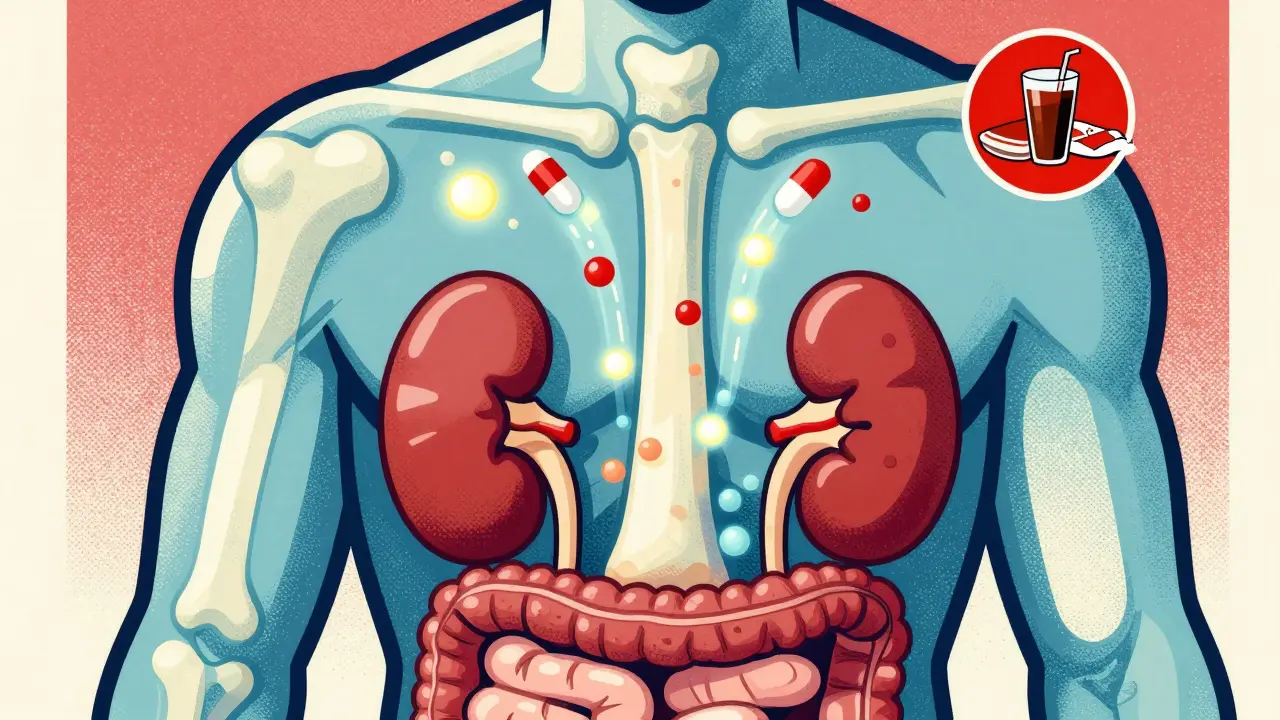
Hypoparathyroidism is a rare endocrine disorder where the parathyroid glands don’t make enough parathyroid hormone (PTH). Without enough PTH, your body can’t regulate calcium and phosphate properly. Blood calcium drops too low (hypocalcemia), and phosphate builds up (hyperphosphatemia). This isn’t just a lab result-it causes real symptoms like tingling in the fingers, muscle cramps, fatigue, and even seizures if left untreated.
Most cases happen after thyroid or neck surgery-about 8 out of 10 people with this condition develop it after removing their thyroid gland. Other causes include autoimmune diseases, genetic conditions like DiGeorge syndrome, or radiation damage to the neck. No matter the cause, the result is the same: your body loses its ability to keep calcium in balance.
Why calcium and vitamin D are critical
PTH normally tells your bones to release calcium, your kidneys to hold onto calcium, and your gut to absorb more from food. When PTH is missing, all three systems fail. That’s why you need to replace what your body can’t make: calcium and active vitamin D.
Regular vitamin D (D3) won’t work here. Your kidneys can’t activate it without PTH. So doctors prescribe calcitriol or alfacalcidol-these are already active forms of vitamin D that bypass the need for PTH. They directly boost calcium absorption from your gut. Dosing usually starts at 0.25 to 0.5 micrograms per day, but it’s adjusted based on blood tests.
Calcium supplements are taken in divided doses-usually 1,000 to 2,000 mg daily, split into two or three doses with meals. Why with food? Because calcium works as a phosphate binder when taken during meals, helping to lower high phosphate levels. Calcium carbonate is preferred because it’s cheaper and packs more elemental calcium (40%) than calcium citrate (21%). That means you take fewer pills to get the same amount of calcium.
Target levels: What your blood tests should show
It’s not about hitting the middle of the normal range. The goal is to keep serum calcium in the lower half of normal: 2.00 to 2.25 mmol/L (or 8.0 to 8.5 mg/dL). Going higher than that increases your risk of kidney stones, calcium deposits in soft tissues like your brain or kidneys, and long-term kidney damage.
One study from the Cleveland Clinic found that patients with calcium levels above 2.35 mmol/L for more than 15 years had nearly three times the risk of calcium buildup in the basal ganglia of the brain. That’s why doctors push for the low end of normal-not because it’s easy, but because it’s safer.
Phosphate levels should stay between 2.5 and 4.5 mg/dL. Too high? That’s a red flag. Magnesium must be above 1.7 mg/dL. Low magnesium makes calcium replacement less effective-even if you’re taking enough calcium and vitamin D, your body won’t respond if magnesium is low.
Monitoring: What tests you need and how often
When you first start treatment, you’ll need blood tests every 1 to 3 months. Once things stabilize, you can cut back to 3 or 4 times a year. But here’s the catch: you can’t just rely on blood calcium alone.
Every time your dose changes, your doctor should check your 24-hour urinary calcium. The target is under 250 mg per day (or 6.25 mmol/day). Exceeding that means you’re at risk for kidney stones or kidney damage. Studies show 35-40% of patients develop high urinary calcium on standard therapy-so skipping this test is dangerous.
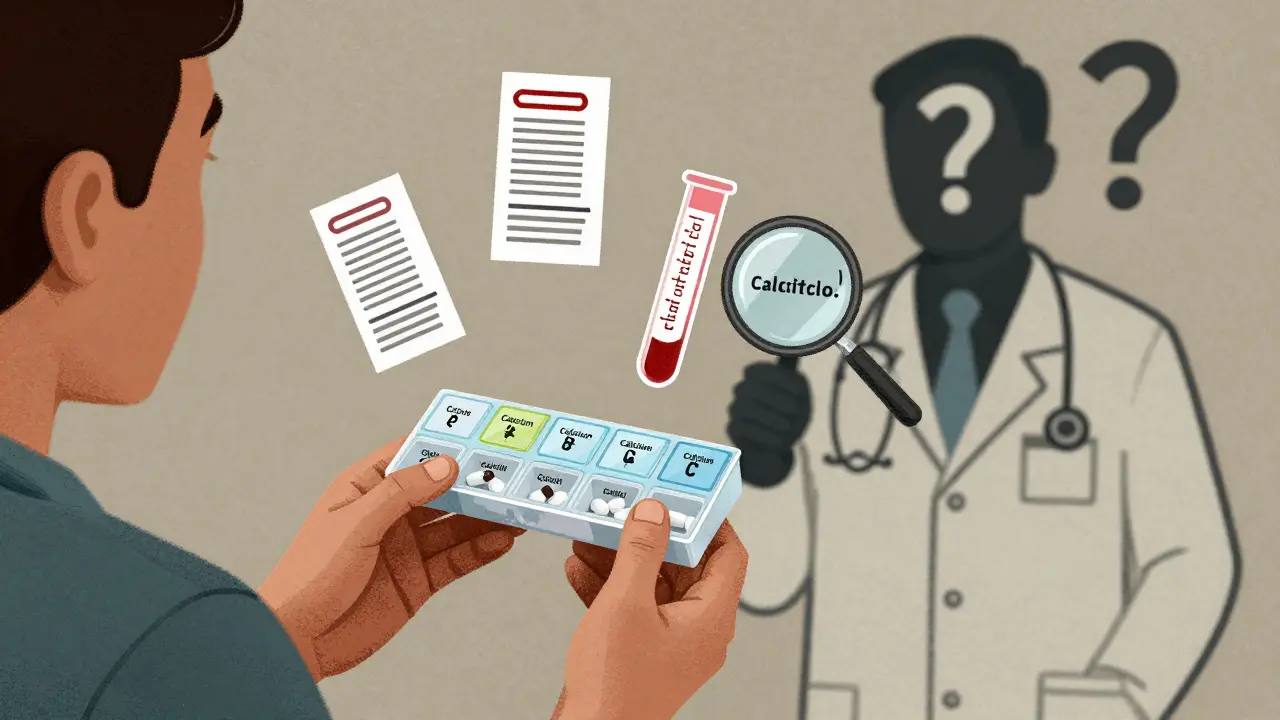
Also check your magnesium and phosphate regularly. If magnesium drops below 1.7 mg/dL, you’ll need a supplement. Magnesium oxide or magnesium citrate at 400-800 mg daily often fixes the problem. Many patients don’t realize their calcium isn’t working because they’re low in magnesium.
Dietary changes that actually help
You can’t just rely on pills. What you eat matters.
Focus on calcium-rich foods: dairy (one cup of milk = 300 mg), kale (100 mg per cup), broccoli (43 mg per cup), and fortified plant milks. These help, but they won’t replace your meds.
Now, avoid high-phosphorus foods. Carbonated drinks? One liter of soda can have 500 mg of phosphoric acid. Processed meats? Each serving adds 150-300 mg. Hard cheese? One ounce has 500 mg. Cut these out. The goal is to keep daily phosphorus under 1,000 mg.
Also limit salt. Too much sodium makes your kidneys dump more calcium into urine. Aim for less than 2,000 mg of sodium per day. That means reading labels and avoiding packaged snacks, canned soups, and fast food.
When standard treatment fails
About 25-30% of people can’t get stable calcium levels with calcium and vitamin D alone. That’s called treatment-resistant hypoparathyroidism. Signs you’re in this group:
- Needing more than 2,000 mg of calcium daily
- Needing more than 2 mcg of calcitriol daily
- Still having high urinary calcium despite max doses
- Constant symptoms like numbness, cramps, or fatigue
If this sounds like you, your doctor might consider recombinant human PTH(1-84) (Natpara) or teriparatide (Forteo). These are daily injections that replace the missing hormone. They reduce calcium and vitamin D needs by 30-40% in most patients.
But there’s a catch. Natpara was pulled from the U.S. market in 2019 due to manufacturing issues and only came back in 2020 with strict safety rules. It costs about $15,000 a month-far more than $100-200 for pills. Insurance approval can take 30-45 days. Many patients wait months to get it.
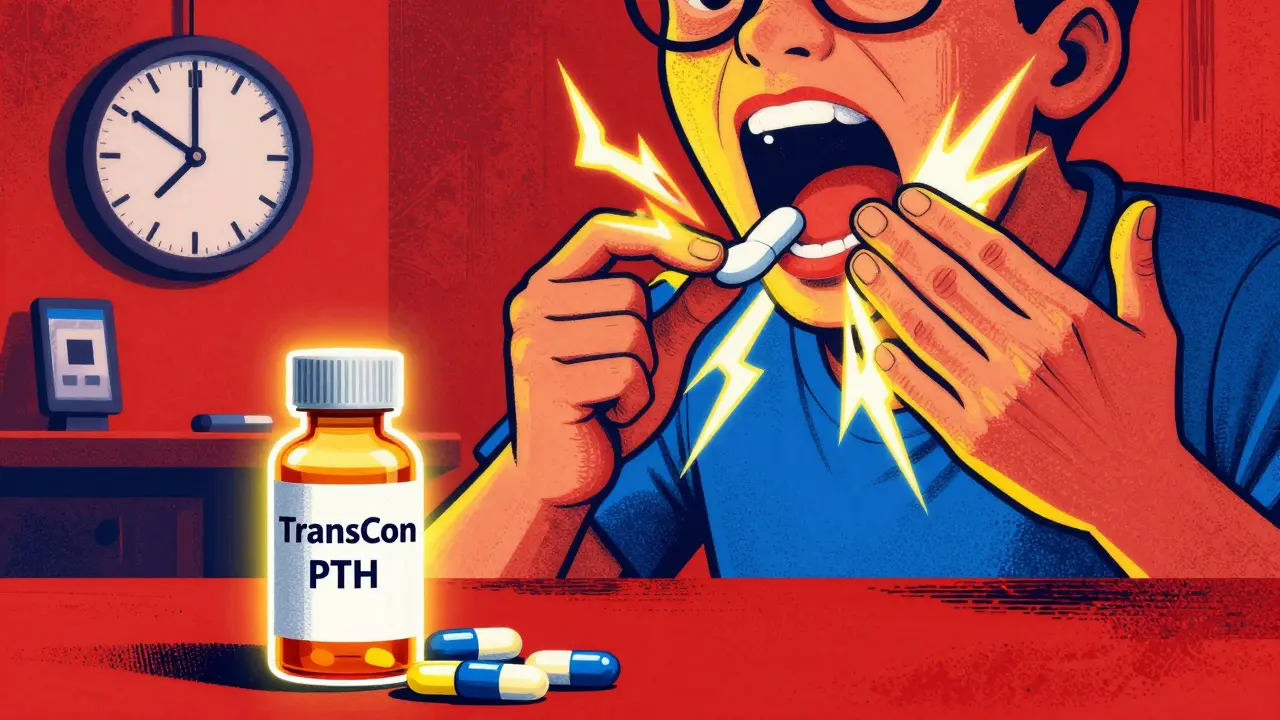
There’s new hope: TransCon PTH, a long-acting version given once daily, showed in a 2022 trial that it normalized calcium in 89% of patients. It’s not yet approved everywhere, but it could be a game-changer if it gets wider access.
Managing side effects and daily life
High-dose calcium causes constipation. Many patients take laxatives just to stay regular. Splitting your calcium into 4 or 5 smaller doses throughout the day helps. One patient in the Hypopara Alliance survey said switching from three big pills to five small ones cut her cramps and bloating in half.
Take vitamin D at bedtime. It absorbs better when your stomach is empty. Calcium with meals. Stick to the schedule. Missing a dose can send your calcium crashing-leading to tingling, anxiety, or even a seizure.
Always carry emergency calcium. Chew 2-3 calcium tablets (500-1,000 mg total) if you feel numbness around your mouth or sudden muscle tightness. Don’t wait. Call your doctor, but act fast.
Many patients describe a "calcium rollercoaster"-levels swing up and down, making them feel great one day and awful the next. Consistency is everything. Use pill organizers. Set phone alarms. Keep a log of symptoms and doses. This isn’t optional-it’s how you stay safe.
Who should manage your care?
Start with an endocrinologist. The first 3 months need close monitoring. After that, if you’re stable, your primary care doctor can handle routine checks-if they know what to look for.
But here’s the problem: 78% of family doctors say they don’t feel trained to manage hypoparathyroidism. That’s why you need to be your own advocate. Bring your lab results. Know your targets. Ask for the 24-hour urine test. If your doctor says "we’ll just check your calcium," push back. That’s not enough.
Support groups like the Hypopara Alliance and Reddit’s r/Hypoparathyroidism (over 1,200 members) are full of people who’ve been there. They share tips on pharmacies, insurance battles, and how to talk to doctors who don’t understand your condition.
Long-term risks you can’t ignore
Living with hypoparathyroidism isn’t just about daily pills. It’s about protecting your kidneys, brain, and heart over decades.
After 10 years on standard therapy, 15-20% of patients develop stage 3 or worse chronic kidney disease. That’s why keeping urinary calcium low matters more than just feeling okay. Calcium deposits in your brain (basal ganglia calcification) can cause movement problems, mood changes, or seizures later in life.
There’s also a small but real risk of heart issues. One study linked daily calcium intake over 2,000 mg to a 20-30% higher risk of heart attacks-though this data comes from healthy people taking supplements, not hypoparathyroid patients. Still, it’s why doctors don’t just crank up the dose when you feel bad. There’s a balance.
Future treatments are coming. Gene therapy targeting the calcium-sensing receptor is in early animal studies. Human trials won’t start before 2026. But for now, the best tool you have is knowledge-knowing your numbers, your limits, and your rights.
What to do next
If you’ve just been diagnosed:
- Get your serum calcium, phosphate, magnesium, and 24-hour urinary calcium tested.
- Start calcium carbonate (1,000-2,000 mg daily, split into doses with meals).
- Begin calcitriol at 0.25 mcg/day-don’t use regular vitamin D3 yet.
- Check your magnesium. If it’s under 1.7 mg/dL, start magnesium oxide 400 mg daily.
- Eliminate soda and processed meats. Eat more leafy greens and dairy.
- Carry emergency calcium tablets.
- Find an endocrinologist who knows hypoparathyroidism. Don’t settle for general advice.
If you’ve been on treatment for years and still feel off:
- Review your last 6 months of lab results. Are you above 2.25 mmol/L? Are you over 250 mg urinary calcium?
- Ask for a referral to a specialist center. You may qualify for PTH replacement.
- Join a patient group. You’re not alone-and others have figured out how to make this work.
This condition doesn’t have a cure. But with the right approach, you can live well. It takes work, patience, and persistence. But it’s possible.
Can I take regular vitamin D (D3) for hypoparathyroidism?
No. Regular vitamin D (cholecalciferol) needs PTH to be activated by your kidneys. Since you don’t make enough PTH, your body can’t convert D3 into its active form. You need calcitriol or alfacalcidol-these are already activated and bypass the need for PTH. Taking D3 alone won’t help your calcium levels.
Why do I need to take calcium with meals?
Calcium acts as a phosphate binder when taken with food. In hypoparathyroidism, phosphate builds up in your blood, which can cause itching, skin problems, and hardening of tissues. Taking calcium with meals helps trap phosphate in your gut so it’s excreted instead of absorbed. It also improves calcium absorption and prevents spikes in blood calcium.
Is it safe to take calcium supplements long-term?
Yes-if you stay within your target range and monitor your urine calcium. The risk isn’t from calcium itself, but from too much of it. Taking more than 2,000 mg elemental calcium daily increases kidney stone risk and may raise cardiovascular risk. The key is to use the lowest effective dose and check your 24-hour urinary calcium regularly. Your doctor should adjust your dose based on urine results, not just blood calcium.
Can hypoparathyroidism be cured?
Currently, no. Most cases are permanent. In rare cases after surgery, the parathyroid glands may recover within months-but this is uncommon. For now, lifelong management with calcium and vitamin D (or PTH replacement) is the standard. Research into gene therapy and long-acting PTH is promising, but human treatments are still years away.
What should I do if I feel numbness or tingling?
Chew 2-3 calcium tablets immediately (500-1,000 mg elemental calcium). This is an emergency. Numbness around the mouth, fingers, or toes is a sign your calcium is dropping dangerously low. Call your doctor after taking the calcium. If symptoms worsen-like muscle spasms or difficulty breathing-go to the ER. Don’t wait.
Why do I need to check my magnesium?
Low magnesium prevents PTH from working properly-even if you’re on replacement therapy. It also makes your cells less responsive to calcium. If your magnesium is below 1.7 mg/dL, your calcium levels won’t stabilize no matter how much you take. That’s why doctors test it regularly and prescribe magnesium supplements if needed. It’s a hidden piece of the puzzle.
Are there any new treatments on the horizon?
Yes. TransCon PTH, a once-daily injection, showed in a 2022 trial that it normalized calcium in 89% of patients-far better than conventional therapy. It’s designed to reduce the number of pills and improve stability. It’s not yet approved everywhere, but if approved, it could become the new standard. Other research is exploring gene therapy to fix the calcium-sensing receptor, but human trials won’t start before 2026.
Janette Martens
December 30, 2025 AT 01:29someone please tell me i'm not the only one who cries in the shower over calcium pills.
Marie-Pierre Gonzalez
December 30, 2025 AT 15:50With sincere respect and unwavering encouragement, I urge you to maintain your regimen, document your symptoms, and advocate fiercely for your health. The path is arduous, but your courage illuminates it for others.
Louis Paré
December 30, 2025 AT 21:10This isn't medicine. This is corporate extortion wrapped in a white coat. The real cure? Stop letting pharma decide how you live. Just say no.
Kelsey Youmans
December 31, 2025 AT 04:37For patients newly diagnosed, I would only add: consistency is not merely helpful-it is foundational. Your body remembers routines. Honor them.
Sydney Lee
January 1, 2026 AT 15:46Also, calcitriol dosing should be titrated by urinary calcium, not blood levels. You’re missing the point entirely. This isn’t diet advice-it’s biochemistry.
Debra Cagwin
January 2, 2026 AT 20:57Now I hike, I cook, I travel. It’s not perfect-but it’s mine. You’ve got this. One pill, one day, one breath at a time.
Hakim Bachiri
January 4, 2026 AT 08:17Also why is everyone so obsessed with urine tests? I'm not a water fountain. Can't we just eyeball it? I mean, if my hands aren't twitching, I'm good right??
Celia McTighe
January 4, 2026 AT 12:58For anyone reading this: if your calcium isn’t working, check your mag. I was at 1.5 for years and thought I was just "bad at meds." Turned out I just needed 600mg of citrate. Life changed. 💪❤️
Ellen-Cathryn Nash
January 6, 2026 AT 01:30You think your brain calcification is just "a little shadow on the scan"? It’s a ticking time bomb. And no one’s talking about the depression that comes from living in a body that refuses to cooperate.
Samantha Hobbs
January 6, 2026 AT 04:35Payton Daily
January 7, 2026 AT 19:21They don’t want you healed. They want you buying calcium carbonate for the next 50 years. Wake up.
oluwarotimi w alaka
January 9, 2026 AT 19:02Ryan Touhill
January 9, 2026 AT 21:31But the insurance battles? The stigma? The way my coworkers say, "Oh, you’re on hormones?" like I’m a villain?
That’s the real cost. Not the price tag. The loneliness.