
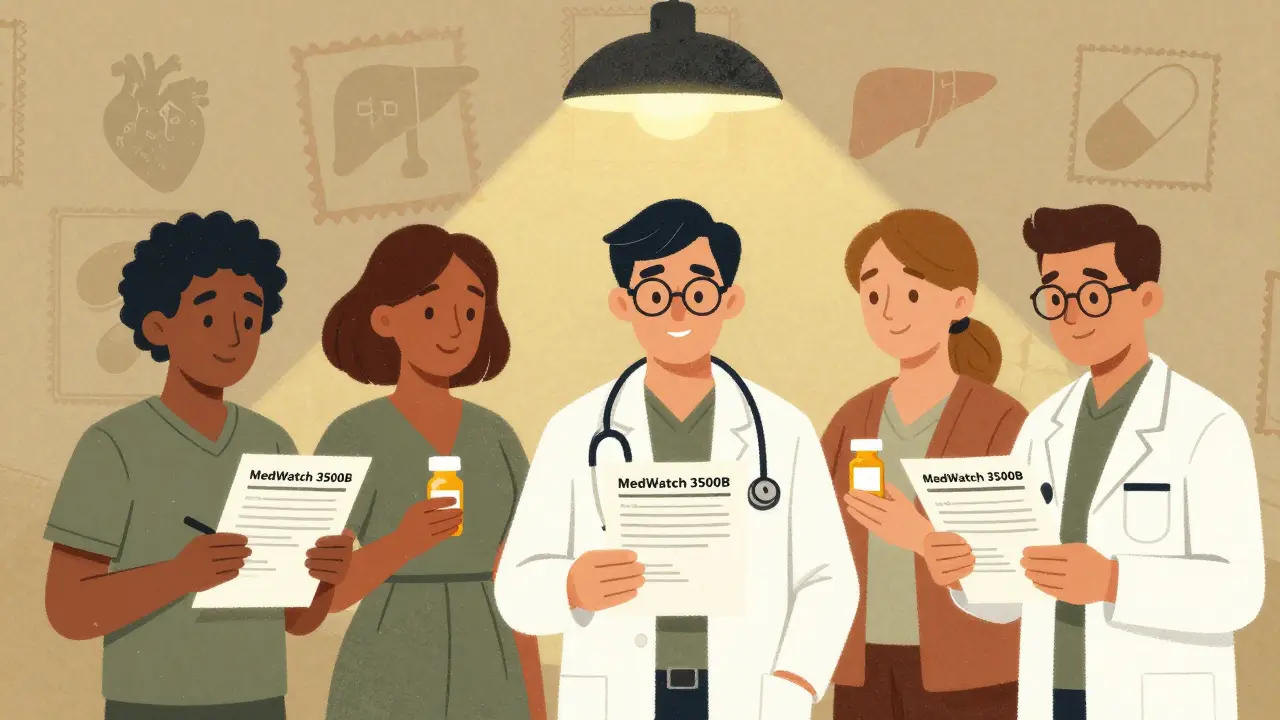
Every year, millions of people take prescription drugs, over-the-counter medicines, and dietary supplements without issue. But for some, a medication causes harm - sometimes serious, sometimes life-threatening. If you’ve experienced an unexpected reaction, you’re not alone. And more importantly, reporting it could help prevent others from going through the same thing.
What Is FDA MedWatch?
MedWatch is the U.S. Food and Drug Administration’s official system for collecting reports about harmful side effects from medications, medical devices, dietary supplements, and even some foods and cosmetics. It’s not a hotline or a complaint portal - it’s a vital safety net. Launched in 1993, MedWatch gathers real-world data that clinical trials simply can’t capture. Those trials involve thousands of people over months or a few years. Real life? Millions of people use drugs for years, sometimes with other conditions or medications mixed in. That’s where MedWatch comes in.The system doesn’t just rely on doctors. Anyone can report: patients, caregivers, pharmacists, nurses, and even family members. Manufacturers are legally required to report serious side effects, but voluntary reports from the public make up a critical 15% of the total. In 2023, MedWatch received over 1.3 million reports. That’s more than 3,500 a day. And while most come from drug companies, the rest? Those are the voices that often catch what the system misses.
What Counts as a Reportable Reaction?
You don’t need to be certain a drug caused the problem. The FDA says: if you suspect it, report it.A serious adverse event includes:
- Death
- Hospitalization (or prolonging an existing hospital stay)
- Disability or permanent damage
- Life-threatening reaction
- Birth defect from a drug taken during pregnancy
- Any reaction not listed in the drug’s official labeling
For example: You take a new blood pressure medication and develop sudden swelling in your throat. You didn’t have allergies before. You didn’t know this was possible. You go to the ER. That’s reportable - even if the doctor says it’s "probably" the drug. You don’t need a diagnosis. You just need to suspect.
Even if the reaction seems minor - like a rash that lasted three weeks after starting a new antibiotic - if it’s unusual for you or not listed as a side effect, it’s worth reporting. These small reports add up. One unusual rash reported by 50 people might reveal a pattern that leads to a label change or warning update.
How to Report: The Three Forms
MedWatch uses three forms, depending on who’s reporting:- FDA Form 3500 - for healthcare professionals (doctors, nurses, pharmacists)
- FDA Form 3500B - for patients and consumers (simple, plain language, available in English and Spanish)
- FDA Form 3500A - for manufacturers, importers, and hospitals (mandatory reporting)
Most people will use Form 3500B. It’s designed to be easy. You don’t need medical training. Just answer the questions as best you can. It takes about 15-20 minutes. You’ll need:
- The name of the drug (brand or generic)
- When you started and stopped taking it
- When the reaction started
- A description of what happened - symptoms, severity, how long it lasted
- Your age and gender
- Any other medications or supplements you were taking
- What you did to treat it (e.g., went to the hospital, took antihistamines)
- Whether you recovered
Don’t worry if you don’t know exact dates or dosages. Estimate. Write "I think it was around 50 mg" or "I started it in early November." The FDA knows patients aren’t pharmacists. They’re looking for patterns, not perfection.
How to Submit Your Report
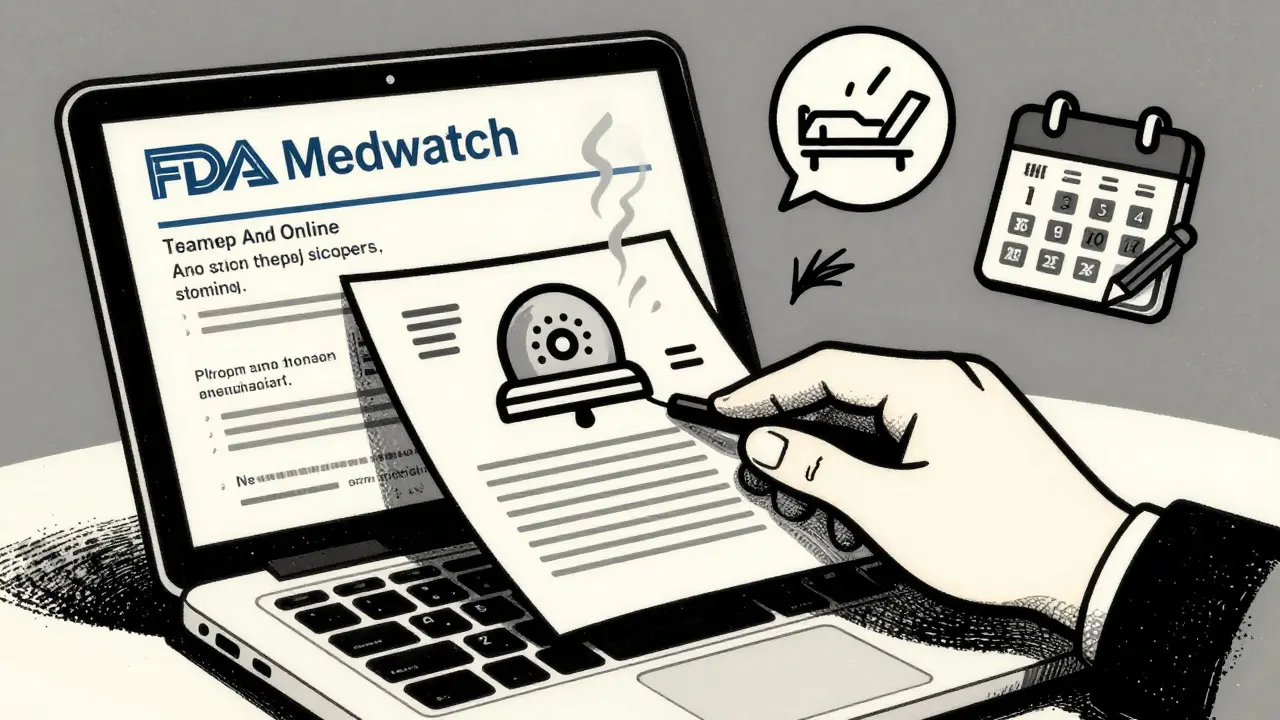
There are three easy ways to submit:- Online - Go to fda.gov/medwatch and click "Report a Problem." Fill out the form directly in your browser. This is the fastest method.
- By phone - Call 1-800-FDA-1088. A representative will guide you through the report over the phone. You can also request a paper form be mailed to you.
- By mail - Download Form 3500B from the website, print it, fill it out, and send it to: MedWatch, FDA, 5600 Fishers Lane, Rockville, MD 20857.
Online reporting is the most common. The system saves your progress if you get interrupted. You’ll get a confirmation number right away. No email? No problem. You don’t need to leave contact info unless you want a follow-up.
What Happens After You Report?
This is the question most people ask: "Will I hear back?"The short answer: probably not.
MedWatch doesn’t send individual responses. That’s because each report goes into a massive database called FAERS (FDA Adverse Event Reporting System). Analysts look for patterns - not single events. If 10 people report the same rare reaction to the same drug, that’s a signal. If 100 do? The FDA may launch a formal safety review. That could lead to a warning label change, a restricted use notice, or even a drug recall.
But here’s the catch: 87% of healthcare professionals say they’ve never received any feedback on their reports. That’s frustrating. But the system isn’t designed for individual replies. It’s designed for population-level safety.
Think of it like a smoke alarm. You don’t get a thank-you note when it goes off. But you’re glad it’s there when the fire starts.
Why Most People Don’t Report - And Why You Should Anyway
A 2023 survey of 1,200 U.S. physicians found that 68% rarely or never report adverse events. Why? Time. Uncertainty. Belief that "it’s not that big of a deal."But studies show only 1% to 10% of serious adverse events are ever reported. That means for every one report the FDA gets, 9 to 99 go unreported. That’s a massive blind spot.
Here’s what you’re really doing when you report:
- You’re helping the FDA spot a hidden danger before it hurts more people.
- You’re helping doctors know what to watch for in their patients.
- You’re helping drugmakers improve labeling so future users get better warnings.
- You’re helping regulators decide if a drug should be pulled from the market.
One real example: In the early 2000s, reports of severe liver damage from a popular herbal weight-loss supplement started trickling in. No one thought much of it - until dozens of reports piled up. The FDA pulled it from shelves. That wouldn’t have happened without patients speaking up.

What You Can’t Do With MedWatch
It’s important to know what MedWatch isn’t:- It’s not a way to get compensation or file a lawsuit.
- It’s not a substitute for calling your doctor if you’re having a medical emergency.
- It’s not a way to get your drug replaced or refunded.
- It’s not a system that tells you if a drug is "safe" - it only flags problems after they happen.
MedWatch doesn’t replace clinical care. But it does make the system safer for everyone after the fact.
What’s New in 2026?
The FDA is trying to fix the underreporting problem. In 2023, they launched "MedWatch Plus," a program aimed at making reporting faster and easier. By 2025, they plan to integrate reporting directly into electronic health records. That means when a doctor sees a patient with a new side effect, the system could auto-generate a MedWatch form - with just one click.They’re also using AI to scan reports for patterns faster. In 2023, the system processed 1.3 million reports manually. By 2027, that number could hit 1.8 million. Without better tools, the system would drown.
But tech alone won’t fix it. People still have to report.
Final Thought: Your Report Matters
You might think: "One report won’t make a difference." But what if your report was the 57th one that caught a dangerous pattern? What if your story helped change the warning label on a drug your sister is about to take? What if your report helped a doctor avoid prescribing that same drug to a teenager with a history of heart problems?MedWatch doesn’t work without you. It’s not glamorous. It’s not fast. But it’s essential. And it only works if people like you - patients, caregivers, pharmacists - take five minutes to speak up.
Don’t wait for someone else to report it. If you’ve had a reaction - even if you’re not sure - report it. It’s simple. It’s free. And it might save someone’s life.
Astha Jain
January 19, 2026 AT 11:54so u report some rash n then what? they just sit on it like a pile of old newspapers? i mean seriously, why even bother if no one ever responds?
Jacob Hill
January 20, 2026 AT 13:25I’ve submitted three reports over the past five years-two for unusual rashes, one for a severe GI reaction-and while I never heard back, I know my data contributed to the FDA’s analysis of that generic antihistamine that later got a black-box warning. It’s not about personal validation; it’s about collective safety. Every report matters, even if it feels invisible.
Jackson Doughart
January 21, 2026 AT 03:02There is a quiet dignity in reporting, even when no one acknowledges it. It is not an act of expectation, but of responsibility. We do not report to be thanked; we report because someone else’s child, parent, or friend may one day be spared the same suffering. That is the unspoken contract between patient and public health.
Phil Hillson
January 22, 2026 AT 13:24lol this whole medwatch thing is such a joke. they get over a million reports a year and do NOTHING with most of them. doctors are lazy, the system is broken, and now they want us to spend 20 minutes filling out forms? please. if they cared, they’d auto-populate this from EHRs. they’re just collecting data to look like they’re doing something
Josh Kenna
January 23, 2026 AT 18:00Yeah but honestly I did report my son’s anaphylaxis to that new ADHD med and the next month the label got updated with a bold warning. I didn’t get a thank you email but I got peace of mind knowing I helped stop another kid from almost dying. So yeah, I’ll keep reporting. Even if the system’s slow, it’s better than silence.
Erwin Kodiat
January 24, 2026 AT 08:07As someone who grew up in a country where reporting side effects was unheard of, seeing this system exist here still feels like magic. In my home country, people just stop taking meds and suffer in silence. Here, even if you’re just one voice, you’re part of a network that listens. That’s worth five minutes.
Lydia H.
January 25, 2026 AT 16:19I think the real beauty of MedWatch is that it doesn’t ask you to be a scientist. It asks you to be human. You felt something strange after taking a pill? Tell them. You don’t need to understand pharmacokinetics. You just need to trust your body enough to speak up. That’s radical, actually.
Valerie DeLoach
January 26, 2026 AT 15:18It’s important to note that MedWatch reports are anonymized and aggregated-this isn’t about blaming individuals or corporations. It’s about recognizing that drugs are tested in controlled environments, but used in messy, real lives. Your experience, however small, becomes part of a larger truth that clinical trials can’t capture. That’s not just valuable-it’s essential.
Christi Steinbeck
January 26, 2026 AT 22:28Stop waiting for applause. Start reporting because it’s the right thing to do. One person’s rash could be the clue that saves a thousand lives. The system isn’t perfect-but it’s the only one we’ve got. And it only works if we use it. So go. Click. Submit. You’ve got nothing to lose and everything to gain.
Aman Kumar
January 27, 2026 AT 04:56The entire MedWatch framework is a classic example of institutional performative compliance. The FDA collects data under the guise of public safety while simultaneously failing to implement meaningful feedback loops, predictive analytics, or real-time monitoring. The reliance on voluntary patient reporting-without standardized triage protocols or AI-driven prioritization-is statistically indefensible. One must question the epistemic legitimacy of a system that treats anecdotal data as if it were evidence without structural validation. This is not public health; it’s data hoarding dressed as civic duty.
Lewis Yeaple
January 28, 2026 AT 23:38It should be noted that the FDA's MedWatch program is governed under 21 CFR Part 310 and 21 CFR Part 803, with mandatory reporting obligations for manufacturers under the Medical Device Reporting (MDR) regulations. The voluntary nature of consumer submissions does not diminish their evidentiary weight in FAERS, as they are subject to signal detection algorithms including proportional reporting ratios (PRRs) and Bayesian confidence propagation neural networks (BCPNN). The absence of individual feedback is by design, as the system is optimized for population-level pharmacovigilance, not patient-centric communication. Therefore, to criticize the lack of response is to misunderstand the fundamental architecture of post-marketing surveillance.