
| Metric | Value |
|---|---|
| Initial Denial Rate | ~6% of requests |
| Appeal Rate (How many people try) | ~11% of denials |
| Success Rate (Reversal after appeal) | ~82% to 83.2% |
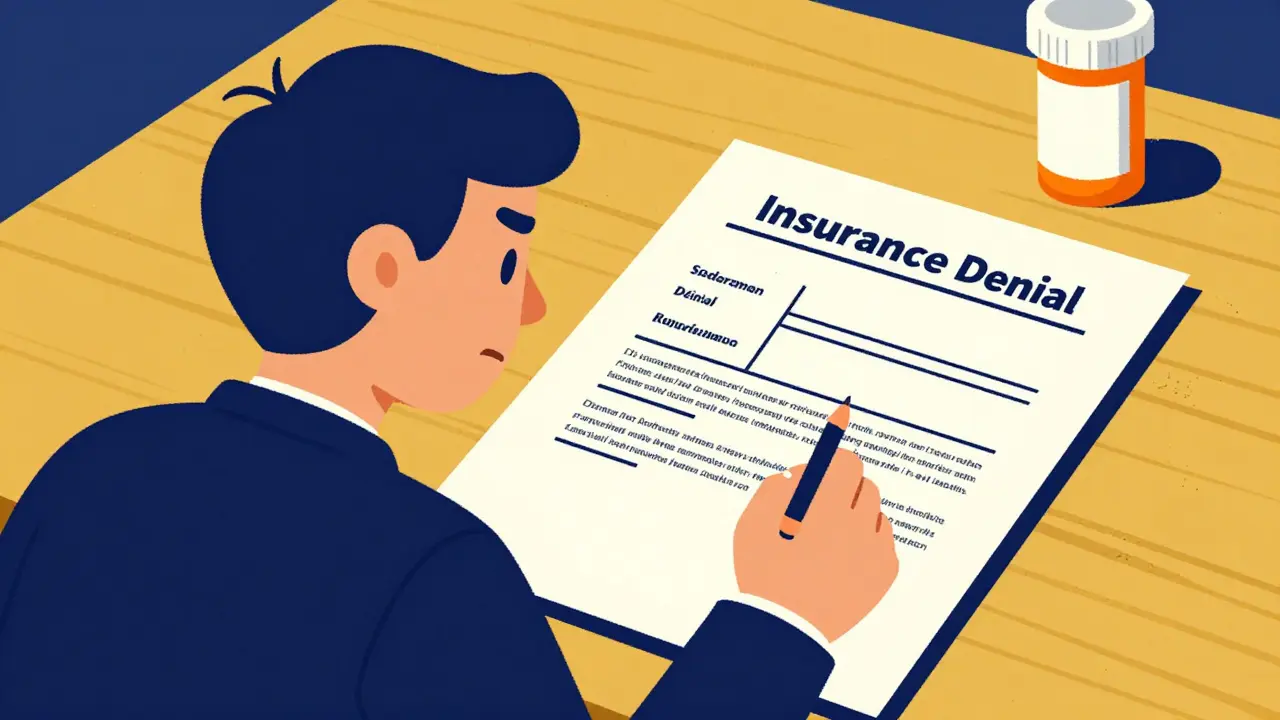
Decode Your Denial Letter
Before you call your doctor or write a letter, you need to understand why the insurance company said no. You can't fight a battle if you don't know what the argument is. Most denials fall into three buckets: incomplete documentation (which happens in about 37% of cases), a lack of proven medical necessity (the most common at 48%), or the service simply not being covered by your plan (15%).
Look for a document called an Explanation of Benefits (EOB). If you don't have a formal written denial, you can't start the process. Some self-insured employer plans are notoriously slow with these, so you may need to call your HR department or the insurer directly to get it. Pay close attention to the specific prior authorization denial reason and any referenced codes. If the letter mentions specific CPT Codes (Current Procedural Terminology), make sure you note them down. Failing to address these specific codes is one of the fastest ways to get a second denial.
Gather Your Evidence
Insurance companies don't want stories; they want data. To win, you need a paper trail that proves the medication is the only viable option for your health. Start by collecting your medical records, recent test results, and clinical notes from your last few visits.
One of the most effective pieces of evidence is a "fail list." This is a detailed timeline of other medications you've tried that didn't work. For example, if you're appealing for a high-cost biologic like Humira, your evidence should show exactly which cheaper alternatives you tried, how long you took them, and why they failed (e.g., "Patient developed a rash after 2 weeks" or "No reduction in joint swelling after 3 months"). A simple two-page timeline of these failures can often flip a denial in a matter of days.
You'll also need specific identifiers. If you're dealing with a provider like CVS/Caremark, they explicitly require your full name, ID number, date of birth, the exact drug name, and clear clinical info from your doctor. Without these, your appeal might be tossed out for administrative errors before a human even reviews the medical side.

Draft a Precise Appeal Letter
Your appeal letter should be direct and clinical. Avoid emotional pleas and focus on the insurer's own coverage criteria. If the insurer's handbook says a drug is covered for "severe chronic plaque psoriasis," your letter should use those exact words and provide the clinical data that proves you meet that definition.
Structure your letter like this:
- The Request: Clearly state you are appealing the denial for [Medication Name].
- Patient History: Include your diagnosis, using ICD-10 Codes (the international standard for diagnosis codes) if possible.
- Treatment Failure: List the medications you already tried and why they didn't work.
- The Clinical Justification: Explain why this specific drug is medically necessary right now.
If you have a specialist, get them involved. Specialist-led appeals have a 32% higher success rate because they can speak the insurer's language. Ask your doctor to write a "Letter of Medical Necessity" that explicitly addresses the reason for the initial denial. When the doctor's rationale aligns perfectly with the insurer's criteria, success rates can jump over 85%.
Navigating the Submission Maze
Every insurance company has a different way of wanting to receive appeals. Some, like UnitedHealthcare, lean heavily on online portals, while others, such as CVS/Caremark, may still require faxes. If you send your appeal to the wrong place, it simply disappears into a void.
Here is a general checklist for submission:
- Confirm the submission method (Portal vs. Fax vs. Mail).
- Verify the deadline. Most insurers require submission within 180 days of the denial.
- Send the package. If using a portal, take a screenshot of the confirmation page. If faxing, keep the transmission receipt.
- Log the date and time of submission.
For those with self-insured employer plans, ERISA (the Employee Retirement Income Security Act) generally requires plans to respond within 60 days. However, most standard reviews take about 30 days. Don't just wait for the mail; follow up. About 78% of physicians report that multiple follow-up calls are necessary to keep an appeal from stalling.

What to Do When the First Appeal Fails
If your internal appeal is denied, you still have options. You can request an external review, where an independent third party looks at your case. Under Healthcare.gov guidelines, you typically have up to 365 days to request this, though some state-specific rules can shorten that window to 60 or 180 days.
Additionally, if you are on a Medicare Advantage plan, you may find the process slightly smoother. These plans recently faced mandates to respond to authorization requests within 72 hours, and they generally show higher appeal success rates than standard commercial plans. If you're feeling overwhelmed, contact the insurer's "provider relations" department; they are often more helpful than the general customer service line and can resolve submission issues for about 76% of patients.
How long does it take to get a decision on a medication appeal?
Most insurance companies take about 30 days to review an appeal. However, if you have a self-insured plan governed by ERISA, they may take up to 60 days. If your health is in immediate danger, your doctor can request an "expedited appeal," which usually forces a decision within 72 hours.
Can I appeal a denial if my doctor says the drug is necessary?
Yes, and you should. In fact, a doctor's support is the most critical part of the process. Over 80% of appeals are overturned when the provider provides strong clinical evidence and a clear rationale showing that other treatments have failed.
What is a "fail first" or "step therapy" requirement?
Step therapy is when an insurer requires you to try a cheaper or more common medication before they will cover a more expensive one. If you've already tried those drugs and they didn't work, documenting those failures in your appeal is the fastest way to bypass this requirement.
Do I need to know medical codes to appeal?
While you don't need to be an expert, including ICD-10 (diagnosis) and CPT (procedure) codes in your appeal significantly increases your chances. Roughly 89% of successful appeals include these specific codes because they remove ambiguity for the insurance reviewer.
What happens if my external review is also denied?
Once an external review is denied, you have exhausted the formal appeal process. At that point, you might look into patient assistance programs (PAPs) offered by the drug manufacturer or search for coupons through pharmaceutical discount platforms to lower the out-of-pocket cost.
Next Steps for Success
If you're just starting this process, don't try to do it all in one hour. Expect to spend about 6 to 8 hours gathering documents, drafting letters, and making phone calls. Start by calling your doctor's office today and ask for the "clinical notes" from your last three visits.
If you're a caregiver or a patient with a chronic condition, create a simple tracking log. Record every person you speak to, the date, and the reference number for the call. Since nearly 44% of appeals are resubmitted due to processing errors, having a detailed log is your only way to prove that you sent the documents and the insurer lost them.
Tokunbo Elegbe
April 19, 2026 AT 21:25This is such a vital resource!!! Many people don't realize how much of a difference a well-documented appeal makes... thank you for breaking this down!!!
Wendy Ajurín
April 20, 2026 AT 06:51The emphasis on the "fail list" is absolutely critical. In my professional experience, providing a chronological history of unsuccessful treatments is the most efficient way to satisfy the medical necessity criteria for most major insurers. It removes the subjectivity from the reviewer's decision process.
Arthur Luke
April 20, 2026 AT 17:03I've always wondered why the success rate for appeals is so high compared to the number of people who actually try. It's wild that most people just give up after the first no.
Shalika Jain
April 22, 2026 AT 05:46Please, spare me the optimism. The system is designed to make you exhausted so you just pay the retail price or suffer in silence. Thinking a few CPT codes will magically make a corporate giant care about your health is just precious.
Olushola Adedoyin
April 23, 2026 AT 11:00It's all a game!! They want you to jump through these hoops to see who's desperate enough to just give up. The insurance companies are probably paying the doctors to make this hard. Total scam to keep the money in their own pockets!!
Aman Tomar
April 23, 2026 AT 23:22My heart goes out to everyone dealin with this. It is truly a tragdy when healh is held hostage by paperwork. I have seen so many peopel suffer because they didnt know how to fight back against these huge la компаnies. The struggle is real and it is heartbreakingly unfair.
Brigid Prosser
April 24, 2026 AT 04:50Get your ducks in a row and don't take no for an answer. If the insurance rep is giving you the runaround, ask for a supervisor immediately. These companies bet on your laziness and your fear; don't let them win. Just keep hammering away until they cave.
Charlotte Boychuk
April 25, 2026 AT 21:55This is a total lifesaver! I've been staring at a denial letter for three days feeling completely defeated, but this guide makes it feel like a puzzle I can actually solve. I'm going to gather my evidence and give them a run for their money with some colorful clinical data!
Don Drapper
April 26, 2026 AT 14:02The sheer inefficiency of the American healthcare administrative apparatus is a testament to systemic failure. It is an absolute travesty that a patient must essentially act as a paralegal and a medical coder simply to access prescribed medication. This is an abhorrent state of affairs that borders on the theatrical in its absurdity. One must wonder if the insurers employ these obstacles specifically to trigger a psychological collapse in the applicant. The bureaucracy is not a glitch; it is the intended feature of a predatory capitalist machine. We are witnessing the commodification of survival where the price of entry is a flawless 800-word essay submitted via a 1980s fax machine. Truly, it is a dystopian nightmare masquerading as 'managed care'. I find the suggestion that a 'tracking log' is the solution to be quaintly naive when the adversary possesses infinite resources and zero empathy. The disparity in power is not just skewed; it is a vertical cliff. To suggest that a few phone calls to 'provider relations' will resolve the structural rot of the industry is an insult to the intelligence of anyone with a basic understanding of corporate greed. It is a farce. An utter, glittering farce.
anne camba
April 26, 2026 AT 14:38The irony is thick... the system demands a level of precision that it refuses to provide itself...