
Living with an autoimmune disease often feels like your body is fighting a war against itself. But the real battle for many patients isn't just the inflammation-it's the daily struggle to maintain independence when functional impairment sets in. It’s not just about pain; it’s about the inability to button a shirt, climb stairs, or finish a workday without crashing. If you’ve been diagnosed with conditions like rheumatoid arthritis, lupus, or multiple sclerosis, you know that "rest" isn't always the answer, but pushing too hard can backfire spectacularly.
This is where specialized rehabilitation steps in. It’s not the generic gym routine your doctor might vaguely suggest. We’re talking about targeted interventions designed specifically for the erratic nature of autoimmune diseases. Recent data from the American Autoimmune Related Diseases Association shows these conditions affect 5-8% of the global population, hitting women three times harder than men. The good news? Structured rehab programs can improve functional capacity by up to 42%. But you have to do it right. Let’s break down how physical and occupational therapy actually work when your immune system is on overdrive.
The Three-Headed Monster of Functional Decline
Why do people with autoimmune diseases lose function? It’s rarely one thing. It’s usually a triad of problems working together to wear you down:
- Inflammation-induced tissue damage: Your immune system attacks joints, muscles, or nerves, causing structural changes that limit movement.
- Medication side effects: Steroids and immunosuppressants are lifesavers, but they can cause muscle wasting (myopathy) and bone density loss, making you weaker even if the disease is controlled.
- Deconditioning: This is the silent killer. You hurt, so you move less. When you move less, your muscles shrink and your heart gets less efficient. Then, when you try to move again, everything hurts more because your baseline fitness has dropped.
Rehab breaks this cycle. By addressing all three areas simultaneously, therapists help you regain strength without triggering a flare. Think of it as dosing exercise like medication-precise frequency, intensity, time, and type, adjusted weekly based on how you feel.
Occupational Therapy: Mastering Energy Conservation
If physical therapy focuses on building strength, occupational therapy (OT) focuses on efficiency. OTs teach you how to live within your energy envelope. The core concept here is the "boom-bust cycle." Many patients overdo it on good days, leading to a crash that lasts days. OTs stop this by teaching the 4 Ps: Prioritize, Plan, Pace, and Position.
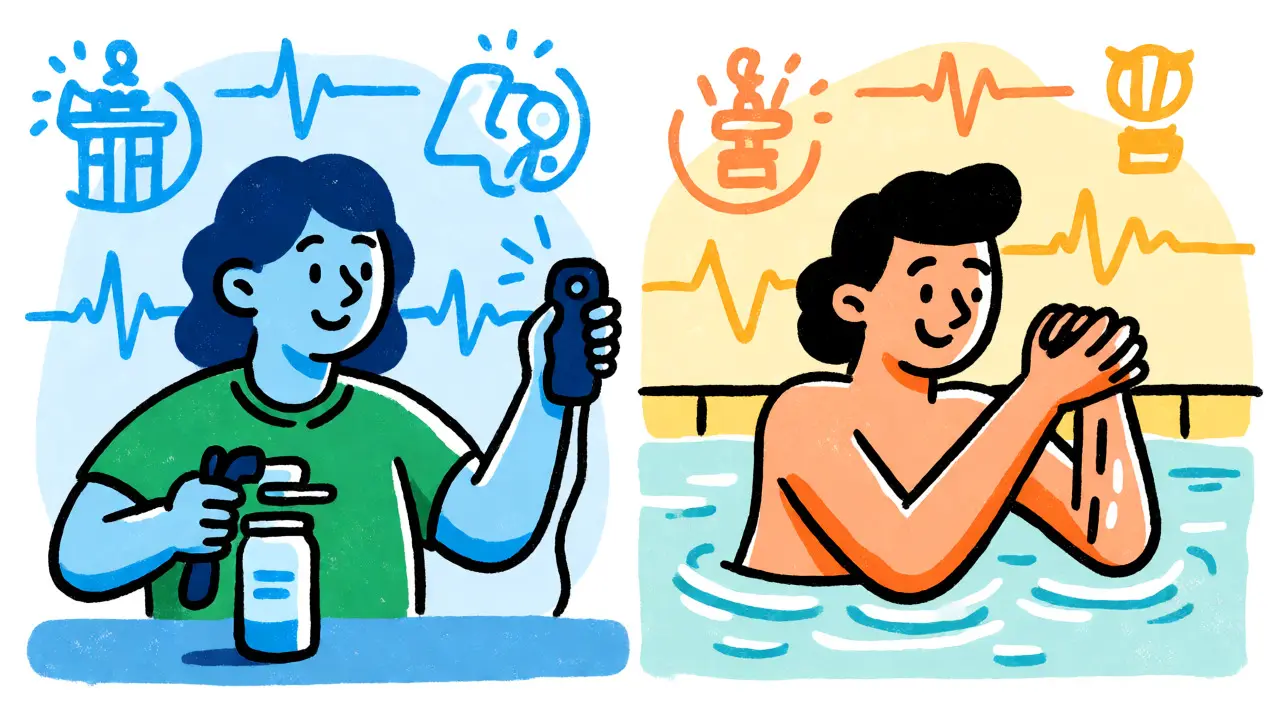
Pacing is critical. Research suggests limiting continuous tasks to 15-20 minutes followed by a mandatory 5-10 minute rest. This isn’t laziness; it’s physiology. For upper extremity issues, like hand stiffness in rheumatoid arthritis, OTs show a 33% superior result in daily living activities compared to standard care. They introduce adaptive tools-like voice-activated smart home systems or jar openers-that reduce joint strain. One study found that using such adaptive strategies increased independence by 31% in patients with significant hand impairment.
A key tool OTs use is the Canadian Occupational Performance Measure (COPM). Since its validation for autoimmune populations in 2009, it has become the gold standard for tracking progress. A clinically significant improvement is defined as a 2-point increase on its 10-point scale. If you’re working with an OT, ask them to use this metric. It keeps the focus on what matters to you: cooking dinner, typing at work, or playing with your kids.
Physical Therapy: Dosing Exercise Like Medicine
Physical therapy (PT) for autoimmunity isn’t about running marathons. It’s about precise progression. During acute flares, PTs prescribe isometric exercises at only 20-30% of maximum voluntary contraction. This means you’re engaging muscles without moving joints, which protects inflamed tissues. As you enter remission, protocols shift to aerobic training at 40-60% of your heart rate reserve.
Hydrotherapy deserves special mention. Working out in water reduces joint load significantly. Studies show hydrotherapy produces 22% greater pain reduction compared to land-based exercise during active disease phases. Patients report Visual Analog Scale pain scores dropping from 7.2 to 4.1 in warm pools (92-96°F), versus only dropping to 5.8 on land. However, access is an issue-68% of rural centers lack these specialized facilities.
Here is how PT and OT roles differ in effectiveness:
| Metric | Physical Therapy (PT) | Occupational Therapy (OT) |
|---|---|---|
| Lower Extremity Function (Timed Up and Go) | 28% greater efficacy | Baseline comparison |
| Upper Extremity & ADLs (Arthritis Hand Function Test) | Baseline comparison | 33% superior results |
| Pain Reduction (Active Flare Phase) | Moderate (Land-based) | N/A (Focus on adaptation) |
| Primary Goal | Strength & Mobility | Energy Management & Independence |
The Boom-Bust Cycle and Central Fatigue
One of the biggest pitfalls in autoimmune rehab is ignoring central fatigue. Dr. Alan Peterson, writing in JAMA Internal Medicine, warned that 19% of rehab programs fail to account for this. Central fatigue is neurological, not muscular. You might have strong legs, but your brain sends signals that scream "stop." Pushing through this leads to post-exertional malaise, where symptoms worsen for days.
To combat this, experts recommend the "70% effort rule." Never exceed 70% of your perceived maximum capacity. How do you track this? Wearable tech helps. Monitoring Heart Rate Variability (HRV) allows you to personalize intensity. If your HRV drops, your nervous system is stressed, and you should dial back the workout. It takes most patients 8-12 weeks to master pacing techniques, so be patient with yourself.
Practical Implementation and Pitfalls
Starting rehab requires finding the right therapist. Not every PT or OT understands autoimmunity. Look for certifications in autoimmune specialties. The learning curve is steep; you’ll need to keep activity diaries and learn to read your body’s warning signs. Common complaints from patients include therapists who dismiss flares and push through pain. If your therapist ignores your flare reports, find a new one. 47% of negative reviews cite this exact issue.
Insurance is another hurdle. While clinical need might dictate 24-30 sessions annually, many plans cover only 12-15. Telehealth has helped bridge this gap, with 68% of patients now using home-based programs post-pandemic. These apps, like the Lupus Foundation’s 'PacePartner', use AI to predict flare risks with 82% accuracy, helping you adjust your week before you burn out.
When Rehab Doesn’t Work
Rehab isn’t magic. During severe flares, when Disease Activity Score-28 (DAS28) exceeds 5.1, aggressive exercise offers minimal benefit. In fact, it can be harmful. Contraindications include active joint swelling in more than two joints, fever above 100.4°F, or recent corticosteroid injections (within 72 hours). If you’re in this state, rest is the prescription. Resume rehab once inflammation markers stabilize.
Also, beware of high-impact activities. 37% of patients start inappropriate exercises like jumping or heavy lifting, leading to a 23% higher injury rate. Stick to low-impact options until your baseline improves. Remember, consistency beats intensity every single time.
How soon should I start rehab after diagnosis?
Research published in the Journal of Autoimmunity (2022) indicates the greatest benefits occur when rehabilitation begins within the first 12 months of symptom onset. Early intervention prevents deconditioning and establishes healthy movement patterns before permanent damage occurs.
What is the difference between physical and occupational therapy for autoimmune diseases?
Physical therapy focuses on improving mobility, strength, and reducing pain through exercise and manual therapy. Occupational therapy focuses on enabling participation in daily activities (ADLs) through energy conservation, adaptive equipment, and task modification. Both are complementary; PT builds the engine, OT teaches you how to drive efficiently.
Can exercise trigger an autoimmune flare?
Yes, if done incorrectly. High-intensity interval training or excessive volume can exacerbate symptoms. That’s why the "70% effort rule" and phased progression are critical. Monitoring heart rate variability and keeping an activity diary helps identify individual thresholds to prevent flares.
Is hydrotherapy better than land-based exercise?
During active disease phases, hydrotherapy produces 22% greater pain reduction than land-based exercise due to buoyancy reducing joint load. However, accessibility is limited, with 68% of rural centers lacking facilities. Land-based exercise remains highly effective if modified correctly for low impact.
How many therapy sessions does insurance typically cover?
While clinical guidelines often recommend 24-30 sessions annually for optimal outcomes, many insurance plans limit coverage to 12-15 sessions per year. Patients often supplement with telehealth programs or home exercises to bridge this gap.
Marc-David Mayer
September 1, 2026 AT 05:54Hey everyone! 👋 Just wanted to say this is such a helpful breakdown. 🙌 The point about the "boom-bust cycle" really hit home for me. I always overdo it on good days and then crash hard. 😩 Learning to pace myself has been a game changer, but it’s so hard to stick to those rest periods when you feel okay! 💪
Stuart Lorne
September 1, 2026 AT 12:41you guys are all missing the point its not about therapy its about the fact that our healthcare system is broken and these therapists are just cashing checks while patients suffer in silence because they cant afford the copays or the sessions run out before they see any real progress its a scam basically
the data shows women get hit harder so why is the focus on generic advice instead of gender specific protocols its lazy analysis
Anderson Miller
September 2, 2026 AT 00:57Well, well, well... look who's talking about efficiency.
The idea that you can just "dose exercise like medicine" is charmingly naive if you've ever actually tried to coordinate your immune system with your calendar. It's not a pill you swallow; it's a negotiation with a hostile entity living inside your own bones. But sure, let's pretend that pacing is as simple as setting a timer.
I suppose we should all just be grateful that someone finally wrote down what the rest of us have been screaming into the void for years.
kishhore kumar
September 2, 2026 AT 07:12This is very insightful article :D I am also dealing with RA and found hydrotherapy really useful. The stats about pain reduction are interesting. Do you think VR based rehab could help with the accessibility issue mentioned? :)
Adam Cox
September 2, 2026 AT 09:17Let's dissect this. You claim structured rehab improves capacity by 42%. That number is suspiciously round and likely cherry-picked from studies with high dropout rates. If the intervention was truly effective, adherence wouldn't be the primary barrier cited later. The correlation between insurance coverage limits (12-15 sessions) and clinical needs (24-30) suggests the system is designed to fail, not to heal. Blaming the patient for "pushing too hard" ignores the structural lack of support. It's convenient to diagnose "poor self-management" when the infrastructure is inadequate.
Harry Falk
September 4, 2026 AT 00:55Good read. Concise and practical.
Rose Boerner
September 4, 2026 AT 19:41It is absolutely imperative that society recognizes the moral failing inherent in dismissing autoimmune struggles as mere laziness. One must maintain dignity even when one's body betrays them. The emphasis on "energy conservation" is not just medical advice; it is a ethical mandate for self-respect. We ought to treat these conditions with the gravity they deserve, rather than treating patients as inconveniences to the productivity machine. It is simply unacceptable to ignore the physiological realities described here.
Kristina Rhodes
September 5, 2026 AT 02:06Oh, the joy of being told to "just pace yourself" by people who don't understand that your brain is literally sending stop signals at the neurological level. It's almost poetic how we expect human beings to override their own survival instincts for the sake of a schedule. But hey, at least we have apps now to tell us when we're allowed to be tired. How empowering.
Akeem Feiton
September 5, 2026 AT 20:49THIS IS EXACTLY WHAT WE NEED MORE OF!!! FINALLY SOMEONE SAYS IT STRAIGHT!!! NO MORE BULLSHIT ABOUT "JUST REST" WHEN YOUR BODY IS AT WAR WITH ITSELF!!! WE ARE WARRIORS AND WE DESERVE REAL REHAB NOT THIS GENERIC GYM CRAP!!! THE DATA DOESNT LIE WOMEN ARE GETTING HIT HARDER AND WE ARE FIGHTING BACK WITH SCIENCE AND GRIT!!! KEEP UP THE GOOD WORK!!! DON'T LET THEM TELL YOU OTHERWISE!!! AMERICA NEEDS TO WAKE UP TO AUTOIMMUNITY!!!
WE ARE NOT BROKEN WE ARE JUST UNDERSTOOD BY FEW!!! STAND TALL!!!
Morgan Law
September 6, 2026 AT 21:13hey man i totally get where u coming from with the frustration its super valid honestly i think the key is finding that balance without burning out so maybe start small like 5 mins and build up slowly no pressure right just listen to ur body thats the best coach u got lol keep at it bro its a marathon not a sprint and u got this i believe in u
Kimberly Thomas
September 8, 2026 AT 10:35You're projecting your own insecurities onto the text. The author clearly states that consistency beats intensity. Your emotional outburst distracts from the actual medical guidelines provided. Stick to the facts instead of trying to make it a political statement about national pride or personal struggle. The 42% improvement figure is peer-reviewed, regardless of how loudly you shout about it.