
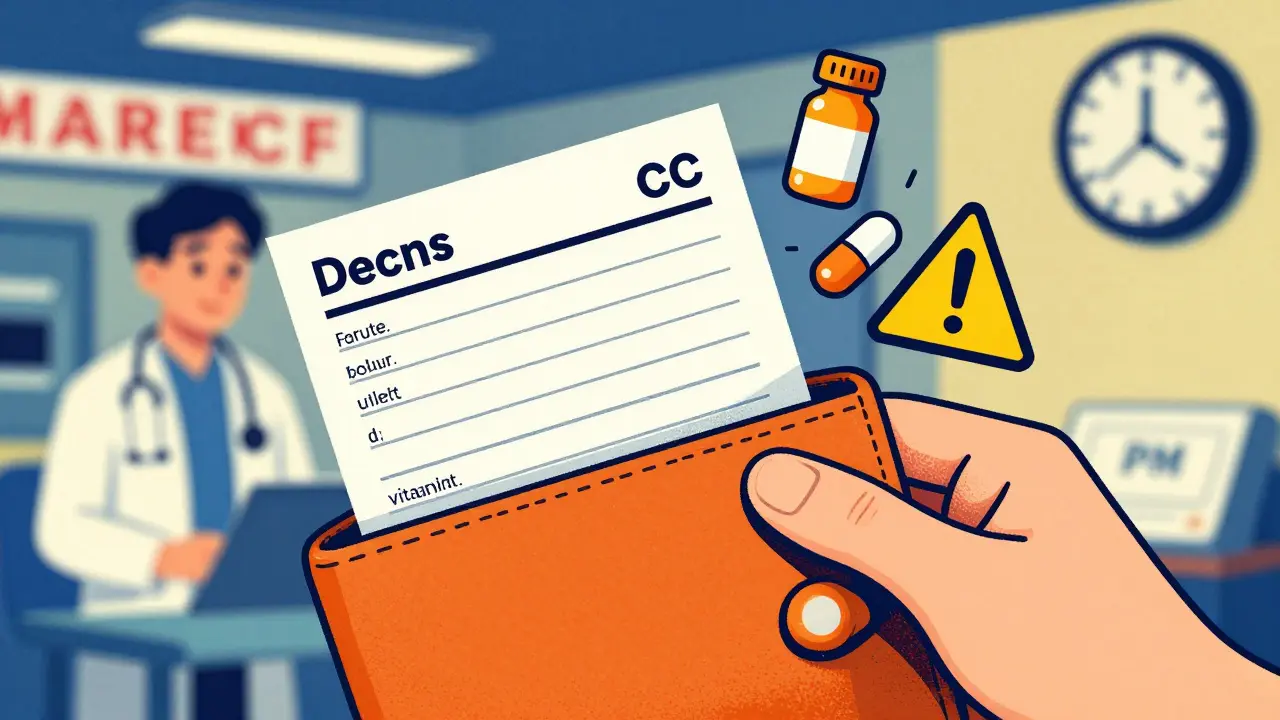
Medication List Builder
Add Your Medications
Generated Medication List
Your list will appear here after adding medications
Every year, over 1.5 million people in the U.S. end up in the emergency room because of medication mistakes. Many of these cases happen because doctors and pharmacists don’t know exactly what someone is taking. It’s not always about forgetting a pill-it’s about not knowing that the person is also taking garlic supplements, ibuprofen for back pain, or a sleep aid from the drugstore. These hidden medications can mix dangerously with prescriptions. The solution? A simple, updated medication list that you carry with you everywhere.
Why Your Medication List Matters
A personal medication list isn’t just a helpful reminder. It’s a safety tool. When you’re rushed in an emergency, or seeing a new doctor, the first thing they need to know is what’s in your system. Without accurate information, they might prescribe something that causes a bad reaction, or miss a drug interaction that could land you in the hospital. The Agency for Healthcare Research and Quality found that nearly half of all medication errors during hospital transfers happen because the patient’s list was wrong or incomplete. That’s not a small risk. It’s a major one. And it’s preventable.What to Put on Your Medication List
Your list needs to be complete. Not just the big prescriptions. Everything. Here’s exactly what to include:- Brand and generic names - Write both. For example: Lipitor (atorvastatin). Some pharmacies use generic names; some doctors use brand names. You need both to avoid confusion.
- Dosage and strength - Not just “take one pill.” Write: 10 mg once daily. If you take different doses on different days, note that too.
- Why you take it - Is this for high blood pressure? Arthritis? Anxiety? Write it down. This helps your doctor spot unnecessary duplicates or drugs that no longer make sense.
- When and how to take it - Morning? With food? At bedtime? On an empty stomach? Include timing and instructions like “take with 8 oz of water” or “avoid alcohol.”
- Over-the-counter (OTC) medicines - This is where most people fail. Tylenol, ibuprofen, antacids, cold pills-these all count. Dr. Sarah Ahmed, a geriatric pharmacist, says 30% of unexpected drug reactions happen because OTC meds were left off the list.
- Vitamins and supplements - Fish oil, vitamin D, magnesium, herbal teas, turmeric capsules. Even “natural” products can interfere with prescriptions. For example, St. John’s Wort can make blood thinners and birth control pills less effective.
- Allergies and bad reactions - Not just rashes. If you’ve ever had nausea, dizziness, swelling, or trouble breathing after a drug, write it down. Include the drug name and what happened.
- Physical description of pills - If you take multiple pills that look alike, note their color, shape, and markings. Example: “Small white oval pill with ‘10’ on one side.” This helps if you lose your bottle or need to identify a pill in an emergency.
Where to Keep Your List
A list that’s locked in a drawer won’t help you in an ambulance. You need it accessible.- Carry a printed copy - Keep it in your wallet, purse, or phone case. Fold it small. Laminate it if you can.
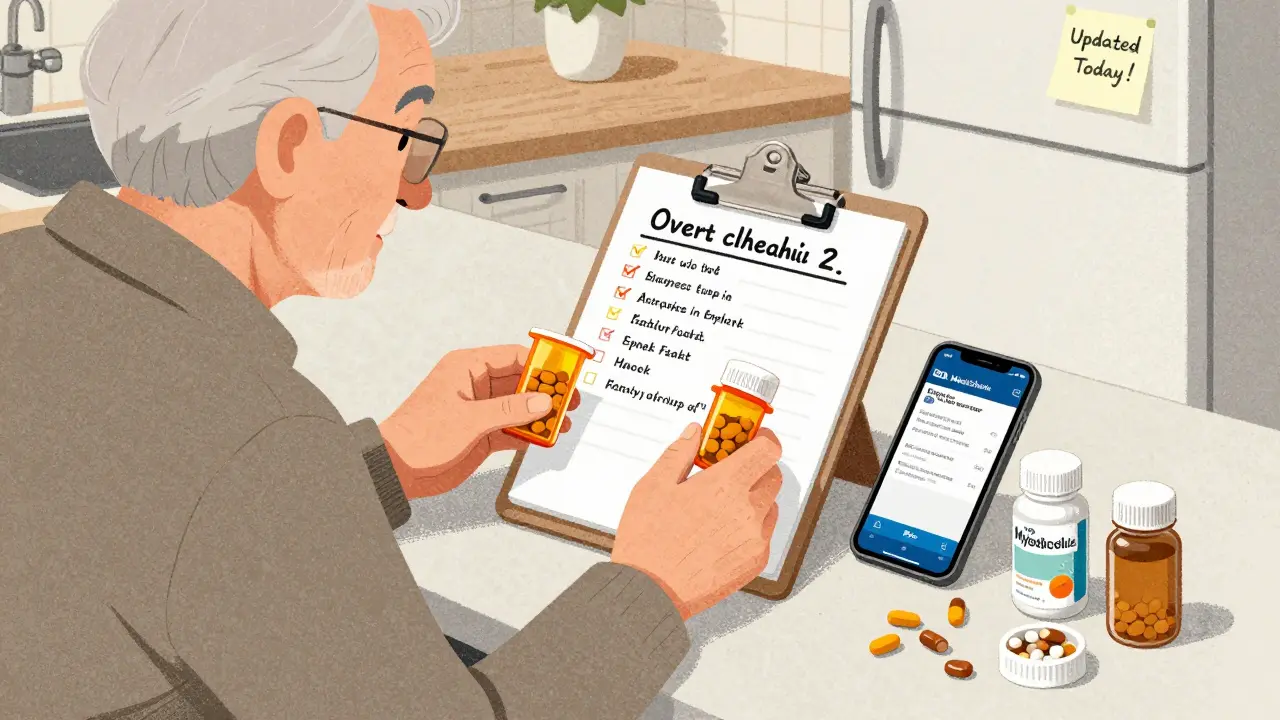
- Use a digital app - The FDA’s MyMedSchedule app (updated in 2024) lets you take a photo of your pill bottle and auto-fills the details with 92% accuracy. Other apps like Medisafe and MyTherapy also let you set reminders and share lists with family or doctors.
- Update it immediately - If your doctor adds, stops, or changes a dose, update your list that same day. AHRQ found that 35% of errors come from outdated lists. Don’t wait until your next appointment.
- Use one pharmacy - CVS, Walgreens, or your local pharmacy can track all your prescriptions in one place. Patients who stick with one pharmacy have 37% fewer drug interactions, according to CVS Health data from 2023.
- Share it with everyone - Not just your primary doctor. Give copies to your dentist, physical therapist, chiropractor, and even your caregiver. They all need to know what you’re taking.
Special Considerations for Older Adults
If you’re 65 or older, you’re more likely to take five or more medications. The CDC says 40% of adults in this group do. That increases your risk of falls, confusion, and dangerous interactions. Medications that affect your brain-like sleep aids, painkillers, antidepressants, and anxiety drugs-can raise your chance of falling by 50%. A simple list helps your doctor spot these risks and adjust your treatment before it’s too late. Many older adults also take supplements. AARP’s 2023 survey found that 74% of adults over 65 keep a medication list-higher than any other age group. That’s because Medicare encourages medication reviews, and seniors know how important it is.What Not to Do
Avoid these common mistakes:- Don’t rely on memory. Even if you think you remember everything, your brain will forget details under stress.
- Don’t ignore empty pill bottles. If you stopped a drug, throw the bottle away. Keep the list updated instead.
- Don’t assume your doctor knows. They don’t. Even if you’ve been with them for years, they might not have your full list in their system.
- Don’t wait for a crisis. Update your list before you need it. Prevention beats emergency response every time.

How to Make It Stick
Making a list is easy. Keeping it updated is the hard part. Here’s how to make it part of your routine:- Set a monthly reminder - Put it on your phone calendar. Every first of the month, check your list against your pill bottles.
- Use a pill organizer - Compartmentalized weekly or daily organizers help you see what you’ve taken and what’s missing. Walgreens’ 2022 study showed a 45% improvement in correct dosing when people used these alongside lists.
- Write notes on the bottle - If you’re taking a pill for joint pain, write “for knees” on the bottle. This prevents accidental refills for the wrong reason.
- Ask for help - If you’re overwhelmed, ask a family member or caregiver to help update the list. Many caregivers say this simple task gives them peace of mind.
The Bigger Picture
Your medication list isn’t just for you. It’s part of a larger system designed to protect patients. The FDA’s Sentinel Initiative now uses patient-submitted lists to detect drug safety issues faster. Hospitals are required by the Joint Commission to reconcile your list when you’re admitted. That means your list directly impacts how safely you’re treated. And it’s working. Studies show that when patients keep accurate lists, medication errors drop by 27% during hospital stays. That’s thousands of preventable problems every year. In 2024, the American Medical Association started pushing for standardized medication list formats across all U.S. health systems. That means one day, your list might automatically sync with your doctor’s electronic record. But until then, you’re the one holding the key.Do I need to include vitamins and supplements on my medication list?
Yes. Vitamins, herbal supplements, and over-the-counter products like fish oil, melatonin, or turmeric can interact with prescription drugs. For example, vitamin K can reduce the effect of blood thinners like warfarin. St. John’s Wort can make birth control pills, antidepressants, and even some cancer drugs less effective. These are not harmless-they’re active substances. Always include them.
What if I can’t read the label on my pill bottle?
Take a photo of the bottle with your phone. Use the FDA’s MyMedSchedule app, which can recognize pills from images with 92% accuracy. Or take the bottle to your pharmacist-they can tell you the name, strength, and purpose. Never guess. A wrong assumption can lead to a dangerous mistake.
Should I keep my medication list on my phone?
Yes, but don’t rely on it alone. Phones can die, get lost, or be locked. Always carry a printed copy too. Use your phone for updates and reminders, but keep a paper version in your wallet or purse. Many emergency responders ask for a physical list first.
How often should I update my medication list?
Immediately after any change. If your doctor adds, removes, or changes the dose of a medication, update your list that day. Don’t wait. The Agency for Healthcare Research and Quality found that 35% of medication errors come from outdated lists. Treat your list like your wallet-update it every time something changes.
Can I use my pharmacy’s app instead of making my own list?
Pharmacy apps show your prescriptions, but they often miss OTC drugs, supplements, and past medications. You still need your own list to include everything. Think of your pharmacy’s app as a tool to help you build your list-not replace it. Always cross-check what’s in your pharmacy’s system with what you’re actually taking.
What if I forget to bring my list to the doctor?
Don’t panic. Ask the doctor to help you make one right then. Bring your pill bottles with you. Even if your list isn’t perfect, having the actual bottles gives your doctor the exact names, strengths, and labels. It’s better than nothing. But make it a habit-bringing your list should be as routine as bringing your ID or insurance card.
Lauren Wall
January 21, 2026 AT 01:17Just carry a laminated card in your wallet. Done. No apps, no fuss. If you can't manage that, maybe you shouldn't be managing your own meds.
Kenji Gaerlan
January 21, 2026 AT 08:50bro why do i need a whole list? i just remember what i take. also why does it matter if i take melatonin? its just a chill pill lmao
Oren Prettyman
January 21, 2026 AT 14:02While the intention behind this article is undoubtedly commendable, one cannot help but observe the profound epistemological limitations inherent in relying on a static, manually maintained document as the primary vector for pharmacological safety in an increasingly dynamic and algorithmically mediated healthcare ecosystem. The very premise presupposes a Cartesian separation between patient and system, a dichotomy that fails to account for the distributed cognition now embedded within electronic health records, AI-driven drug interaction engines, and real-time pharmacy dispensing analytics. A laminated card, however well-intentioned, is a pre-digital anachronism.
Tatiana Bandurina
January 22, 2026 AT 13:50Interesting how they never mention that most doctors don’t even look at these lists. I’ve seen patients hand them over and the doctor just nods and throws it in the trash. This whole thing is performative safety. It makes the patient feel in control while the system remains just as broken.
Philip House
January 24, 2026 AT 13:45Let’s be real. The U.S. healthcare system is a dumpster fire. You’re telling me the solution to 1.5 million ER visits is... a piece of paper? What about universal healthcare? What about regulating supplement labels? What about forcing pharmacies to auto-sync with EHRs? No. We need to fix the system, not make patients carry more paperwork. This is victim-blaming dressed up as advice.
Akriti Jain
January 26, 2026 AT 12:10They don't want you to know this, but the FDA and Big Pharma actually WANT you to mix meds wrong. It's why they push so many pills and why supplements aren't regulated. The more you get sick, the more you buy. Your 'med list' is just a distraction so you don't ask why your doctor keeps prescribing you 7 new drugs every visit 🤫💊
Mike P
January 28, 2026 AT 06:31Man, I’ve been doing this for years. I write everything on a notepad in my pocket. OTC, vitamins, even that weird ashwagandha tea I drink at night. My PCP was shocked I had it all written down. Told me I was the only patient who ever came prepared. You’re not crazy for doing this - the system is crazy for not expecting it.
shivani acharya
January 28, 2026 AT 11:35Let me tell you what they’re not saying. The real reason they want you to track every pill is so they can sell you more. Every time you update your list, your doctor sees a gap - and fills it. That ‘new’ anxiety med? It’s not because you need it. It’s because your list showed you were taking 3 things already, and they’re paid to prescribe. And don’t get me started on how the app companies monetize your health data. You think MyMedSchedule is free? You’re the product. Your meds, your habits, your fears - all packaged and sold to insurers. This isn’t safety. It’s surveillance with a smiley face.
Sarvesh CK
January 30, 2026 AT 03:23The concept of a personal medication list is a microcosm of a broader ethical imperative in healthcare: the primacy of patient agency within a complex, often fragmented system. While technological integration remains an ideal, the act of compiling, maintaining, and communicating one’s pharmacological regimen constitutes a profound assertion of autonomy. It is not merely a procedural tool, but a moral practice - one that bridges the epistemic gap between clinical expertise and lived experience. One might even argue that in an age of algorithmic decision-making, such manual documentation becomes an act of resistance - a reaffirmation of human memory and responsibility against the depersonalization of care.
Hilary Miller
January 30, 2026 AT 12:22Just brought my list to my dentist yesterday. She had no idea I was on blood thinners. Saved me from getting a cleaning that could’ve gotten me hospitalized. This isn’t optional. It’s basic.
arun mehta
January 31, 2026 AT 01:30As someone who manages medications for my elderly mother, I can confirm that a detailed, up-to-date list has been the single most effective tool in preventing adverse events. The consistency of documentation, cross-referenced with pharmacy records and physician notes, reduces ambiguity and fosters collaborative care. I encourage all caregivers to treat this as a sacred duty - not as a chore, but as a form of love in action.
Neil Ellis
January 31, 2026 AT 09:31I used to think this was overkill - until my uncle ended up in the ICU because his ‘just a little aspirin’ was clashing with his new blood pressure med. Now I keep my list on my phone, my wallet, and my fridge. I even sent a copy to my dog walker. (Yes, really. She knows I’m on meds that make me dizzy.) This isn’t paranoia. It’s being smart.
Alec Amiri
February 1, 2026 AT 11:15So let me get this straight - you’re blaming patients for the system’s failure? Cool. Next time you’re in the ER and they don’t know what you’re on, maybe you’ll be the one screaming at the doctor while they give you the wrong drug. Just saying.
Rob Sims
February 2, 2026 AT 02:42Anyone who doesn’t have a full meds list is just asking for trouble. I’ve seen people die because they ‘forgot’ their fish oil. Don’t be that guy. Your life isn’t a game of telephone. Write it down.
Patrick Roth
February 2, 2026 AT 04:53Actually, in Ireland we just use the national health card. It auto-syncs everything. Why are Americans still using paper lists? It’s 2025. You’ve got smartphones, you’ve got data - why are you still writing things down by hand? This feels like a cultural relic.