
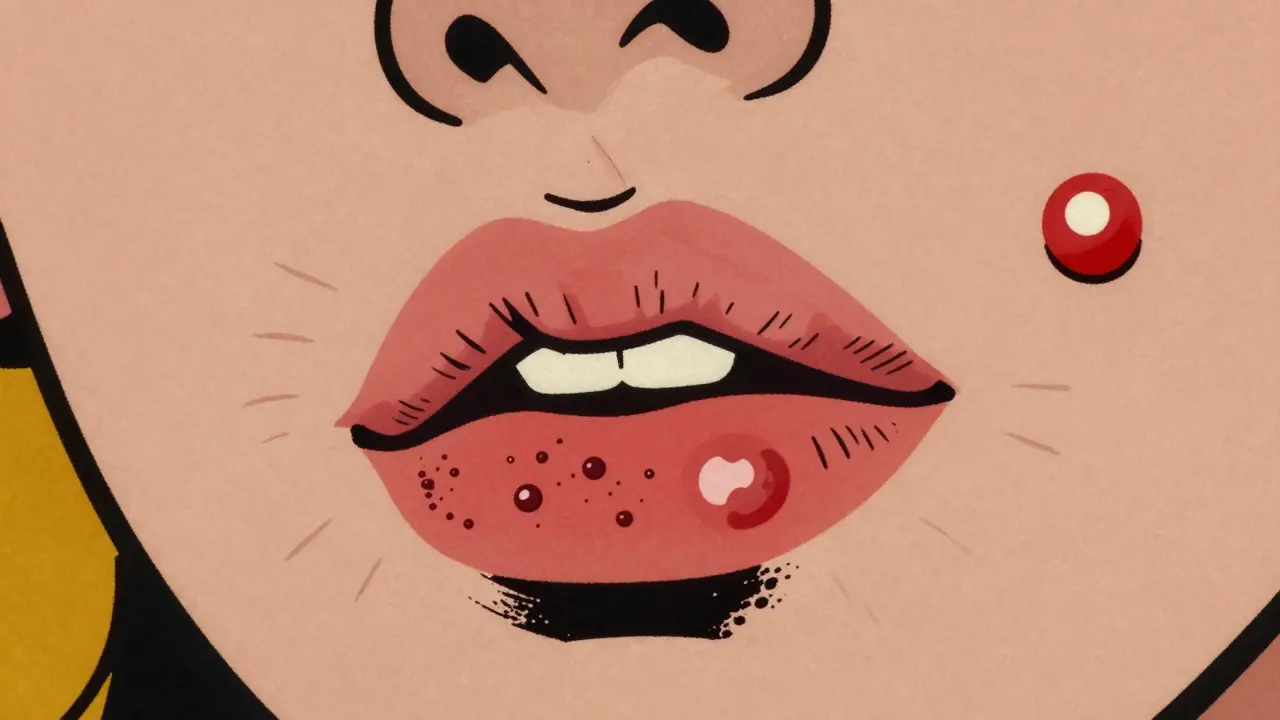
What’s the Difference Between a Cold Sore and a Pimple?
You wake up, look in the mirror, and there it is - a small bump near your lip. Is it a cold sore? A pimple? Or something worse? Many people mix them up because both can look red, swollen, and annoyingly noticeable. But they’re not the same. Mistaking one for the other can make things worse. Applying acne cream to a cold sore might spread the virus. Putting toothpaste on a pimple? That’s not helping either. Knowing the difference isn’t just about looks - it’s about treating it right.
Cold Sores: A Viral Infection You Can’t Ignore
Cold sores are caused by the herpes simplex virus type 1 (HSV-1). It’s not rare - about 67% of people under 50 worldwide carry it, according to the World Health Organization. Most people get infected as kids, often through a kiss or sharing a cup. Once you have it, the virus stays in your nerves for life. It doesn’t go away, but it can stay quiet for months or years.
When it wakes up, you’ll feel it before you see it. A tingling, burning, or itching sensation on your lip - that’s the prodrome stage. It happens 12 to 48 hours before the blister shows up. Then, small fluid-filled blisters form, usually in a cluster. They’re not one big bump. They’re three to five tiny ones grouped together, right at the edge where your lip meets your skin. That’s a key sign.
These blisters turn cloudy, then burst. After that, they crust over with a yellow or brown scab. Healing takes 7 to 14 days without treatment. The whole process is predictable: tingling → blisters → rupture → scab → fade. And yes, it’s contagious. You can spread HSV-1 by kissing, sharing lip balm, or even touching the sore then touching your eye. The virus spreads easily during active outbreaks.
Pimples: A Clogged Pore, Not a Virus
Pimples are part of acne. They happen when dead skin cells, oil (sebum), and bacteria clog a hair follicle. The main bacteria involved is Cutibacterium acnes - it’s always on your skin, but when trapped inside a pore, it triggers inflammation. That’s what makes the redness and swelling.
Unlike cold sores, pimples don’t come with warning signs. No tingling. No itching. Just a red bump that hurts when you press it. It might have a white or yellow head - that’s pus. Pimples can show up anywhere on your face: forehead, chin, cheeks, nose… even on your lip surface, because your lips have hair follicles too. But they never cluster like cold sores. One bump at a time, usually.
They’re not contagious. You can’t catch a pimple from someone else. No kissing, no sharing towels, no touching - it won’t spread. Healing time varies. A small pimple might disappear in 3 to 7 days. A deeper, cystic one can last weeks. The key difference? No viral trigger. No tingling. No blisters. Just a blocked pore.
Location, Sensation, and Appearance: The Three Clues
If you’re unsure, ask yourself three simple questions:
- Where is it? Cold sores almost always appear on the vermillion border - the very edge of your lip. Pimples can be anywhere on your face, including the lip surface, but rarely right at the lip edge unless it’s a follicle issue.
- What does it feel like? Cold sores tingle, burn, or itch before they show up. Pimples just hurt when you touch them. No warning.
- What does it look like? Cold sores are clusters of tiny blisters. Pimples are single bumps with a head or no head at all.
Get this right, and you’re halfway to fixing it.
Treatment: What Works for One Will Hurt the Other
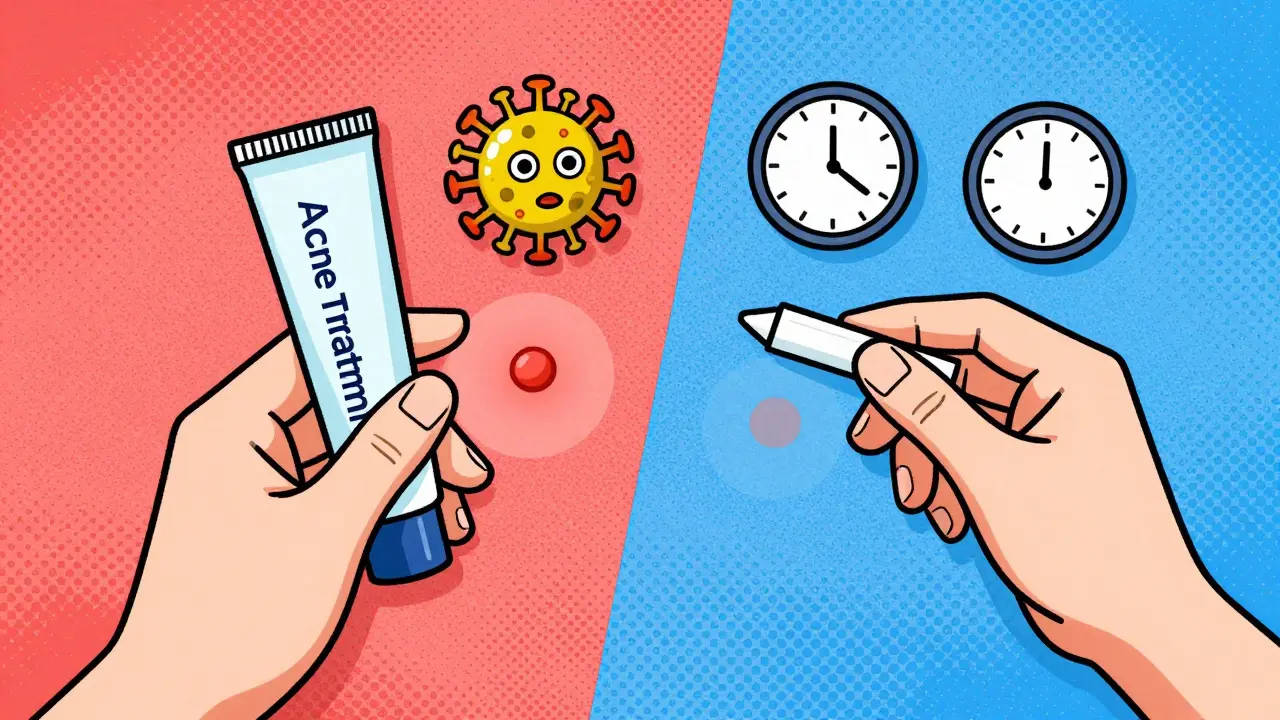
This is where most people mess up. Cold sores need antivirals. Pimples need acne treatments. Using the wrong one can make things worse.
Cold sore treatment: Start as soon as you feel that tingling. Prescription antivirals like acyclovir (Zovirax) or valacyclovir (Valtrex) can cut healing time by 1 to 2 days. Over-the-counter docosanol (Abreva) helps too - but you need to use it 5 times a day for 4 to 5 days. Prescription penciclovir (Denavir) works best when applied every 2 hours during the first 4 days. Don’t wait for the blister to form. Act fast.
Pimple treatment: Benzoyl peroxide (2.5% to 10%) kills bacteria and dries out the pimple. Salicylic acid (0.5% to 2%) unclogs pores. Both need daily use. They’re not instant fixes. You’ll see results in 4 to 8 weeks. Spot treatments work best when applied early, before the pimple gets big.
Never put acne cream on a cold sore. Benzoyl peroxide can break open blisters, spread the virus, and irritate the skin. Same with toothpaste, baking soda, or alcohol - they’re myths. They dry out the area but don’t stop the virus. They just make it more painful.
Common Mistakes and How to Avoid Them
People make the same mistakes over and over:
- Popping the bump. If it’s a cold sore, popping it spreads the virus. If it’s a pimple, it causes scarring. Don’t do it.
- Sharing lip balm or utensils. HSV-1 spreads easily this way. Use your own products, especially during an outbreak.
- Skipping sunscreen. UV exposure triggers 32% of cold sore outbreaks. Use a lip balm with SPF 30+ every day.
- Waiting too long to treat. Cold sores respond best to antivirals in the first 24 hours. If you wait until it’s a big blister, treatment is less effective.
- Using alcohol-based products. They sting and dry the skin, making cold sores worse. They don’t kill the virus.
One Reddit user shared that they popped what they thought was a pimple - and ended up with three cold sores on their chin. They spread it to their finger. That’s how contagious HSV-1 is.
Prevention: Stopping Outbreaks Before They Start
Cold sores don’t come out of nowhere. They’re triggered. The top three triggers:
- Stress - 28% of outbreaks
- UV exposure - 32% of outbreaks
- Hormonal changes - 19% of outbreaks
Manage these, and you reduce outbreaks. Use sunscreen daily. Practice stress relief - sleep, exercise, breathing. If you get outbreaks often, talk to a doctor about daily antiviral suppressive therapy. It’s not for everyone, but it works for some.
For pimples, prevention is about keeping pores clear. Wash your face twice a day with a gentle cleanser. Don’t overwash - that irritates skin and makes acne worse. Use non-comedogenic moisturizers and makeup. Change pillowcases twice a week. Avoid touching your face.
When to See a Doctor
You don’t need to run to the clinic for every bump. But see a dermatologist if:
- Your cold sore lasts longer than 2 weeks
- You get more than 5 outbreaks a year
- The sore spreads to your eyes or fingers
- Your pimple is huge, painful, and doesn’t improve after 8 weeks of treatment
- You’re getting cystic acne (deep, hard lumps under the skin)
There are new treatments on the horizon. In 2023, the FDA approved pritelivir - an experimental antiviral that cuts viral shedding by 70%. For acne, microbiome-friendly products are becoming popular - they target bad bacteria without wiping out the good ones.
Bottom Line: Know Your Bump
Cold sores and pimples look similar, but they’re totally different. One is viral. One is bacterial. One is contagious. One isn’t. One needs antivirals. One needs acne meds.
Don’t guess. Look at the location. Listen to your body. If you feel tingling before the bump - it’s a cold sore. If it’s just a red, painful bump with no warning - it’s a pimple.
Treat it right the first time. Save yourself weeks of pain, spreading, and frustration.
clarissa sulio
February 1, 2026 AT 20:01Ansley Mayson
February 2, 2026 AT 02:07Bob Hynes
February 3, 2026 AT 20:49Marc Durocher
February 5, 2026 AT 09:54Nick Flake
February 7, 2026 AT 08:47Akhona Myeki
February 8, 2026 AT 09:26Chinmoy Kumar
February 8, 2026 AT 23:15Bridget Molokomme
February 10, 2026 AT 16:59Vatsal Srivastava
February 10, 2026 AT 23:26phara don
February 11, 2026 AT 13:32Hannah Gliane
February 11, 2026 AT 17:19Murarikar Satishwar
February 12, 2026 AT 01:40Dan Pearson
February 14, 2026 AT 01:16larry keenan
February 15, 2026 AT 04:06Brett MacDonald
February 15, 2026 AT 07:45