
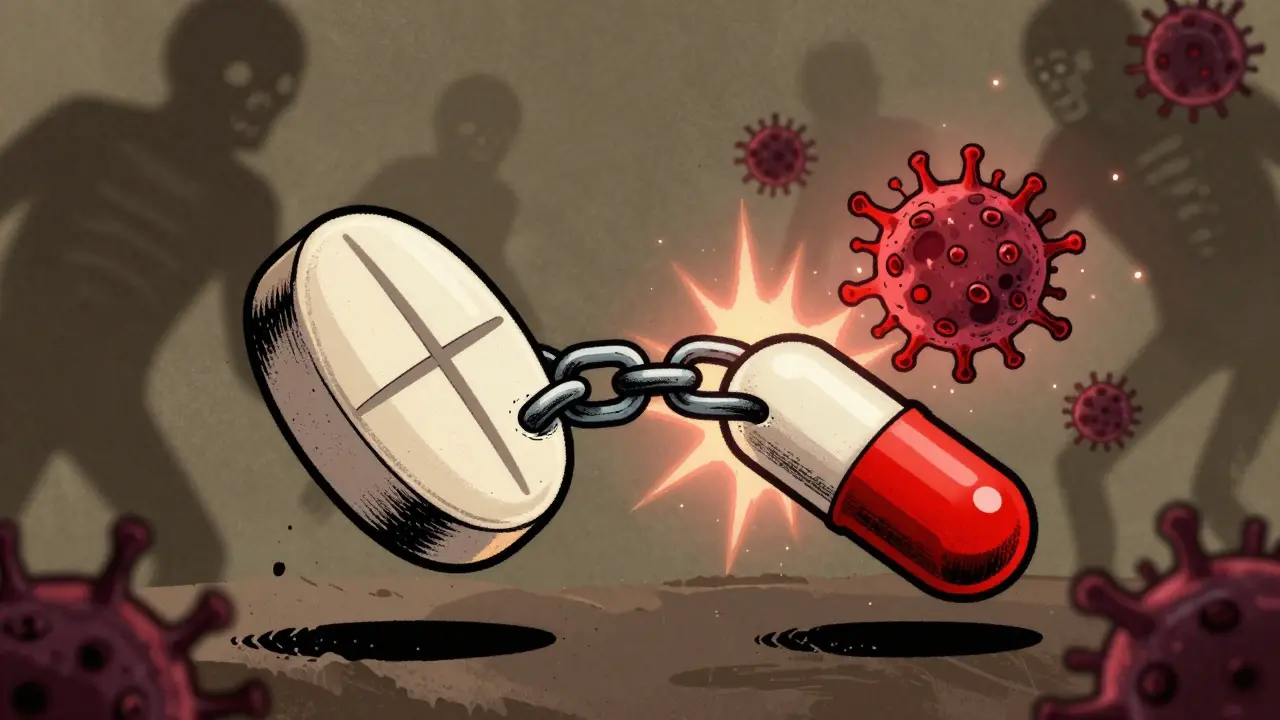
Many people take calcium and iron supplements without realizing they can make their medications work worse-or not at all. If you’re on antibiotics, thyroid medicine, or heartburn pills, your daily supplement could be quietly undermining your treatment. This isn’t theoretical. It’s happening right now to millions of people who think they’re doing the right thing for their health.
How Calcium Blocks Antibiotics
Calcium doesn’t just build bones. It also binds to certain antibiotics like tetracycline, doxycycline, and ciprofloxacin, forming a solid compound your body can’t absorb. This is called chelation. When that happens, the antibiotic can’t reach the infection. A study published in U.S. Pharmacist found that calcium carbonate reduces the absorption of ciprofloxacin by 40%. That’s not a small drop. It’s enough to turn an effective treatment into a failed one. If you’re on cipro for a urinary tract infection or doxycycline for Lyme disease, taking a calcium pill at the same time could mean your infection lingers-or gets worse.Doctors and pharmacists agree: if you’re on these antibiotics, skip calcium supplements for the duration of the course. That includes antacids like Tums, fortified milk, and calcium tablets. Even if you take your antibiotic in the morning and your calcium at night, you might still be at risk. The safest bet is to separate them by at least four hours. Some experts recommend six, especially if you’re on a long course or have a serious infection.
Iron and Antibiotics: A Similar Problem
Iron supplements-especially ferrous fumarate, the most common form prescribed in the UK-face the same issue. Iron binds tightly to tetracycline-class antibiotics, just like calcium does. The result? The antibiotic doesn’t get absorbed. Your body gets neither the iron nor the drug. That’s why GoodRx recommends taking iron at least two hours before or four hours after these antibiotics. It’s not about avoiding them entirely-it’s about timing.But here’s the catch: iron doesn’t just need space from antibiotics. It needs acid. Iron is best absorbed in a low-pH environment, meaning your stomach needs to be acidic. That’s why taking iron with orange juice helps-it’s mildly acidic and boosts absorption. On the flip side, if you’re on heartburn medication like omeprazole, pantoprazole, or famotidine, your stomach acid is suppressed. That makes iron absorption much harder. A 2023 NHS update confirmed this: people on proton pump inhibitors often need higher iron doses or different forms of iron because their bodies just can’t absorb it well.
Thyroid Medication and Calcium: A Silent Conflict
If you’re taking levothyroxine for hypothyroidism, calcium is one of your biggest hidden enemies. Levothyroxine is absorbed in the upper small intestine, and calcium interferes with that process. A 2004 study in the South Medical Journal showed that taking calcium within four hours of levothyroxine cuts thyroid hormone absorption by up to 50%. That means your TSH levels stay high, your fatigue doesn’t improve, and your weight stays stubborn. Many patients are told to take levothyroxine on an empty stomach in the morning-but then they grab a calcium pill with their breakfast. That’s a recipe for under-treated thyroid disease.The fix? Take levothyroxine at least four hours before or after any calcium supplement. That’s longer than most people realize. Some patients switch to taking their thyroid pill at bedtime, which avoids the morning calcium rush. Others take calcium at dinner, well after their thyroid dose. Either way, consistency matters. If you’re taking calcium every day, your thyroid dose might need adjusting. Talk to your doctor before making any changes.
Iron and Milk: Why Your Breakfast Might Be Hurting You
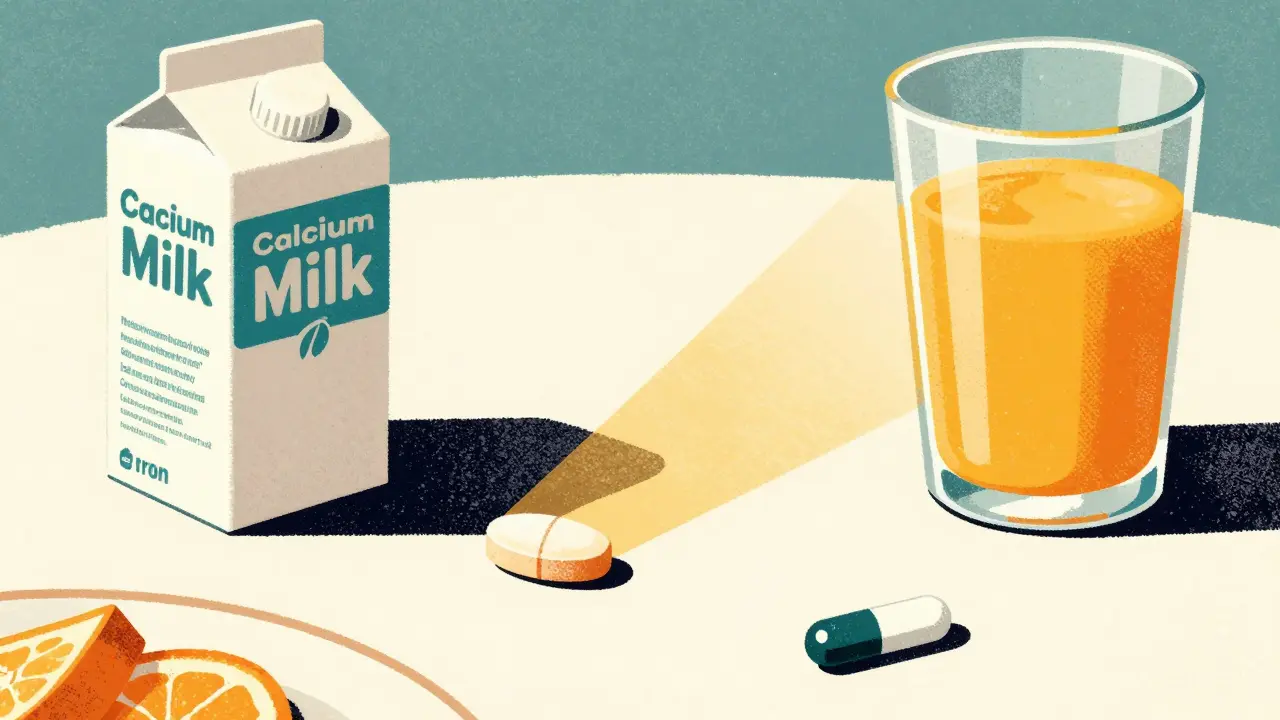
Parents often give iron supplements to kids with anemia, and they want to make it easier by mixing it with milk. That’s a mistake. Milk contains calcium, and calcium binds to iron just like it does to antibiotics. HealthyChildren.org notes that iron taken with milk can be up to 60% less absorbed. For a child with iron-deficiency anemia, that means slower recovery, longer fatigue, and possible developmental delays.The solution? Take iron with vitamin C-rich foods instead. Orange juice, strawberries, or even a small glass of tomato juice can boost absorption. Avoid dairy, tea, coffee, and calcium-fortified plant milks for at least two hours before and after the dose. For kids, it’s easier to give iron right after brushing teeth (when they’re not hungry) and follow it with an orange or a few strawberries.
What About Other Minerals?
Calcium and iron aren’t the only troublemakers. Zinc, magnesium, and even aluminum in antacids can interfere with antibiotics like ciprofloxacin and levofloxacin. Magnesium supplements can reduce the absorption of bisphosphonates used for osteoporosis. Even multivitamins with minerals can be a problem if taken at the same time as thyroid or antibiotic meds.The rule of thumb? If it contains minerals, assume it might interfere. Always check the label. And if you’re unsure, ask your pharmacist. They’re trained to spot these conflicts-and they see them every day.
Real-Life Scenarios: What Goes Wrong
A 68-year-old woman in Brighton takes levothyroxine every morning and a calcium tablet at breakfast. Her TSH levels keep rising, even though she’s taking the right dose. She’s told she’s non-compliant. But she’s not skipping pills-she’s just timing them wrong. A teenager on doxycycline for acne also takes an iron supplement for low energy. His acne doesn’t clear up. His doctor blames poor hygiene. But the real issue? The iron blocked the antibiotic. A man on omeprazole for acid reflux takes ferrous fumarate for anemia. He’s taking it as directed, but his hemoglobin stays low. His doctor increases the dose. Still no improvement. He doesn’t realize his heartburn pill is stopping the iron from being absorbed.These aren’t rare cases. They’re common. And they’re preventable.
How to Stay Safe
Here’s what you can do right now:- Keep a list of every supplement and medication you take-including over-the-counter ones.
- Ask your pharmacist: “Do any of my supplements interfere with my prescriptions?” Don’t assume they know what you’re taking.
- For calcium: Wait at least four hours after taking levothyroxine or antibiotics. Avoid taking it with meals if you’re on those drugs.
- For iron: Take it two hours before or four hours after antibiotics. Take it with vitamin C, not milk or tea. Avoid taking it within two hours of heartburn meds.
- If you take a multivitamin with minerals, take it at a different time than your key meds-not at breakfast or dinner.
There’s no magic pill or shortcut. It’s about timing, consistency, and communication. You’re not being difficult-you’re being smart.
When to Call Your Doctor
If you’ve been taking supplements and notice:- Your thyroid symptoms (fatigue, weight gain, cold intolerance) aren’t improving
- Your infection isn’t clearing up despite taking antibiotics
- Your iron levels aren’t rising even after months of supplements
It’s not necessarily that the treatment isn’t working. It might be that your supplement is blocking it. Talk to your doctor or pharmacist. Don’t stop your meds. Just ask: “Could my calcium or iron be interfering?”
The truth is, supplements aren’t harmless. They’re powerful. And when mixed with prescription drugs, they can change how your body works in ways you can’t see. You don’t need to stop taking them. You just need to take them right.
Can I take calcium and iron together?
No, you shouldn’t. Calcium and iron compete for absorption in the gut. Taking them together reduces how much of each your body can use. If you need both, take them at least four hours apart. Iron is best absorbed on an empty stomach with vitamin C, while calcium is often taken with food. Space them out based on your schedule and your doctor’s advice.
Is it safe to take calcium with levothyroxine if I wait a few hours?
Yes-but only if you wait at least four hours. Studies show that taking calcium within four hours of levothyroxine cuts absorption by up to half. Waiting six hours is even safer. Many people take levothyroxine at bedtime and calcium at dinner, which works well. Never take them together, even if you think the gap is enough. When in doubt, wait longer.
Do all antibiotics interact with calcium and iron?
No, only certain ones. Tetracyclines (like doxycycline) and fluoroquinolones (like ciprofloxacin and levofloxacin) are the main ones affected. Penicillins, cephalosporins, and macrolides like azithromycin don’t typically interact with minerals. But always check the label or ask your pharmacist. If your antibiotic has a warning about dairy or antacids, calcium and iron are likely part of the problem.
Why does my iron supplement make my stomach upset, and how can I fix it?
Iron can irritate the stomach, especially on an empty stomach. If you’re taking it with food to reduce nausea, you’re probably reducing absorption too. Try taking it with a small amount of food that’s low in calcium and high in vitamin C-like a banana with orange juice. If stomach upset continues, ask your doctor about switching to a different form of iron, like ferrous bisglycinate, which is gentler on the stomach and still well absorbed.
Should I stop taking calcium if I’m on antibiotics?
If you’re on tetracycline or a fluoroquinolone, yes-for the length of the course. A short course of antibiotics (5-10 days) isn’t worth risking treatment failure. You can resume calcium after you finish the antibiotics. For longer-term calcium use, talk to your doctor about alternatives like dietary sources (kale, sardines, fortified plant milks) or adjusting your timing so it doesn’t overlap with meds.
Can I take my multivitamin with my morning meds?
Probably not. Most multivitamins contain calcium, iron, zinc, or magnesium-all of which can interfere with thyroid meds, antibiotics, or heartburn drugs. Take your multivitamin at lunch or dinner, at least four hours after your key medications. If you need a daily vitamin, ask your pharmacist for one without minerals, or get your nutrients from food instead.
Ryan Pagan
January 29, 2026 AT 20:40Yo, this is the kind of post that saves lives. I’m a pharmacist and I see this every single day - people popping calcium with their thyroid med like it’s candy. One lady came in with TSH at 18 and swore she took her levothyroxine ‘like clockwork.’ Turned out she was swallowing her Tums with breakfast and her pill at the same time. She cried. We fixed it. Now she’s got energy again. Don’t be that person. Timing isn’t optional - it’s biology.
Also, iron + milk? That’s like pouring gasoline on a fire. I had a kid come in with anemia, mom was mixing the syrup with chocolate milk. No wonder hemoglobin didn’t budge. Orange juice. Just do it. It’s not a suggestion, it’s a damn prescription.
And yes, multivitamins? Most are mineral bombs. Take them at lunch. Not with your meds. Your body isn’t a cocktail mixer.
Stop guessing. Ask your pharmacist. They’re the unsung heroes of your medicine cabinet.
Paul Adler
January 30, 2026 AT 11:43This is a well-researched and critically important summary of a widespread, under-discussed issue in public health. The clinical evidence cited is robust, and the practical recommendations are both clear and actionable. It is unfortunate that such interactions are not more systematically communicated to patients during medication counseling. Healthcare providers must prioritize explicit, written instructions regarding supplement timing, especially for chronic medications like levothyroxine and antibiotics. A simple handout distributed at pharmacy pickup could prevent significant morbidity. This post deserves to be shared with primary care clinics and patient education portals.
Robin Keith
January 30, 2026 AT 23:27Ohhhhh... here we go again - the silent, invisible war inside our guts... the biochemical ballet of chelation... the tragic dance between calcium’s noble quest to build bones and iron’s lonely, acid-hungry journey to become hemoglobin... and then - oh, the cruelty - the proton pump inhibitors, those cold, calculating architects of gastric silence, shutting down the very engine that lets iron breathe...
And levothyroxine? That fragile, elegant molecule, gliding through the duodenum like a ghost, only to be snatched by calcium’s iron grip... and we wonder why we’re tired? Why we gain weight? Why we feel like a hollowed-out shell? It’s not depression - it’s *mineral betrayal*.
And don’t even get me started on the multivitamin - that little plastic capsule of false security, packed with zinc and magnesium and aluminum - the quiet assassins of antibiotic efficacy...
We are not just taking pills - we are conducting symphonies of molecular conflict, and most of us are deaf to the music...
So yes - wait four hours. Six if you dare. Let your stomach be a temple, not a battlefield. And if you’re still tired after all this? Maybe you’re not broken - maybe you’re just being poisoned by your own good intentions.
Sheryl Dhlamini
February 1, 2026 AT 22:12I just cried reading this. I had hypothyroidism for 8 years and my doctor kept saying I wasn’t compliant. I was taking my pill at 6am and my calcium at 7am. I thought I was being careful. I didn’t know. I thought I was doing everything right. My anxiety, my brain fog, my exhaustion - it was all because of a 60-minute gap. I finally figured it out after reading a Reddit thread and switching to bedtime levothyroxine. Now I have energy. I can think. I can live. Please, if you’re on thyroid meds - PLEASE read this. Don’t wait eight years like I did.
Doug Gray
February 2, 2026 AT 03:39So... like... if I take my iron at night and my antibiotic in the morning, is that cool? I mean, I’m not dumb, I just like my routine. Also, I take a multivitamin with dinner. Should I be worried? 😐
Also, why do we even have supplements if they’re just gonna fight with our meds? Isn’t that like buying a Ferrari and then putting diesel in it? 🤔
Kristie Horst
February 4, 2026 AT 02:02How touching. Truly. A 68-year-old woman in Brighton is told she’s ‘non-compliant’ because she took calcium with her thyroid med - but the real tragedy? No one ever told her. Not her doctor. Not her pharmacist. Not her daughter who brought her the Tums. We live in a world where medical literacy is treated like a luxury, not a right. And yet, we blame the patient. How convenient.
Let me guess - the next time someone’s infection doesn’t clear up, the doctor will just prescribe another round. And another. And another. Because it’s easier than asking, ‘Do you take calcium?’
Bravo. You’ve written a public service announcement disguised as a blog post. Now go tell your doctor to print this out and hand it to every patient over 50.
LOUIS YOUANES
February 5, 2026 AT 00:41Look. I’ve been on doxycycline for acne since college. I also take iron because I’m ‘always tired.’ I thought the fatigue was from stress. Turns out? My supplement was nullifying my antibiotic. My skin didn’t clear because I was giving my body a placebo. I felt like a fraud. Now I take iron at midnight. My skin’s better. My energy’s back. And I stopped pretending I’m a ‘health person.’ I’m just a guy who learned the hard way that biology doesn’t care about your hustle.
Also - Tums are not snacks. Stop eating them like popcorn.
Andy Steenberge
February 5, 2026 AT 07:48Excellent summary. One clarification: while calcium and iron compete for absorption, the primary mechanism for antibiotic interference is chelation - not competition. Chelation forms insoluble complexes in the GI tract, preventing absorption entirely. Iron absorption is also pH-dependent, which is why PPIs are such a problem. The four-hour separation rule is conservative but evidence-based. For patients on long-term levothyroxine, bedtime dosing (with no food or supplements for 3–4 hours prior) is often more effective than morning dosing. Pharmacists should be consulted before any supplement regimen change. This is not anecdotal - it’s pharmacokinetics.
Laia Freeman
February 5, 2026 AT 17:12OMG I JUST REALIZED I’VE BEEN TAKING MY IRON WITH MY MILK FOR MY KID AND SHE’S STILL SO TIREDDDD 😭😭😭 I THOUGHT IT WAS JUST BECAUSE SHE’S A TEENAGER 😭 I’M GOING TO BUY ORANGES TOMORROW AND THROW OUT THE MILK 😭😭😭 THANK YOU THANK YOU THANK YOU I FEEL LIKE A NEW PERSON 😍
rajaneesh s rajan
February 5, 2026 AT 20:18Interesting. But let’s be real - in India, most people don’t even have access to these supplements. We’re fighting to get enough iron from lentils and spinach. Meanwhile, in the West, you’re over-supplementing and then blaming your meds for not working. The real issue? Over-medicalization of normal life. But hey - if you’re rich enough to buy calcium pills and levothyroxine, maybe you should also be rich enough to read the label. 😏
paul walker
February 7, 2026 AT 08:59My doctor told me to take my thyroid pill on an empty stomach and I did… but I didn’t know I couldn’t have my protein shake with calcium. I thought ‘empty stomach’ meant no food, not no supplements. Now I take it at 10pm. Life changed. Thank you for this.
Alex Flores Gomez
February 8, 2026 AT 18:27Bro, I took my cipro with a glass of almond milk because I thought it was ‘healthy.’ Turns out it’s calcium fortified. My UTI came back worse. Now I drink water. And I hate myself. But at least I know now. Thanks for the wake-up call. 🤡
Frank Declemij
February 9, 2026 AT 02:38Clear, accurate, and vital. The four-hour rule is supported by multiple studies. The most common error is assuming that morning and evening separation is sufficient. In reality, the half-life of chelation interference extends beyond simple time gaps. Consistency and separation are key. Always consult a pharmacist. They are the frontline defense against these interactions.