
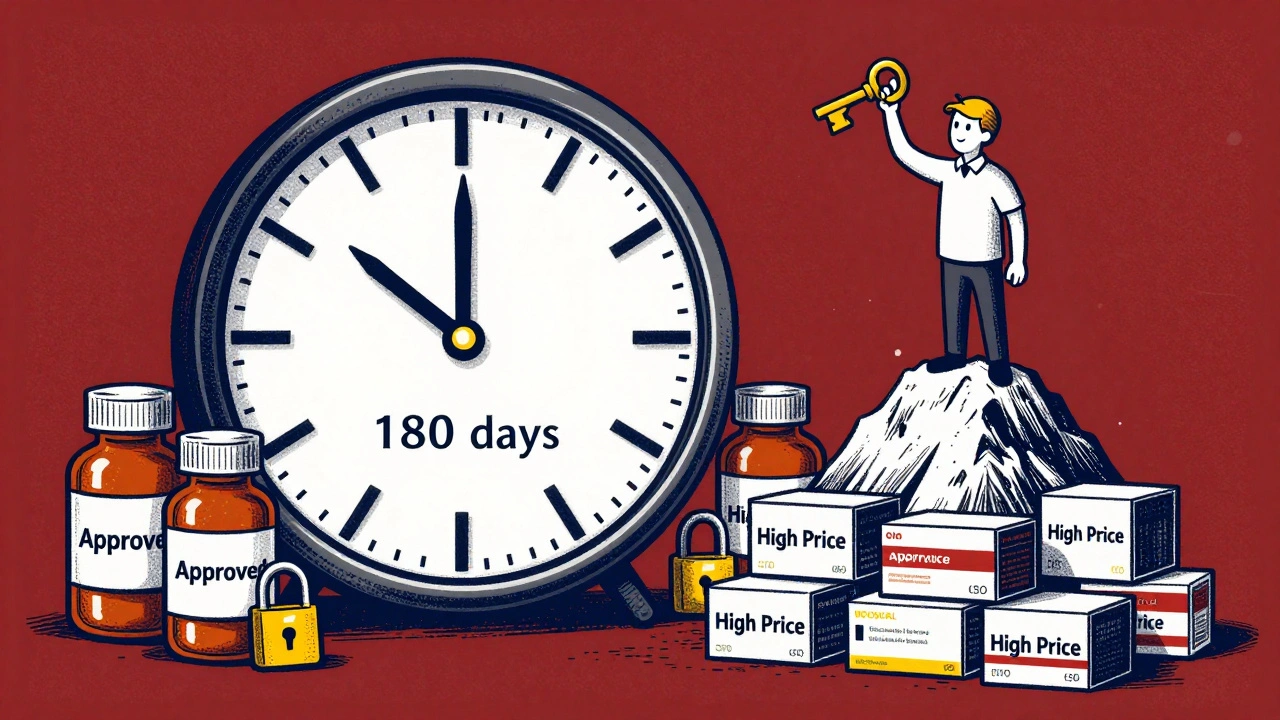
When a brand-name drug’s patent expires, you’d expect generic versions to flood the market right away-cheaper, just as effective, and available to patients who need them. But that’s not how it works. Thanks to a legal loophole built into U.S. drug law, the first generic company to challenge a patent can lock out all other generics for 180 days. And if that company decides not to launch right away? The clock doesn’t start. The market stays blocked. For years.
What Exactly Is 180-Day Exclusivity?
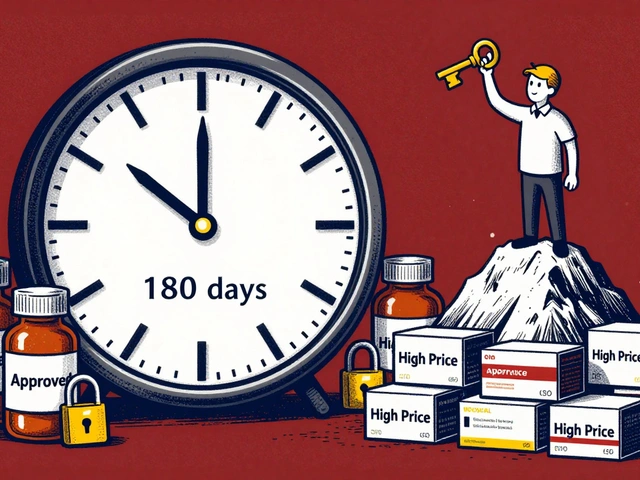
The 180-day exclusivity rule comes from the Hatch-Waxman Act of 1984. It was meant to encourage generic drug makers to take on the risky and expensive job of challenging weak or overreaching patents. If a generic company files what’s called a Paragraph IV certification-saying a brand-name drug’s patent is invalid or won’t be infringed-they get a reward: 180 days of exclusive rights to sell the generic version. That means no other generic company can get FDA approval for the same drug during that time. Even if they’ve got their paperwork in order, even if their product is ready to ship, they have to wait. This isn’t just a delay. It’s a legal monopoly. The catch? The 180 days don’t start when the FDA approves the drug. They start when the generic company actually starts selling it-or when a court rules the patent is invalid or not infringed. And here’s the problem: a company can sit on approval for years, waiting for patent lawsuits to play out, and still hold onto that exclusivity. While they wait, no other generic enters the market. Prices stay high. Patients pay more.Why Do Generic Companies Play This Game?
The financial stakes are enormous. For a blockbuster drug like Lipitor or Humira, the first generic maker can make over $1 billion in those 180 days. That’s why companies race to be the first to file a Paragraph IV certification. It’s a legal lottery. One company files early, invests millions in litigation, and if they win, they get a golden ticket. But it’s not just about speed. It’s about timing. Some companies file just to block others. They don’t plan to launch the drug at all-they just want to prevent competitors from entering. This tactic, called “reverse payment settlements,” happens when the brand-name company pays the generic maker to delay launch. Courts have cracked down on this, but it still happens in subtle ways. The FDA says a company can lose its exclusivity if it doesn’t start selling within 75 days of a court decision or if it fails to market the drug for more than 30 days after approval. But proving a company didn’t try to market the drug? That’s hard. Many companies delay launch legally, by filing appeals, requesting additional reviews, or claiming manufacturing issues. The rules are full of gray areas.Who Gets Hurt?
Patients. Pharmacists. Insurance companies. Taxpayers. Everyone who pays for prescriptions. When the first generic delays launch, the brand-name drug keeps its monopoly. Prices stay high. Generic alternatives-sometimes cheaper than the brand even without exclusivity-never get a chance to compete. The FDA estimates that generic drugs save the U.S. healthcare system over $1.7 trillion every decade. But if the first generic doesn’t move, those savings vanish. Smaller generic companies suffer too. They can’t afford to file Paragraph IV certifications. They don’t have legal teams or patent lawyers on retainer. So they wait. And wait. And wait. By the time they’re ready, the exclusivity window is closed. The market is already saturated by the first entrant. No competition means no price drop.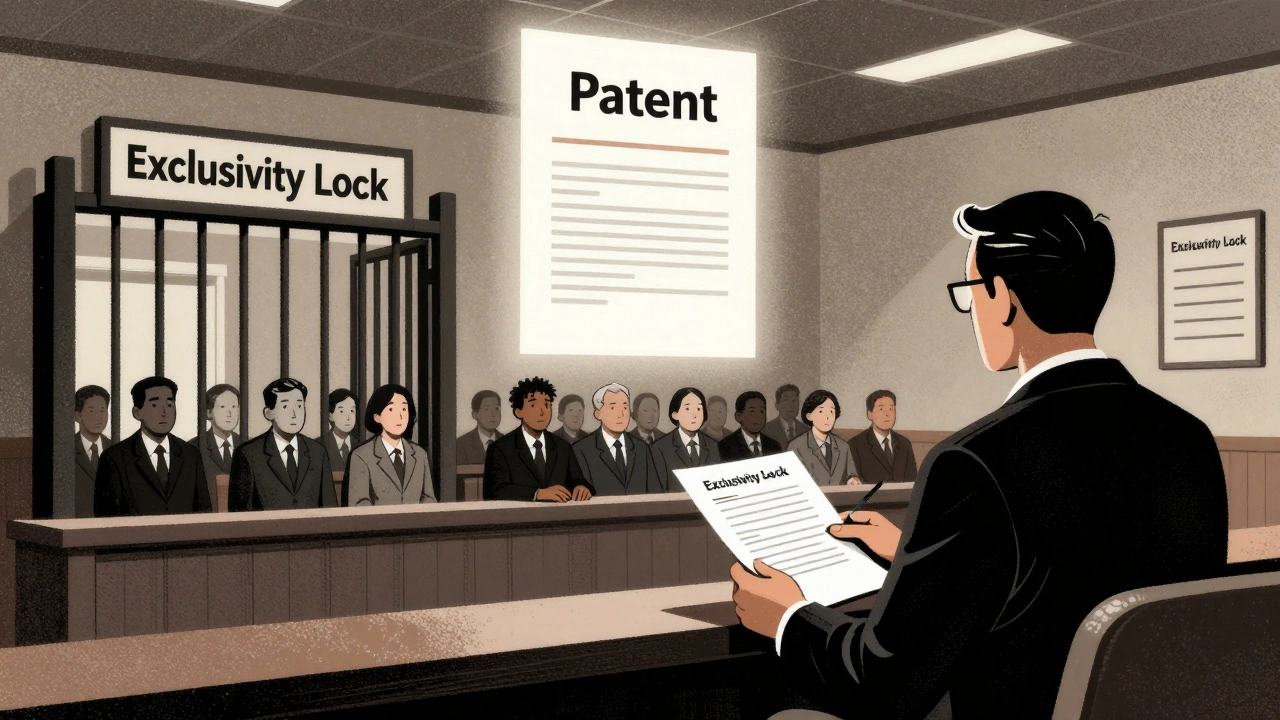
How the FDA Is Trying to Fix It
In March 2022, the FDA proposed a major change. Instead of letting the exclusivity period drag on for years, they want it to start only when the first generic actually hits the market. That way, if a company delays launch for two years, they don’t get two extra years of exclusivity. They get 180 days from the day they start selling. The proposal also suggests a new rule: if a company launches more than five years before the patent expires, they’d get 270 days of exclusivity instead of 180. That’s meant to reward early challengers who take on patents still far from expiration. But these changes haven’t been finalized. Congress hasn’t acted. The legal battles keep going. Meanwhile, generic companies keep filing Paragraph IV certifications, and brand-name companies keep defending their patents.What’s the Real Impact on Drug Prices?
Here’s the truth: 180-day exclusivity was supposed to lower prices. And it did-for a while. After Hatch-Waxman, generic market share jumped from 19% in 1984 to over 90% today. That’s huge. But now, the system is broken. The exclusivity period is being used as a weapon, not a reward. A 2023 study by the Government Accountability Office found that in 30% of cases where a generic filed a Paragraph IV certification, the drug didn’t enter the market for more than two years after approval. In some cases, it took over five years. And when the drug finally does launch? Often, only one generic is on the market. That’s because the first entrant holds exclusivity. The second, third, and fourth generics still can’t enter. So prices don’t drop as fast as they should. Patients pay more than they should. The system isn’t working the way Congress intended.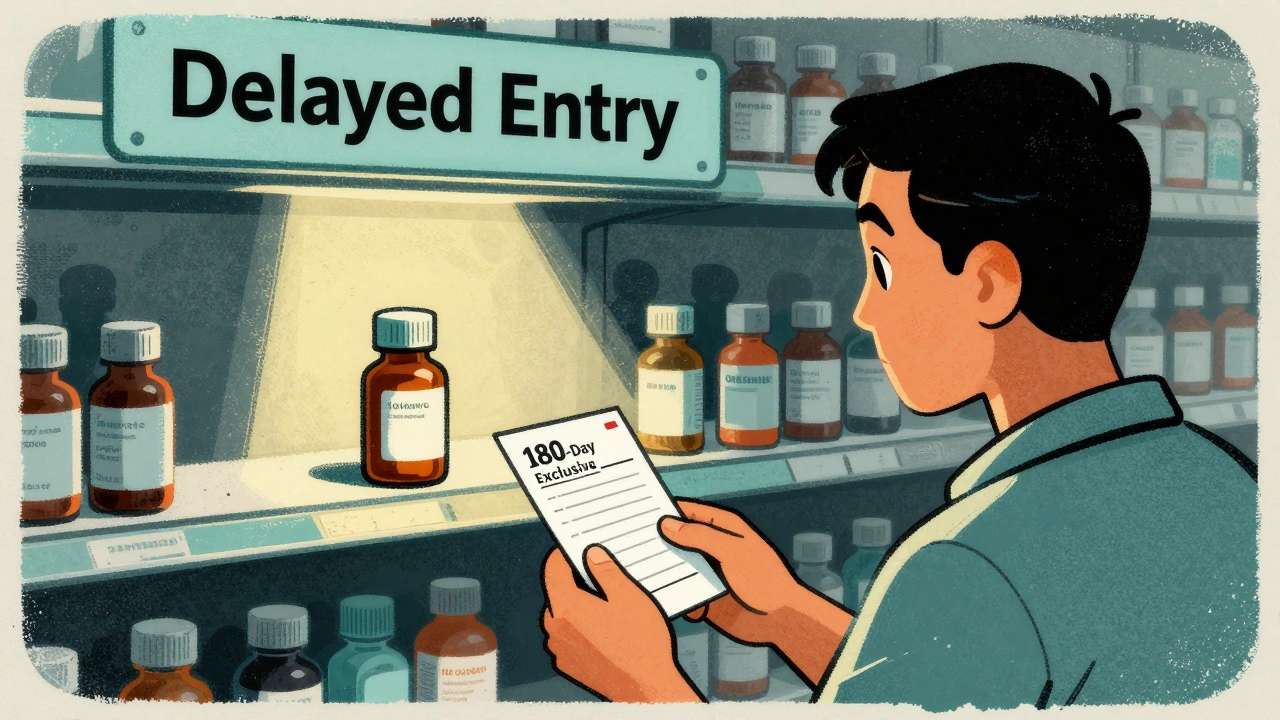
What Happens When Multiple Companies File on the Same Day?
It happens more than you think. Two or more generic companies file identical Paragraph IV certifications on the same day. Who gets the 180 days? The FDA says it goes to the first one to submit a substantially complete application. But what does “substantially complete” mean? That’s where the legal fights begin. In 1998, a court ruled in Granutec, Inc. v. Shalala that an application must include all required data and certifications to qualify. But the FDA still has discretion. They’ve issued guidance letters-like the one in 2018 on buprenorphine/naloxone film-that clarify what counts as complete. Still, companies argue over it. Litigation follows. And the clock keeps ticking.Is There a Better Way?
The biosimilar pathway-used for complex biologic drugs-handles exclusivity differently. It gives 12 months to the first interchangeable biosimilar, and multiple companies can qualify if they meet the criteria. No winner-takes-all. No waiting for years. Some experts say the 180-day rule should work the same way. Let multiple generics enter at once. Let competition drive prices down faster. Let patients benefit sooner. But changing the law isn’t easy. Drug companies spend millions lobbying Congress. Generic companies are split-some want the exclusivity, others want it gone. The FDA is stuck in the middle, trying to interpret a 40-year-old law in a modern market.What Should Patients and Providers Do?
Know the system. If your prescription is expensive and no generic is available, ask your pharmacist: “Has a generic been approved but not launched?” If yes, the 180-day exclusivity might be blocking entry. Talk to your doctor about alternatives. Sometimes, a different drug in the same class is available as a generic. Sometimes, a different brand has already lost its patent. And push for transparency. Demand that insurers and pharmacies report when generics are approved but not on the shelf. Pressure lawmakers to fix the loophole. The law was meant to help patients. It’s time it did.What triggers the 180-day exclusivity clock for generic drugs?
The clock starts on the earlier of two dates: the first day the generic drug is commercially marketed, or the date a court rules the challenged patent is invalid or not infringed. Approval by the FDA alone does not start the clock.
Can a generic company lose its 180-day exclusivity?
Yes. Under the Medicare Modernization Act of 2003, a company can forfeit exclusivity if it fails to market the drug within 75 days of a court decision, or if it stops selling for more than 30 consecutive days after launching. The FDA can also determine that the original application wasn’t "substantially complete," which disqualifies the applicant.
Why don’t more generic companies challenge patents?
Challenging a patent is expensive and risky. Legal fees can exceed $10 million, and if the company loses, they may not recover costs. Smaller manufacturers often can’t afford the gamble. Only large generic firms or those with deep legal resources typically file Paragraph IV certifications.
Does the 180-day exclusivity apply to all generic drugs?
No. It only applies to generic drugs that file a Paragraph IV certification challenging a patent listed in the FDA’s Orange Book. Drugs without patents, or those approved under different pathways like 505(b)(2), don’t qualify. Biosimilars follow a different rule under the BPCIA.
How does the 180-day rule compare to the biosimilar exclusivity system?
Biosimilars get 12 months of exclusivity for the first interchangeable product, but multiple companies can qualify if they meet the criteria. Unlike the 180-day rule, it’s not winner-takes-all. This encourages faster market entry and more competition from the start.
val kendra
December 4, 2025 AT 02:57This system is broken and everyone knows it. The 180-day loophole isn’t helping patients-it’s just a profit shield for big pharma and the first-mover generics who play dirty. I’ve seen prescriptions sit unchallenged for years while people ration pills. It’s not innovation. It’s exploitation.
And the FDA’s half-measures? Too little, too late. If they really wanted change, they’d let multiple generics in at once like biosimilars. No winner-takes-all. No waiting. Just competition. Simple.
Joe Lam
December 5, 2025 AT 05:06Let me guess-you think this is about ‘patients’? Please. This is corporate chess. The first filer isn’t some hero-they’re a cartel member with a law degree. And you’re acting like the FDA is the villain when they’re just trying to keep up with a law written before smartphones existed.
The real problem? Congress won’t touch it because Big Pharma donates $200 million a year to keep this mess alive. Blame the lobbyists, not the regulators.
Jenny Rogers
December 7, 2025 AT 02:52One cannot help but observe the profound ethical dissonance embedded within the current regulatory architecture. The Hatch-Waxman Act, while ostensibly designed to foster competition, has been perverted into a mechanism of monopolistic rent-seeking under the guise of legal incentive.
It is not merely inefficient-it is morally indefensible to permit a private entity to withhold a life-sustaining therapeutic from the public market for years, solely to preserve its own profit margin. The FDA’s proposed reforms, while a step in the right direction, remain insufficiently radical. A true remedy would require the abolition of exclusivity as a concept in this context entirely.
Patents are meant to incentivize innovation, not to orchestrate market suppression. When the public good is subordinated to corporate calculus, we are no longer a democracy-we are a corporate oligarchy masquerading as a healthcare system.
Rachel Bonaparte
December 8, 2025 AT 05:18Ever wonder why your insulin costs $300? It’s not just the pharma companies. It’s the generic manufacturers too. They’re in cahoots. They file the patent challenge just to block others. Then they sit on it. Why? Because the brand-name company pays them under the table-$50 million here, $100 million there.
It’s all documented. You just don’t see it because the courts bury the evidence in sealed filings. The FDA? They’re asleep at the wheel. They know. They just don’t care. You think this is about patents? No. It’s about control. And the people paying? They’re the ones getting played.
And don’t even get me started on how they use ‘manufacturing issues’ as an excuse. That’s the same BS they used for the opioid crisis. Same playbook. Same lies. Same victims.
Scott van Haastrecht
December 9, 2025 AT 12:39Let’s cut through the noise. The 180-day rule was never about access. It was about creating a bottleneck. The first filer gets a monopoly. The rest? They’re collateral damage. And the FDA’s ‘guidance’? That’s not policy-that’s a suggestion written by a lawyer who got paid to make it sound reasonable.
30% of cases take over two years? That’s not a glitch. That’s the design. You want to know why drug prices are still rising? It’s because the system is engineered to delay competition. Not encourage it. The ‘reward’ is a trap. And you’re all just arguing about how to clean the trap instead of smashing it.
Bill Wolfe
December 9, 2025 AT 20:56Look, I get it. You think this is about fairness. But let’s be real-no one cares about fairness in pharma. It’s about who has the most lawyers and the deepest pockets.
Smaller generics? They’re not victims. They’re just bad at the game. If you can’t afford a $10M lawsuit, you shouldn’t be playing. This isn’t kindergarten. It’s capitalism with a patent twist.
And the biosimilar comparison? Totally different ballgame. Biologics are complex. Chemical generics? Not even close. You can’t just ‘let them all in’-that’s like saying everyone should get a Ferrari because one guy bought one. It’s not how markets work.
Stop romanticizing competition. This is a legal game. Play to win-or get out.
Ollie Newland
December 10, 2025 AT 06:37It’s wild how the system was meant to be a catalyst but turned into a chokehold. I’ve worked in pharmacy for 15 years and seen this play out-patients asking why their metformin’s still $50 when the patent expired in 2019. The answer? ‘It’s been approved since 2021.’
The real shame? The first filer often doesn’t even make the drug affordable. They just delay everyone else. And then they jack the price up just enough to stay profitable, but not enough to trigger scrutiny.
It’s a quiet crisis. No headlines. No outrage. Just people skipping doses because the generic ‘isn’t available.’
Rebecca Braatz
December 10, 2025 AT 07:33If you’re reading this and you’re a patient or a provider-don’t wait for Congress to fix this. Ask your pharmacist: ‘Has this been approved but not launched?’ If yes, call your rep. Write to the FDA. Tweet it. Share the story.
Change doesn’t come from lobbyists. It comes from people who refuse to stay silent. I’ve seen patients get their meds after one angry email to their insurance. One voice. One question. That’s how it starts.
We don’t need more laws. We need more pressure. And we need to stop treating this as ‘complicated.’ It’s not. It’s just unethical.
Michael Feldstein
December 11, 2025 AT 19:36Interesting how everyone blames the big guys but nobody talks about the smaller generics who actually benefit from this. They’re the ones who file the Paragraph IV certs just to get paid off by the brand. They’re not heroes-they’re gatekeepers with a business model.
And honestly? The FDA’s 75-day rule is a joke. How are they supposed to prove someone ‘didn’t try’ to market? The paperwork’s a minefield. You need a lawyer just to fill out the forms.
Maybe we need a public registry-like a live dashboard-showing which generics are approved but not on the shelf. Transparency could force action faster than any law.
michael booth
December 11, 2025 AT 21:24It is imperative to acknowledge that the statutory framework governing generic drug market entry was conceived in a pre-digital, pre-globalized economic milieu. The notion of 180-day exclusivity, while conceptually coherent in 1984, is now functionally obsolete in the context of modern supply chains, digital regulatory infrastructure, and pharmaceutical market dynamics.
Furthermore, the absence of mandatory disclosure requirements regarding commercialization intent constitutes a critical regulatory gap. A statutory amendment mandating public reporting of launch timelines upon FDA approval would mitigate strategic delay. Such a measure, grounded in evidence-based policy, would restore the original intent of the Hatch-Waxman Act: to enhance, not obstruct, market competition.
Carolyn Ford
December 13, 2025 AT 02:41Wait-so you’re telling me the ‘first to file’ rule is supposed to be a reward… but it’s actually a weapon? And the FDA just lets them do it? That’s not oversight-that’s negligence. And don’t even get me started on the ‘substantially complete’ nonsense. Who even defines that? A bureaucrat? A lawyer? A lobbyist?
And you think biosimilars are different? Please. They’re just the same game with more jargon. They’re still blocking competitors. It’s all just corporate theater. Everyone’s playing the same game. Only the labels changed.
And you know what? I bet the people who wrote this law are all retired now, sipping martinis in Florida, laughing at how dumb we all are for still believing this works.
Heidi Thomas
December 13, 2025 AT 14:36It’s not about 180 days. It’s about the fact that one company can sit on approval for five years and still own the market. That’s not a loophole. That’s a backdoor monopoly. And the FDA lets them. They’re not enforcing the rules-they’re making them up as they go. And patients? They’re the ones who pay the price. Every. Single. Day.
Jake Deeds
December 13, 2025 AT 21:03Oh, so now we’re all experts on pharmaceutical regulation? How quaint. The Hatch-Waxman Act was a masterpiece of balanced policy-until the rabble started misreading it as a public utility mandate. The exclusivity window isn’t a flaw-it’s a calculated incentive structure. You don’t get innovation without risk. And you don’t get risk without reward.
Yes, some companies game it. But that’s true of every system. You don’t abolish the system because a few bad actors abuse it. You fix the enforcement. You don’t turn it into a morality play for people who think capitalism is a bug, not a feature.